







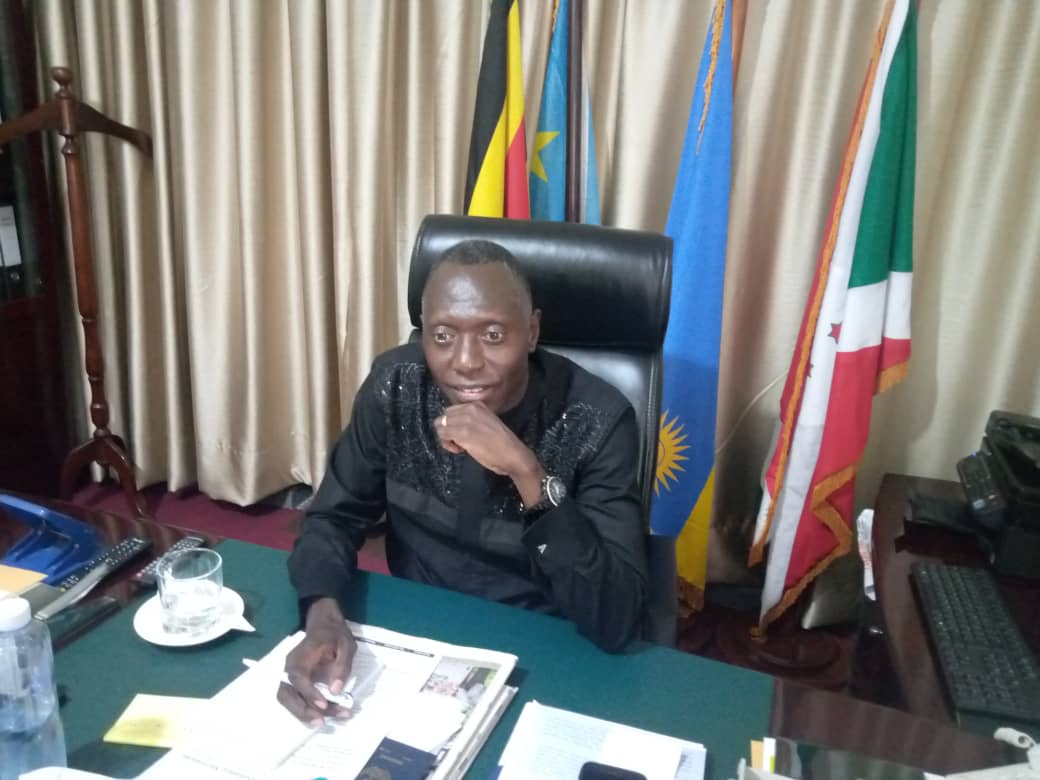
The ongoing peace process in South Sudan being cemented by the new Transitional Government of National Unity heralds a new chapter in the development of South Sudan. With guns gone silent and the protagonists returning to work together, the prospects are high with everybody yearning for a new beginning. The Public Lens Team caught up with H.E Simon Michael Duku, Ambassador Plenipotentiary to Uganda, Rwanda and Burundi on the latest developments. Excerpts;-
Uganda and South Sudan have enjoyed warm bilateral relations. Take us through the nature and character of these relations?
The two countries have had excellent bilateral relations basing on the number of South Sudanese nationals staying here [in Uganda]. We call this our second home. Uganda hosts the largest number of South Sudanese who are here as refugees, students, traders, among others. Our students don’t need resident permits to come here and study because they are treated as citizens. The question we should be asking is why the South Sudanese would prefer staying in Uganda in large numbers and not any other country. We feel much more comfortable and appreciated here in Uganda.
When we were still in the jungles fighting as SPLA/M for our freedom and self-determination as South Sudanese, I used to hold a Ugandan passport. So many people including those in Sudan and Uganda thought I was Ugandan. I would easily crossover to Uganda on official missions and also do my personal trade freely.
What you should also learn is that the first ever-wedding of two diplomats happened here in Uganda. My wife and I are both diplomats from South Sudan but we chose to have our marriage ceremony here. Other high-ranking officials from South Sudan including military generals have also had their weddings in Uganda.
The mutual relationship between NRM and SPLM was hatched right in the bush times; both movements were still operating as rebel groups when their founders met to hammer out a relationship, and this relationship has blossomed to this very day. The founders of the two revolutionary movements Yoweri Museveni and John Garang had earlier met at the University of Dar-es-Salaam in Tanzania as students. Garang had also lived in Uganda where he received his elementary education. However, I have heard some accounts that SPLM was started by NRM. This is not true.
The Republic of South Sudan has acquired a house in Kampala called The South Sudan House.
What is the significance of this house in relation to the two countries?
This is not the first building to be bought by the government of South Sudan, but the first building to be bought and commissioned by the Minister of Foreign Affairs of South Sudan. Our Foreign Affairs Minister [now pending redeployment under the new government] sent money and we bought the property. This development was widely reported about by the media in South Sudan. It is the first of its kind. This house symbolises that we are here to stay as South Sudan. And on the economic benefit, the purchase of this house has led to the sky-rocketing of property rates in Kampala, we are seeing a number of South Sudanese buying more real estate.
We have also set the pace for other embassies to buy properties [permanent residences] of their own, with the Netherlands Embassy taking cue.
There have been tensions between Ugandan traders operating in South Sudan and the South Sudanese government over non-payment, harassment, and among other reported ill-treatments in the hands of South Sudanese. South Sudanese have also complained of the same in Uganda.

How has your government settled this issue?
These trade complaints started emerging in 2007 when we established a liaison office in Kampala to, among other things, work on trade relations. When we became a sovereign government, there are some fundamental policies we took as government, and chief of them was to cut off the Arabs from the north who had for centuries operated business in the south without any significant development, save exploiting the local populations of South Sudan. These Arabs were making too much wealth and using it to develop the north. Something had to change here. We decided to open our borders and invite other nationals from the regional countries including Uganda, Kenya, etc, to come and share the trade benefits in South Sudan keeping with our pan-African spirit. This didn’t augur well with the Arabs, who had monopolised trade and commerce. They [Arabs] started instigating our local populations to rise up against the foreign nationals doing business in Juba and other areas. The SPLM intervened and this was quelled.
There was also a problem of traders who would want to take money and deliver nothing. In this category we have traders who would collude with unscrupulous government officials to forge business documents on streets of Kampala and such documents would then be signed off by the corrupt government officials including governors implying that a given businessman or company had supplied goods of this amount to the government, and yet in actual sense there was nothing. Later, they would meet somewhere either in Kampala or Juba and share the loot once the money was paid. In most cases, the problem would arise from the sharing; the shrewd traders would intend to pay the officials less than agreed…and the result would be revenge on other innocent Ugandans once these corrupt officials went back to Juba. And for the cases of the South Sudanese complaining here in Uganda, I would say those are minor issues which they deal with regularly without even having to come to the Embassy to complain.
Having said that, the key issue is that the government of South Sudan is in the process of compensating all the verified traders who claim not to have been paid. A big number have already been paid.
The ongoing peace process which is being cemented by the formation of the new government of national unity bears positive prospects for the resumption of huge trade volumes between Uganda and South Sudan.
How do you look at the prospects?
In 2017, following four years of full-scale conflict between the government and rebels, the volume of business between Uganda and South Sudan had plummeted from $30m a month (about Shs 111b) to $500 (about Shs 1.85b). Following the normalisation of the peace and security situation, all signs are clear that business shall blossom again. We tried a small experiment where our state-owned company which deals in food supplies partnered with Uganda’s Operation Wealth Creation (OWC) to deliver food supplies [maize grain, maize flour, beans, soya, etc] worth Shs 3.6b a month. And this money would be paid in cash. This is just one transaction, there are other transactions going on with other agencies of government and suppliers worth billions of shillings. The projection is that in the next four months, the trade volumes should have soared with the resumption of peace. Other rebel groups have signed peace agreements with the government, meaning that major trade and supply routes which were once in the control of rebels have now been re-possessed by the State.
What are the prospects in Juba following the peace process and new government?
Everybody is praying to see that Riek Machar stays to work together with other leaders to develop the nation. He says, this time round, he has come to stay. We only pray he lives to his pledge because everybody wants peace. We have been at conflict for long, and it’s time we settled to develop our country. South Sudan, being the youngest country and UN member 193, needs all the support and chance at peace. The time has come for this nation, which holds immense potential and development prospects, to take up her position in the region. The stability of South Sudan is the stability and shared prosperity of the entire region.
What about the peace process in relation to oil production?
The oil production is projected to increase. We are now servicing all the oil wells including all those which were in the rebel territories. In the past six months, production has increased to 450,000 barrels a day from 130,000 barrels. We have two new players doing exploration [South Africa Energy and Oranto from Nigeria]. Total should soon start production. Abyeyi, which has been under contest, is still under negotiation, and soon a solution is about to be reached.
We are witnessing the appointment of a woman [Rebecca Garang] to the position of vice president. Is this a deliberate step towards women emancipation?
Rebecca Garang is the first ever woman to hold the portfolio of vice president. We congratulate her on that. We have also had other women serving in the various sensitive portfolios. For instance we have had the first-ever female minister for Foreign Affairs. The minister for youth and sports, deputy minister for information, heads of missions in London, Germany, and among others are women. We are going to see more women in government and cabinet.
There is a perception that government and cabinet positions are occupied by mainly Dinka. How true is this?
This is absolutely not true. For a start, I am a Kakwa, one of the small tribes in South Sudan, but am serving in government as Ambassador. This is negative propaganda from some of our detractors. For instance, the ambassadors in our missions in Turkey, Niger, Kenya, Washington, Ethiopia, China, Uganda, India, and among others are not Dinkas, but majority of them are Nuers. This propaganda is made by some ideologically-bankrupt and sectarian groups to show that the non-Dinkas are marginalised. The Nuer are in high-ranking military command and control positions, cabinet, etc. I was appointed to serve as ambassador because of my commitment and loyalty to SPLM, but not because of tribal consideration.