














Trucks loaded with maize flour and beans have become a familiar sight on the roads into Karamoja.
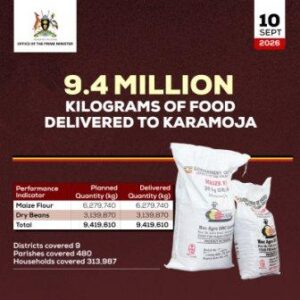
Over the past two months, government has delivered more than 9.4 million kilograms of that relief to families across the sub-region.
The Office of the Prime Minister confirmed that the food had been procured specifically to support vulnerable households caught in a worsening food crisis.

The scale of the operation has been considerable.
Distribution has now covered all nine districts of Karamoja, reaching 480 parishes and 313,987 households.
But behind those numbers sits a harder question that officials, local leaders and the government itself have all been forced to confront: why does Karamoja keep needing this, and what would it take to make this the last time?
The Numbers Behind the Crisis
The dry spell driving this year’s crisis has not been an isolated event.
Karamoja is Uganda’s most drought-prone sub-region, a semi-nomadic pastoralist area that has experienced repeated multi-year dry spells stretching back to at least 2006, and one that consistently records the country’s worst human development indicators.
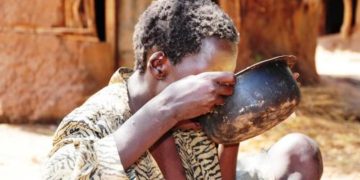
This year’s conditions pushed the region into what food security analysts classify as “crisis” level, a threshold at which households are missing meals entirely or barely meeting minimum food needs by selling off their livestock, a negative coping strategy that drives families deeper into poverty even as it buys short-term survival.
Reports from early July indicated that at least 16 people had already died from severe food shortages in the region, a grim marker of how quickly the situation had deteriorated.
Members of Parliament raised the alarm in the House itself, describing extensive crop losses and a crisis that had moved well beyond an agricultural problem into what one legislator called a full-blown humanitarian emergency.
Parliament went further, pushing for the swift deployment of 38 million dollars from the Northern Uganda Social Action Fund’s Disaster Risk Financing Facility to address drought impacts stretching across West Nile, Acholi, Lango, Karamoja, Teso, Bukedi, Bunyoro and the Elgon sub-region.

Nabbanja’s Flag-Off: Cheaper Grain Through NEC
The emergency relief operation itself was formally launched by Prime Minister Robinah Nabbanja at a flag-off ceremony at the National Enterprise Corporation headquarters in Kampala.
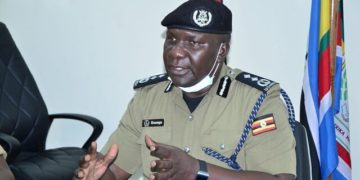
She was joined by NEC Managing Director Lt. Gen. James Mugira, State Minister for Karamoja Affairs Esther Anyakun, and State Minister for Disaster Preparedness Sam Engola.
Nabbanja said the assistance was aimed at helping communities whose food supplies had been devastated by the extended dry spell.
She urged officials on the ground to ensure the aid reached those most in need without delay.
The operation followed a direct order from President Yoweri Kaguta Museveni to release Shs45 billion for emergency food relief in Karamoja, issued after reports of severe hunger and hunger-related deaths began reaching Kampala.
Nabbanja used the occasion to commend the Uganda People’s Defence Forces for their swift response, noting that the UPDF, operating through NEC, had supplied food at prices well below what private suppliers were charging.
She pointed out that some private vendors had been charging up to Shs4,500 per kilogram of beans and Shs3,320 per kilogram of posho, while NEC supplied beans at Shs4,000 per kilogram and posho at Shs2,800 per kilogram, a meaningful difference for families already stretched thin.
Why Karamoja Keeps Needing Relief
Even as the trucks rolled out, officials on the ground were already pointing toward a harder truth.
State Minister for Disaster Preparedness Sam Engola urged government to invest in longer-term solutions to the region’s recurring food shortages, specifically calling for more dams and expanded electricity infrastructure to support irrigation.
Local leaders echoed that call in the weeks that followed.
John Paul Kodet, the LC V chairman of Napak District, argued that investment in water harvesting could mitigate many of the challenges the region faces year after year.
LC V chairpersons from Moroto and Napak praised government’s quick emergency response but pressed for more strategic, long-term planning to break the annual cycle of hunger.
The Minister for Karamoja Affairs, Dr John Baptist Lokii, also confirmed that government had increased the Senior Citizens Grant, known as SAGE, for elderly residents in Karamoja from Shs25,000 to Shs75,000 per month, a targeted response to how disproportionately the crisis has hit the region’s most vulnerable.
“We appreciate President Yoweri Museveni for his humility and generosity as the fountain of honour. The people of Karamoja are blessed,” Lokii said.
Museveni’s Three-Phase Plan
Those calls for a longer-term fix were answered directly by the President himself.
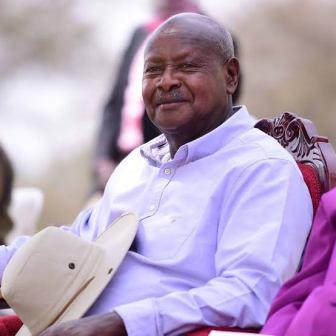
Speaking at the 11th Karamoja Cultural Event at Naitakwae Grounds in Moroto District, held under the theme “Unity in Culture, Strength in Peace, Prosperity Through Tourism and Natural Resources,” President Museveni unveiled what his office described as a three-phase food stabilisation strategy for the sub-region.
He said the strategy was designed to reduce Karamoja’s recurring dependence on emergency food relief by helping households withstand future droughts and strengthen their own food security over time.
He explained the logic behind the plan’s first phase directly to the crowd.
“The immediate phase would focus on crops capable of producing food within a relatively short period,” he said, naming sorghum, green gram and white peas as varieties suited to Karamoja’s short and unpredictable rainy seasons.
He cautioned residents against leaning too heavily on maize, arguing that its longer maturation period makes it poorly suited to the region’s dry conditions.
He confirmed that government was, at the time of his address, still distributing food relief worth approximately Shs45 billion to drought-stricken areas, underscoring that the new strategy was meant to sit alongside emergency relief rather than replace it immediately.
Big Dams and a Warning on Wetlands
The medium- and long-term phases of Museveni’s plan reach considerably further than seed distribution.
He said these later phases would progressively move households away from subsistence farming toward modern, commercial agriculture.
Irrigation, he said, would sit at the centre of that transformation.
“We are going to put up big projects to support irrigation in Karamoja, like big dams,” he said.
He paired that commitment with a caution about how the region manages its natural resources going forward, warning against wetland encroachment and stressing the importance of protecting existing water sources even as new infrastructure is built.
President Museveni said the Cabinet had resolved to move toward this more sustainable approach specifically because of how repeatedly climate change has forced government back into emergency relief mode in Karamoja.
He tasked the Minister for Karamoja Affairs, Hon. John Baptist Lokii, with elaborating on the Cabinet decision and outlining exactly how the three-phase strategy would be implemented on the ground.
A Debate Over Whether the Plan Goes Far Enough
Not everyone watching the announcement was fully convinced the strategy addresses the root of the problem.
Analysts at the Karamoja Anti-Corruption Coalition’s Department for Critical Thinking and Alternative Analysis welcomed the President’s move away from repeated emergency relief, while pressing for the strategy to be grounded in established watershed management and climate adaptation research specific to Karamoja’s dryland catchments.
Their broader point was that infrastructure alone, without sustained attention to how Karamoja’s watersheds and grazing lands are managed, risks repeating the same cycle in a different form.
That tension, between building new irrigation infrastructure and protecting the natural systems the region already depends on, is likely to shape how closely the three-phase strategy is watched as it moves from announcement to implementation.
Whether This Time Will Be Different
For now, the food relief keeps moving, with 313,987 households across all nine Karamoja districts having already received a share of the 9.4 million kilograms distributed so far.
The Office of the Prime Minister has said the intervention will continue as government works to address the sub-region’s underlying food security challenges.
Whether the three-phase strategy announced in Moroto succeeds in finally breaking Karamoja’s cycle of drought and relief will depend on how quickly the promised dams, irrigation schemes and climate-resilient seed programmes move from presidential pledge to functioning infrastructure on the ground.
For a region that has weathered dry spells since at least 2006, that will be the real test of whether this round of trucks is remembered as just another delivery, or as the beginning of the last one.