
















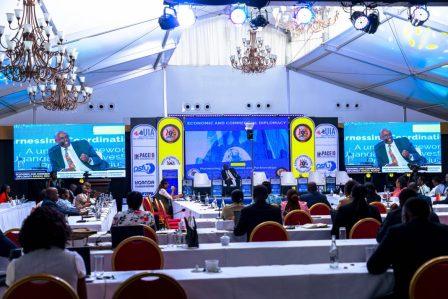
For three days this week, a golf resort on the shores of Lake Victoria became the setting for an uncomfortable conversation.
Officials from the Ministry of Foreign Affairs, Uganda’s missions abroad, government agencies and private-sector representatives gathered at the Lake Victoria Serena Golf Resort & Spa from 16th to 18th September 2026.
Their task was to review how well Uganda’s Economic and Commercial Diplomacy Strategy had performed during the 2025/26 financial year.

The underlying question was sharper than any progress report: how much of Uganda’s diplomatic activity abroad has actually turned into trade, investment and jobs at home.
From Handshakes to Balance Sheets
Opening the retreat on behalf of the Permanent Secretary, Amb. Bagiire Vincent Waiswa, the Head of ECD and Regional Economic Cooperation, Amb. Richard Kabonero, laid out the scale of what was being reviewed.
He said about US$35 million had been invested in the programme during 2026.
The returns presented during the review, he said, were projected at nearly four times that investment.
Kabonero described economic diplomacy as a shared responsibility, spanning government institutions, Uganda’s missions abroad and the private sector.
He noted that the country had now moved beyond the pilot phase of the programme into full-scale implementation.
That shift in language, from pilot to full-scale, reflects a broader repositioning that has been building inside the Ministry of Foreign Affairs for more than a year.
Missions as Uganda’s “Commercial Front Line”
The idea that embassies should function as business operations rather than purely political posts has become something of a mantra within the Ministry over the past year.
At an earlier review of the same strategy, Permanent Secretary Bagiire put it plainly, saying the ministry wanted to sharpen its outputs and even reduce their number to ensure maximum returns rather than many activities producing little outcome.
State Minister for Foreign Affairs Haruna Kyeyune has pushed missions to prioritise finding markets for coffee, dairy products, fresh foods and other agricultural exports, while working with domestic agencies to help farmers meet international demand consistently.
The framing was captured most directly in a line that has circulated widely within the ministry.
“Our missions abroad are not simply Uganda’s political representatives. They are increasingly this country’s commercial front line,” officials have said in describing the shift.
The Money Behind the Mandate
Pressure to deliver measurable results has come loudest from the Ministry of Finance.
At a separate ECD retreat earlier this year, Permanent Secretary and Secretary to the Treasury Dr. Ramathan Ggoobi told delegates that economic diplomacy could no longer be treated as a secondary duty.
“Economic diplomacy is no longer a polite supplement to political duties. It is the frontline of Uganda’s economic transformation,” Ggoobi told delegates at a retreat in Kampala.
He warned that ambassadors and heads of mission would now be judged in dollars, on investment secured, exports achieved and tourists brought in, rather than on the traditional business of diplomacy.
He went further still, saying that funding for missions abroad would now depend on their performance, a position he has pushed consistently in recent months.
At this week’s review, that same Ministry of Finance scrutiny was represented by Moses Kabanda, Commissioner for Public Administration.
Kabanda said the review was examining opportunities generated by Uganda’s missions, sorting them into those converted into actual investments or trade, those still active, and those that had been lost entirely.
He identified a list of recurring problems: differences in performance among missions, inadequate follow-up, limited market intelligence, export-readiness gaps, and delays in responding to opportunities once they arose.
Director of Budget at the Ministry of Finance, Ashaba Hannighton, added that diplomatic engagements should ultimately be judged against measurable economic outcomes.
He named exports, investment, employment, business opportunities and government revenue as the yardsticks that matter.
The Numbers the Strategy Can Point To
For all the criticism embedded in the review, officials have real growth figures to cite in the strategy’s defence.
Export earnings rose from US$7.8 billion in FY2023/24 to US$15.8 billion in FY2025/26.
Foreign direct investment increased from US$3 billion to US$3.6 billion between FY2023/24 and FY2024/25.
Tourist arrivals climbed from 1.27 million in 2023 to 1.64 million in 2025.
Diaspora remittances grew from US$1.51 billion to US$2.55 billion over the same period.
Uganda Tourism Board Chief Executive Juliana Kagwa has argued that even strong visibility numbers mean little without follow-through.
“Time for strategy is over, it’s now execution,” Kagwa has said, pushing missions to measure success by bookings generated rather than leads, interest or social media engagement.
52 Opportunities, Each With a Name Attached
Beyond the headline statistics, the retreat drilled into specifics.
Officials reviewed 52 investment, trade and climate-financing opportunities identified through more than 10 Ugandan missions abroad.
For each one, officials say, there must be clear ownership, defined timelines, identified prospective partners, an estimated value, and specific follow-up actions.
That level of granularity marks a departure from the broader, less accountable approach that has characterised economic diplomacy in the past.
What’s Still Getting in the Way
Participants at the retreat did not shy away from naming the obstacles still blocking opportunities from converting into deals.
They identified non-tariff barriers as a persistent constraint.
They pointed to standards and quality compliance challenges facing Ugandan exporters.
They flagged infrastructure constraints as another limiting factor.
They cited weak market intelligence, a shortage of bankable projects, and slow institutional responses as further obstacles working against the strategy’s goals.
The System Now Watching Every Deal
To address the follow-up problem specifically, the Ministry of Foreign Affairs has been building a digital tracking system for the entire ECD process.
Bagiire has described this as an effort to automate the implementation of the strategy, tracking trade and investment opportunities identified by missions abroad from first contact through to outcome.
“We are automating the processes of ECD implementation,” Bagiire said, addressing an earlier Annual Retreat on Economic and Commercial Diplomacy Implementation in Kampala.
The ministry has also established an Economic and Commercial Diplomacy Operations Hub, intended to support missions abroad, coordinate with headquarters, and strengthen collaboration with other government agencies working on trade and investment.
A Plan Due by Year’s End
The Lake Victoria retreat is not simply a review exercise for its own sake.
It is expected to conclude with the development of Uganda’s 2026/27 Economic and Commercial Diplomacy plan and implementation matrix.
That matrix will set out priority activities, assign responsible institutions, and establish timelines aimed squarely at improving follow-up and converting overseas engagements into measurable economic gains.
Whether Uganda’s missions can meet the higher bar now being set for them, after years of being judged mainly on visibility and goodwill, will determine whether next year’s review reads as a success story or as another list of opportunities that got away.