















The gathering that opened at the Office of the President Conference Hall in Kampala brought together two groups Uganda does not often seat side by side.
On one side were representatives of the Ugandan diaspora, the roughly two million citizens living and working abroad whose money has become one of the country’s largest sources of foreign exchange.
On the other were forced migrants and refugees, part of a population Uganda has hosted in numbers larger than any other African country.

The theme chosen for the High-Level Conference for Diaspora and Forced Migrant Communities captured the intent: “Bridging Worlds: Diaspora & Forced Migrants for Shared Prosperity.”
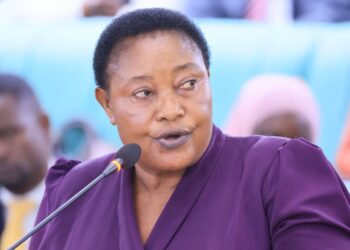
Opening the conference was the Minister for the Presidency, Hon. Babirye Milly Babalanda.
Her central message was direct: the money sent home is welcome, but it is no longer enough.
Greetings and a Statement of Principle
Babalanda began by conveying warm greetings from President Yoweri Kaguta Museveni.
She extended the same greetings from the First Lady and Minister of Education and Sports, Maama Janet Kataaha Museveni.
She passed on further greetings from the Permanent Secretary of the Office of the President, Hajji Yunus Kakande, and the entire staff of the Office of the President.
She then framed the subject at hand in human rather than economic terms.
She said migration is ultimately about people and their search for hope and a better life.
She added that government remains committed to protecting the rights and dignity of every Ugandan, whether living at home, abroad, or returning home.
Africa’s Largest Refugee Host
Babalanda turned next to Uganda’s own record as a host country.
She said the country’s hospitality is demonstrated by its open-door refugee policy, which has earned Uganda a global reputation as Africa’s largest refugee-hosting nation.
That reputation rests on substantial numbers.
Uganda hosted more than 2 million refugees and asylum-seekers as of July 2026, according to UNHCR data, making it Africa’s largest refugee-hosting country.
Babalanda connected that policy directly to national character.
“This demonstrates the character of our people: we know what it means to need a helping hand, and we believe every person deserves dignity,” she said.
Hospitality With Conditions Attached
Having praised that openness, Babalanda was equally clear that it carries obligations on both sides.
She appealed to forced migrants whose stay in Uganda has not been regularised to work with the relevant authorities to bring their status into line with Ugandan law.
She cautioned that hospitality comes with responsibility.
She urged all communities living in Uganda to respect the country’s laws, just as Ugandans abroad are expected to respect the laws of their host countries.
Rescues, Repatriations and Kyankwanzi
Babalanda also used her address to set out what government has been doing for Ugandans who ran into trouble overseas.
She reaffirmed government’s commitment to Ugandans in distress abroad.
She cited recent interventions to rescue and repatriate Ugandans from situations of exploitation.
She pointed specifically to the rehabilitation of thousands of returnees from South Africa at the National Leadership Institute in Kyankwanzi, where they received start-up and resettlement support.
The Numbers That Changed the Conversation
The heart of Babalanda’s economic argument rested on a figure that has caught the attention of Uganda’s entire economic establishment.
She said Ugandans abroad have a critical role to play in the country’s development, noting that diaspora remittances had risen from about $1.9 billion to $2.8 billion in the 12 months to March 2026, according to figures cited in her address.
That translates to more than Shs 10 trillion flowing into Ugandan households in a single year.
The jump has been steep enough to prompt questions at the highest levels of the Finance Ministry about what actually drove it.
Permanent Secretary and Secretary to the Treasury Ramathan Ggoobi told a Ministry of Foreign Affairs retreat that remittance inflows jumped to $2.8 billion, up from $1.6 billion the previous year, describing the increase as remarkable and worthy of closer examination.
Ggoobi openly speculated about the cause.
“Last year, something must have happened,” he said, asking whether it was a one-off shock linked to geopolitics, whether Ugandans abroad had grown nervous and decided to send money home, or whether it reflected the government’s economic and commercial diplomacy work.
Whatever the driver, remittances have become one of Uganda’s largest sources of foreign exchange, standing alongside earnings from gold and coffee exports and helping support the country’s balance of payments.
“Think Beyond Remittances”
It was against that backdrop that Babalanda issued her core challenge.
“That contribution is important, but I challenge the diaspora to think beyond remittances,” Babalanda said, urging Ugandans abroad to also transfer knowledge, technology, skills and investments back home.
She said the country needs the diaspora’s expertise and international networks as Uganda enters what she described as its next phase of economic transformation.
Her call echoes a shift already underway elsewhere in government and the private sector.
Equity Bank’s 2026 Diaspora Webinar, which drew Ugandans from Europe, North America, the Middle East, Asia, Australia and East Africa, was held under the theme “From Remittances to Investment Capital: Unlocking Diaspora Wealth for Uganda’s Economic Transformation.”
At that same event, Joseph Enyimu, commissioner for Economic Development Policy and Research at the Finance Ministry, outlined government ambitions for a $500 billion economy built on innovation and industrialisation.
Read together, these engagements suggest a coordinated effort to reposition the diaspora from a source of household support into a pool of investment capital and technical expertise.
Where the Money Comes From, and Where It Lands
Behind the headline remittance figure lies a more textured picture of who sends money to Uganda and where it goes.
Bank of Uganda data shows the United States remains the largest single source of inflows, followed by Saudi Arabia, the United Kingdom, the United Arab Emirates and Canada.
Mobile money has now overtaken banks and cash pickups as the main channel for sending money home, with 73 percent of inbound remittances arriving electronically and mobile money platforms alone accounting for 61 percent.
But the benefits are not spread evenly across the country.
Analysis by the Economic Policy Research Centre, drawing on the 2024 National Population and Housing Census, found that regional disparities remain stark: Buganda receives the highest inflows, followed by Ankole and Busoga, while Karamoja and Lango receive significantly less.
Cost remains a live issue too.
Uganda’s average remittance transaction cost stands at about 8 percent, well above the United Nations Sustainable Development Goal target of 3 percent, with high fees continuing to limit the full economic benefit reaching recipients.
The Office Coordinating It All
Babalanda highlighted the institutional machinery working on diaspora engagement.
She pointed to the role of the Office of the President Diaspora Affairs, headed by Ambassador Abbey Walusimbi, Senior Presidential Advisor on Diaspora Affairs.
That office, she said, coordinates with other Ministries, Departments and Agencies to ensure meaningful diaspora participation in President Museveni’s development agenda.
Walusimbi: “Connecting Them in Practical Ways”
Ambassador Walusimbi, in turn, thanked Minister Babalanda for honouring the invitation to open the conference and for her continued support to the diaspora community.
He described the conference’s purpose in plain terms.
“This conference is about connecting them in practical ways. We want the knowledge, networks, skills, and resources of the Ugandan diaspora to open doors for forced migrants and returnees. We also want the resilience and experiences of those who have been displaced or have returned to be recognized and supported,” he said.
Three Outcomes, Deliberately Modest
Walusimbi set out what he expected the conference to actually produce.
The first outcome, he said, was a clearer understanding of the real challenges and opportunities facing Ugandan diaspora communities, returnees and forced migrants, grounded in lived experience.
The second was a short list of practical ideas on how diaspora networks can support livelihoods, skills transfer, mentorship and reintegration, including linkages with the National Return and Reintegration Framework being advanced by the Ministry of Gender, Labour and Social Development.
The third was stronger coordination among the institutions handling these issues, so that the Office of the President Diaspora Affairs, the Ministry of Foreign Affairs, the Ministry of Gender, Labour and Social Development, refugee management bodies and local governments complement rather than duplicate each other.
He was candid about deliberately keeping expectations contained.
“We believe that these outcomes are deliberately modest and achievable. We prefer a few things done well to many ideas that remain on paper,” Walusimbi emphasised.
The Families Behind the Statistics
Walusimbi also pushed the room to keep sight of who the discussion was actually about.
He noted that behind every agenda item are real Ugandan families.
Some are households receiving remittances that cover school fees and daily needs.
Others are returnees trying to restart their livelihoods after difficult experiences abroad.
Others still are forced migrants seeking stability, or host communities sharing limited resources and space.
He acknowledged that Uganda’s generosity in hosting refugees, and the benefits it has drawn from diaspora contributions, both come with pressures on services, social cohesion and local economies, whether in Kampala, in refugee-hosting districts, or in regions such as Karamoja.
“When systems work and people support one another, hope grows. When people are left behind or processes are unclear, the whole nation feels the cost,” he said.
A Call for Honest Engagement
Walusimbi framed his own office’s role modestly.
He said its purpose is to help bridge gaps, to convene, to listen, and to support practical collaboration, while fully respecting the mandates of every institution represented in the room.
He asked participants to engage with honesty and a solution-oriented spirit, sharing experiences openly, listening with respect, and focusing on what can realistically be done within Uganda’s institutional framework.
“On behalf of our visionary leader, grandfather and freedom fighter, His Excellency President Yoweri Kaguta Museveni, I thank you once again for being part of this effort,” he said.
“Let us work together to turn dialogue into practical bridges that serve the people of Uganda and strengthen our shared future,” he concluded.
A Room Worth Watching
The conference brought together heads of diplomatic missions, senior government officials, representatives of diaspora and forced migrant communities, and civil society organisations.
Whether it produces the modest, achievable outcomes Walusimbi described will depend on follow-through long after the delegates have left the Conference Hall.
But the framing on display was unmistakable.
For a country whose diaspora now sends home more foreign exchange than most of its export commodities earn, the conversation has shifted from gratitude for remittances to a harder, more ambitious question: how to convert that money, and the skills behind it, into something that builds rather than simply sustains.