











Land in Busoga is shrinking with every generation.
What used to be sprawling family estates has, over decades of inheritance and subdivision, splintered into plots barely large enough to feed a household, let alone build wealth from.
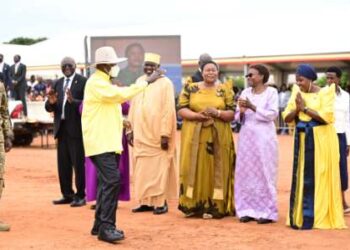
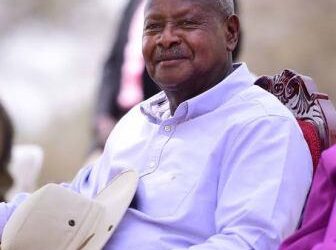
It was against this backdrop that President Yoweri Kaguta Museveni chose Iringa Township Primary School in Nkondo Sub-county, Buyende District, to deliver a pointed message to the people of Busoga: stop waiting on the land you don’t have, and start working the land you do.

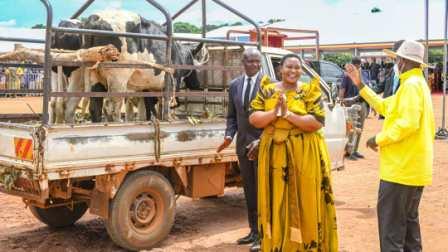
The President was in the district to officiate at the thanksgiving ceremony of Hon. Babirye Milly Babalanda, the Minister for the Presidency and Budiope West Member of Parliament.
But the ceremony quickly became a platform for one of Museveni’s most consistent economic messages of the past three decades — that a family does not need a large farm to escape poverty, only a well-calculated one.
Small Land, Big Ambitions
Museveni told the gathering that land fragmentation is among the most persistent drivers of household poverty across Busoga.
Each generation inherits a smaller slice of the family estate than the one before it, he said, until plots become too small to sustain a family through conventional, extensive farming.
His answer, as it has been since the NRM’s 1996 manifesto, is the Four-Acre Model — a system of dividing even modest landholdings into productive, income-generating enterprises rather than treating them as space for subsistence alone.
Under the model, as the President and government officials have described it in similar addresses this year, one acre is typically set aside for coffee, one for fruit trees, one for food crops, and one for pasture, with smaller enterprises such as poultry, piggery and fish farming layered in wherever space allows.
“Even if you do not do all the seven activities, as long as what you are doing is taking you out of poverty and you are doing it with calculation—ekibaaro—you can succeed,” Museveni told the Buyende crowd.
He urged farmers to size their ambitions to their land, encouraging those with small plots to farm intensively while those with larger holdings pursue extensive production.
The Farmers Museveni Wants Busoga to Copy
To make his case, the President reached for examples he has cited in wealth-creation rallies across the country in recent months.
He pointed to Mr. George Matongo, a farmer in Ngoma, Nakaseke District, whom he said produces roughly 900 litres of milk a day and earns more than Shs21 million a month from dairy alone.
He also cited Mr. Johnson Basangwa of Kamuli, whose poultry enterprise on a small piece of land, according to the President, brings in about Shs20 million a day.
Government accounts of the Four-Acre Model elsewhere in the country point to similarly striking figures — farmers earning tens or even hundreds of millions of shillings a year from a few acres of coffee, fruit, dairy and poultry, according to state media reports on Museveni’s recent tours of Masaka, Mpigi and Bunyoro.
Fish farming featured heavily in the President’s Buyende remarks as well.
He told residents that two fish ponds on a single acre could generate as much as Shs140 million, and urged communities near wetlands and Lake Kyoga to explore fish farming at the water’s edge, within the bounds of the law.
Beyond the Four Crops
Museveni was careful to stress that the Four-Acre Model is not a rigid prescription limiting farmers to a fixed list of enterprises.
He cited Namubiru Rashida of Butambala, a goat farmer, as proof that success under the model can come from enterprises outside its most commonly cited activities.
He cautioned Busoga residents, however, against over-reliance on sugarcane, rice and tobacco on small plots, warning that the returns on these crops are often too thin to lift a household out of poverty.
Instead, he pointed residents toward four broad sectors the government has identified for wealth creation and economic transformation: commercial agriculture, services, ICT and manufacturing.
He urged citizens to weigh their own circumstances and resources and pick opportunities from within those sectors accordingly.
On the money to fund such enterprises, Museveni urged residents to put their Parish Development Model (PDM) funds to proper use, channelling them into ventures capable of generating sustainable household income rather than one-off spending.
Regulating the Lake, Rewarding the Land
Uganda’s natural resources — its minerals and its water bodies — remain under national regulation, Museveni reminded the gathering, even as communities living near them stand to benefit within the law.
He said government will continue to regulate fishing on the country’s lakes to ease congestion on the water and protect fish stocks for the long term, while at the same time supporting communities to take up fish farming as a more sustainable alternative.
For Buyende specifically, the President pledged government support in the form of a milk tank and cooling facility, a move aimed at strengthening the district’s dairy value chain.
A Promotion, and a Reminder of Busoga’s War-Era Contribution
The ceremony was also the setting for a promotion.
President Museveni elevated Ms. Sarah Kasadha from Deputy Resident District Commissioner (DRDC) to full Resident District Commissioner (RDC).
Ms. Kasadha currently serves in Namayingo District and is the daughter of the late Samuel Kasadha, who served as a FRONASA coordinator for Busoga during the movement’s formative years.
Gratitude, Roads and a Call for Skills
Rt. Hon. Rukia Isanga Nakadama, the Third Deputy Prime Minister and Minister without Portfolio, thanked the President for the Parish Development Model, crediting it with helping young people and other Ugandans work their way out of poverty through income-generating activities.
Minister Babalanda, whose thanksgiving ceremony brought the gathering together, said the event was meant to thank God for the gift of life, to appreciate the President for entrusting her with ministerial responsibility, and to renew her commitment to serving Budiope West.
She commended Museveni for visible development in Buyende District, citing improvements to the road network and a new ferry that she said had eased water transport across the district.
She also called for a technical institute to be established in Buyende, arguing that practical skills would allow the district’s young people to create employment for themselves rather than wait for it.
Buyende District Woman MP Hon. Sarah Namulondo thanked the President for the peace and stability in the district, which she credited to the presence of the UPDF and Police.
The Shadow of the Nuclear Project
Not every voice at the ceremony spoke solely of gratitude.
Hon. Namulondo used the platform to press government on one of the district’s most consequential pending decisions: the long-planned nuclear power plant slated for Bukungu.
Government identified Buyende in 2019 as one of eight potential sites for a 2,000-megawatt nuclear power project, and by late 2023 officials were engaging residents of villages including Kasaato, Buyanja and Nawansaso over a resettlement expected to affect more than 25,000 people, according to reporting by the Daily Monitor and KFM at the time.
Namulondo asked government to expedite compensation for affected residents so that they could settle their affairs with certainty.
She said many residents were living in limbo over possible displacement, and as a result were reluctant to make long-term investments on land they might soon have to leave.
Faith Leaders Weigh In
Pastor Jimmy Kajura of the Seventh-Day Adventist Church in Buyende thanked the President for the security provided during the recent elections in the Busoga sub-region.
Pastor Samuel Kajoba commended Museveni’s anti-corruption efforts and said the President had remained committed to the pledges in the NRM manifesto.
Kajoba also welcomed the establishment of National Cleaning Day, arguing that improved sanitation would help cut disease, and he thanked the President for accommodating the religious observances of the Seventh-Day Adventist community on the designated day.
A Model That Needs More Land to Work With
Speaking on behalf of NRM chairpersons across the Busoga sub-region, Iganga District NRM Chairperson Hajji Abubakar Walubi commended Museveni for promoting wealth creation through the Four-Acre Model.
He nonetheless pushed back gently, telling the President that limited land remains a defining challenge for household incomes across Busoga and calling for interventions tailored more specifically to the region’s realities.
Walubi also called for community-based irrigation projects, arguing that irrigation schemes should be designed to benefit entire communities rather than a handful of individual beneficiaries.
The thanksgiving ceremony drew religious leaders, political leaders, government officials, Members of Parliament and residents from across Buyende and the wider Busoga sub-region.