















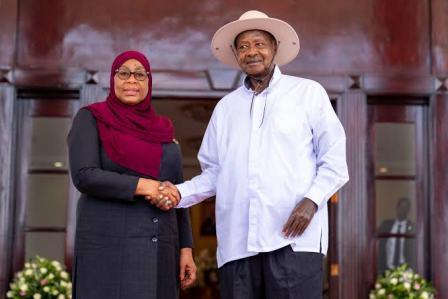
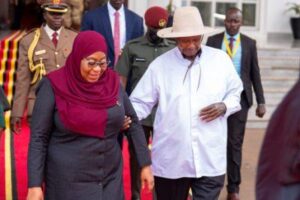
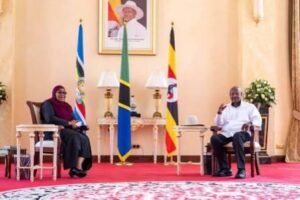
When President Yoweri Kaguta Museveni welcomed Dr. Samia Suluhu Hassan to State House, Entebbe, on Wednesday, November 18, 2026, the talks were about more than courtesy.
The Tanzanian President is in Uganda for a two-day State Visit, running from November 18 to 19.
She came at President Museveni’s invitation.

She travelled with Tanzanian ministers and senior government officials.
Their message after the talks was that Uganda and Tanzania will speed up the projects that bind them together.
These include the East African Crude Oil Pipeline (EACOP), the Standard Gauge Railway (SGR) and cross-border energy links.
Brothers Forged in Struggle: The Road to Entebbe
To understand why the two leaders speak so warmly, one has to go back several decades.
Museveni’s own story is tied to Tanzania.
As a young man he chose to study at the University of Dar es Salaam, then a gathering place for African liberation thinking.
Tanzania’s Julius Nyerere was by then one of the continent’s leading statesmen.
Relations between Kampala and Dar es Salaam soured after January 1971.
That was when Idi Amin seized power from President Milton Obote.
Obote was a close friend of Nyerere and went on to live in Tanzania.
Ugandan exiles based in Tanzania attacked Uganda in 1972, and relations stayed strained afterwards.
The crisis came in late 1978.
Uganda declared a state of war against Tanzania and sent troops to annex part of the Kagera region.
On November 2, 1978, Nyerere declared war on Amin’s regime.
Tanzanian forces then joined Ugandan exile groups organised under the Uganda National Liberation Army.
Museveni’s Front for National Salvation was among those groups.
The Tanzanian army pushed about 1,500 kilometres from Dar es Salaam, and Amin was ousted in Kampala on April 11, 1979.
Ugandan exiles meeting at Moshi, Tanzania, formed the Uganda National Liberation Front, and Museveni became a minister in the new government.
Museveni took power in 1986 and has spoken of Nyerere with admiration ever since.
In 2019 he recalled that Nyerere wanted to build a powerful centre of gravity in the form of an East African federation.
Many in the region, and Suluhu herself, describe the relationship as one of kinship.
She has said the two countries share historical and genealogical ties that keep growing.
From the Battlefield to the Boardroom: Oil Draws the Two Closer
The partnership has since moved from war to commerce.
The two governments signed the Intergovernmental Agreement for the crude export pipeline in May 2017.
Studies found Tanga to be the cheapest route for carrying Uganda’s oil from Hoima to the international market.
In April 2021, Suluhu travelled to Kampala on her first foreign trip as head of state, to sign the tripartite pipeline agreement.
A month later, Museveni was in Dar es Salaam for the signing of Tanzania’s host government agreement, the last key deal needed to start the project.
The pipeline is 1,443 kilometres long, with 296 kilometres in Uganda and the rest in Tanzania.
It is against this record that this week’s talks must be read.
“One People, One Destiny”
President Suluhu described relations between the two countries as cordial and strong.
She said her visit would give fresh impetus to existing cooperation and open new avenues, especially in agriculture and other strategic sectors.
She reaffirmed Tanzania’s commitment to working with Uganda under the principle of “one people, one destiny.”
She asked both governments to speed up the implementation of bilateral agreements.
Commitments, she said, must be turned into tangible results.
She announced plans to create a standalone Ministry of East African Community Affairs, separated from the Ministry of Foreign Affairs.
The move, she explained, would give regional integration dedicated ministerial attention and strengthen Tanzania’s engagement with the East African Community.
She also praised Uganda for being the first country to start building its diplomatic chancery in Dodoma, Tanzania’s capital.
That step, she said, had encouraged other countries to think about opening diplomatic offices there.
Museveni’s Case: Resources, People and Markets
In the joint press briefing, President Museveni argued that lasting prosperity rests on several things.
Countries must make effective use of their natural resources.
They must develop productive populations.
They must secure markets for what they produce.
They must also invest in efficient transport and communication.
Production alone, he said, cannot create wealth if there are no markets to take the goods.
He pointed to the development of the United States as an example of a country that built prosperity by harnessing its resources and strengthening its economic systems.
EACOP Nears the Finish Line
The two leaders welcomed the progress on the East African Crude Oil Pipeline, which is now 93.9% complete.
They urged that the remaining construction, testing, commissioning and operational readiness work be completed quickly.
They described EACOP as a flagship regional project.
Its completion, they said, will strengthen energy security, attract investment, create jobs and speed up socioeconomic development in Uganda, Tanzania and the wider region.
Beyond the Pipe: Refineries, Storage and a Regional Energy Hub
President Museveni called for the two countries to invest jointly across the whole petroleum industry.
Fragmented national approaches, he warned, could lead to duplicated infrastructure, higher costs and missed opportunities.
He pointed to Uganda’s plan for a small refinery in Hoima and its support for a larger refinery in Tanga.
A coordinated regional plan, he argued, would let countries pool resources and build well-placed facilities.
He described failure to advance such arrangements as a “crippling mistake.”
Cooperation, he said, should cover refining, storage, distribution and the rest of the petroleum value chain.
The two Presidents called for an integrated regional energy industry built on value addition, industrialisation and joint investment.
They directed the relevant authorities to speed up the August 2026 Memorandum of Understanding to develop Tanga into a Regional Energy Hub.
The proposed hub would support petroleum storage, refining, trading, distribution and logistics.
It would also host joint ventures making fertilisers, plastics, industrial chemicals and other petroleum-based products.
The leaders also asked for faster work on natural gas and refined petroleum product pipelines.
They called as well for faster work on the 400kV electricity interconnector linking Wobulenzi, Masaka, Ibadakuli and Shinyanga.
Rails, Ships and Ports
On railways, the two Presidents welcomed the signing of a Framework Agreement for the Isaka–Lusahunga–Murongo/Kikagati–Mpondwe Standard Gauge Railway project.
They directed ministries, railway authorities and other institutions to speed up feasibility studies, technical designs, financing arrangements and other outstanding preparatory work.
The railway is expected to improve cross-border connectivity and make trade easier.
It should also lower transport and logistics costs and strengthen regional integration.
President Suluhu announced that the MV Mwanza vessel will begin operating between Mwanza and Port Bell.
The vessel can carry 400 metric tonnes of cargo and 1,200 passengers.
She said Tanzania is also modernising the ports of Dar es Salaam and Tanga and expanding its railway network to improve regional trade.
The two leaders welcomed efforts to improve transport on Lake Victoria.
These include plans to upgrade Port Bell and strengthen its rail link to Kampala.
The improvements are expected to improve multimodal transport, increase cargo-handling capacity and ease the movement of goods and people.
Trade: Fair Play, Mivumba and Cheaper Rice
The two governments committed to balanced and mutually beneficial trade.
They pledged to pursue it through better market access, a wider range of goods and services, value addition and stronger private-sector partnerships.
President Museveni challenged both countries to protect their textile industries.
Continued imports of second-hand clothes, commonly called Mivumba, he warned, were hurting local manufacturing.
He asked why the issue had not been prioritised by the countries’ inter-ministerial committee in Arusha.
He urged officials to take it up in their coming engagements.
Stronger textile manufacturing, he argued, would expand industrial output, create jobs and keep wealth in the region.
He asked Tanzania to support Uganda’s position in the coming discussions.
He also cautioned against retaliatory trade restrictions.
Protectionist measures, he said, could undermine regional integration and hurt producers in both countries.
On Tanzanian rice entering the Ugandan market, he said he had refused calls to block the imports.
The rice, he explained, was cheaper and of better quality.
Restricting Tanzanian farmers, he warned, could invite similar measures against Ugandan products in neighbouring markets.
He urged East African countries to embrace competition and integration rather than build trade barriers.
He challenged regional leaders to choose between deeper integration towards a United States of Africa and continued economic fragmentation.
Clearing the Barriers
In their joint communiqué, the two leaders voiced concern over persistent Non-Tariff Barriers.
These barriers, they said, raise the cost of doing business, weaken competitiveness and limit the gains of regional integration.
They directed their ministries and agencies to settle outstanding trade barriers through dialogue and the established bilateral and East African Community mechanisms.
They also called for a Tanzania–Uganda Joint Trade Committee to handle trade-related challenges.
They recalled the Fifth Session of the Uganda–Tanzania Joint Permanent Commission, held in Tanzania in March 2026.
They directed ministers and institutions to speed up outstanding commitments in energy, infrastructure, transport, trade, investment and tourism.
Peace, Health and a Louder African Voice
On regional and international affairs, the two leaders reaffirmed their commitment to working through the East African Community, the African Union, the Intergovernmental Authority on Development and the United Nations.
They aim to promote peace, security and stability.
They voiced concern about conflicts, terrorism and political instability in parts of Africa and the world.
They stressed dialogue, diplomacy and peaceful settlement of disputes.
They also recognised pandemics and public health emergencies as shared threats.
These, they said, call for stronger disease surveillance, information sharing, cross-border preparedness and resilient health systems.
Both governments committed to equitable access to vaccines, medicines and other essential health commodities.
President Suluhu commended President Museveni for his contribution to regional peace and stability as Chair of the Regional Oversight Mechanism.
President Museveni, in turn, recognised her continental roles.
She is African Union Champion for Child and Maternal Health, for Women and Youth in Trade under the African Continental Free Trade Area, and for Clean Cooking.
The two Presidents also called for reform of the United Nations system to make it more representative, democratic and responsive to today’s global realities.
They specifically asked for equitable African representation on the UN Security Council, in line with the Ezulwini Consensus and the Sirte Declaration.
A Partnership Built to Last
The leaders said they were satisfied with the outcome of their discussions.
They pledged to turn the agreed commitments into concrete action to strengthen the longstanding partnership between Uganda and Tanzania.
President Museveni thanked President Suluhu for accepting his invitation.
The Tanzanian President thanked the Government and people of Uganda for the reception and hospitality given to her delegation.