












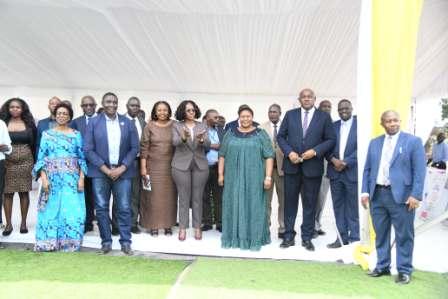
At Mbarara University of Science and Technology (MUST), three days of talks on one of Uganda’s longest battles came to a close on Wednesday, November 18, 2026.
The event was the National HIV and AIDS Symposium, held under the theme “Sustainable Interventions to End AIDS as a Public Health Threat by 2030.”
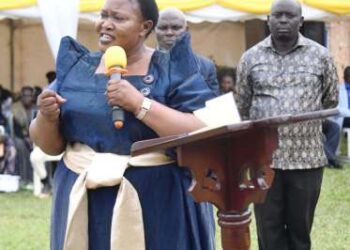
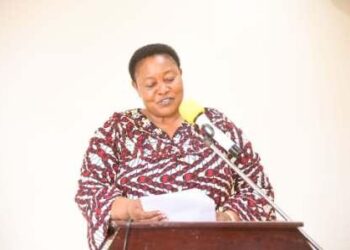
The Minister for the Presidency and Member of Parliament for Budiope West Constituency, Hon. Babirye Milly Babalanda, delivered the closing remarks.

She praised President Yoweri Kaguta Museveni for visionary leadership and decisive action against HIV/AIDS.
She also urged Ugandans to protect the gains already made and push on towards ending AIDS as a public health threat by 2030.
When Silence Was the Enemy
Hon. Babalanda took her audience back to a time when HIV was wrapped in stigma, fear and silence.
In her telling, the President showed courage and a willingness to transform how the country spoke about the disease.
She recalled that soon after taking power in 1986, he raised the HIV/AIDS challenge openly at the World Health Assembly.
That openness, she said, showed the importance of confronting the epidemic through public awareness and collective action.
The epidemic’s roots go deep into Uganda’s own soil. Doctors first identified clinical AIDS in Rakai District in 1982.
Communities there reported a mysterious illness marked by persistent fever, chronic diarrhoea, skin rashes and dramatic weight loss.
Locals called it “slim disease.”
By 1986, up to 900 cases had been reported, rising to 6,000 by 1988.
After 1986, the President adopted an unusually open approach to discussing the epidemic, and public campaigns promoted the ABC strategy.
In 1989, the musician Philly Bongole Lutaaya became the first celebrity in Uganda to publicly declare his HIV status.
In 1990, the AIDS Information Centre opened one of Africa’s first dedicated voluntary counselling and testing services.
By 2002, prevalence had fallen to 6.2% from 18% in 1992, and Uganda was acclaimed as the first developing country to bring prevalence down.
ABC and a Public Test
Hon. Babalanda highlighted the President’s championing of the ABC prevention strategy.
ABC stands for Abstinence, Being faithful and Condom use.
She also recalled the President’s personal decision to take an HIV test at Kiswa Health Centre in Kampala in 2013.
That act, she said, encouraged Ugandans to overcome fear and accept voluntary testing.
Public leaders had rarely tested for HIV in public, and officials wanted the President to serve as a role model.
On the day, the President urged all Ugandans to find out their status.
Numbers That Tell Two Stories
The Minister said Uganda has made significant progress.
Prevalence, she said, has fallen from about 18 per cent in the 1980s to 5.9 per cent today.
New infections now stand at about 34,000. AIDS-related deaths stand at about 19,000. Her figures match those given by the Uganda AIDS Commission.
The Commission’s board chair says a national survey puts prevalence at 5.9 per cent, and that about 34,000 new infections are recorded each year, more than a third of them among young people, particularly adolescent girls and young women.
New infections have dropped from 96,000 in 2010 to 37,000 in 2024.
One analysis notes that infections still exceed deaths, so epidemic control has not yet been achieved.
That is why Hon. Babalanda warned against complacency. Every new infection, she stressed, is an affected individual.
It is also a burdened family. And it is a lost development opportunity.
A Word to the Bazukulu
Addressing young people, whom she affectionately calls Bazukulu, the Minister spoke directly.
She urged them to put education first. She urged them to abstain from sex until they are mature and responsible.
She urged them to avoid alcohol and drug abuse. She urged them to make informed decisions that protect their health and their future.
She also challenged a dangerous misconception. Antiretroviral therapy (ART), she said, does not make HIV harmless.
Treatment lets people living with HIV live longer and more productive lives.
It is not a cure, she noted, and it requires lifelong medication and regular medical monitoring.
The concern has been voiced before. Free ARVs have been available in Uganda since 2004, and some believe they led to complacency because AIDS is no longer an immediate death sentence.
Girls, Schools and Economic Power
Hon. Babalanda voiced particular concern about new infections among adolescent girls and young women.
She called for deliberate interventions that combine HIV prevention with economic empowerment.
Government wealth-creation programmes, she said, should be directed to benefit vulnerable households, adolescent girls and young women.
These include the Parish Development Model (PDM), Emyooga and various skilling initiatives.
Economic empowerment, she explained, gives young women skills, income and financial independence.
That in turn lets them make informed decisions, resist exploitation and negotiate relationships that protect their health.
She also underlined the importance of keeping girls in school. She pointed to Government’s Universal Primary and Secondary Education programmes under the Bonna Basome policy.
Education, she noted, helps protect girls from early marriage, teenage pregnancy and other vulnerabilities linked to HIV infection.
She asked parents, teachers, religious leaders and community leaders to work together. Their goal, she said, should be that no girl is unnecessarily pushed out of school.
Mothers, Babies and a Message of Hope
On the prevention of mother-to-child transmission, the Minister encouraged pregnant women to test early and seek appropriate medical care.
She assured them that being HIV-positive does not stop a woman from giving birth to an HIV-negative child.
That outcome, she said, depends on following proper treatment and medical guidance.
She urged health authorities and other stakeholders to ensure that every pregnant woman is tested.
She asked that every HIV-positive mother receives the necessary medication. She asked that every HIV-exposed child gets appropriate follow-up care.
She also called on Resident District Commissioners (RDCs), Resident City Commissioners (RCCs) and other local leaders to take part.
They should work with development partners and use available Government communication platforms, she said, to spread accurate HIV prevention messages in communities.
The Fast Track to 2030
Hon. Babalanda recalled the Presidential Fast Track Initiative to End AIDS as a Public Health Threat by 2030, launched in 2017.
It has five priorities. The first is engaging men to prevent new infections among adolescent girls and young women.
The second is speeding up test-and-treat interventions to reach the 95-95-95 targets.
The third is eliminating mother-to-child transmission. The fourth is ensuring the financial sustainability of the HIV response. The fifth is strengthening national leadership and coordination.
When the Money Runs Thin
The Minister admitted that Uganda still faces real challenges. These include new infections among young people, and stigma and discrimination. They also include emerging financial pressure from reduced external funding.
The pressure is real. Uganda spends about Shs1.9 trillion a year on HIV services, and around 60 percent of it has come from donors, mainly the U.S. government through PEPFAR.
The Uganda AIDS Commission has warned that thousands of health workers supporting the HIV response lost their jobs or were at risk after the U.S. aid freeze in January 2025.
The Commission’s Vincent Bagambe has said Uganda must begin working towards a self-reliant HIV response system.
Hon. Babalanda reaffirmed Government’s commitment to uninterrupted access to essential HIV medicines and services.
She warned that Uganda cannot afford to reverse gains won through decades of investment and collective sacrifice.
From Donor Dependence to Self-Reliance
The Minister commended the Uganda AIDS Commission and its development partners for developing the National HIV Sustainability Roadmap.
She described it as an important step in moving the HIV response from donor dependence to a nationally led, integrated and sustainable financing model.
She welcomed the roadmap’s alignment with the Fourth National Development Plan (NDP IV).
The fight against HIV/AIDS, she noted, is not a health-sector responsibility alone.
It is an integral part of human capital development and of Uganda’s wider socio-economic transformation.
She summed up the point in words aimed at every household.
“Health is wealth.”
“A healthy population is a productive population.” “Your health is your first asset, and protecting it is a personal, family and national responsibility,” she emphasised.
Thanks to the Partners
Hon. Babalanda also recognised the development partners who have supported the response.
She named the United States Government and the United Nations family in particular.
She thanked religious and cultural leaders, civil society organisations and networks of people living with HIV.
Their efforts, she said, have been instrumental in prevention, treatment, advocacy and the fight against stigma.
She paid special tribute to President Museveni for his sustained commitment.
His leadership, she said, has helped save countless lives and let many Ugandans live healthier and more productive lives.
She also cited his international recognition, including the Distinguished Leadership Excellence Award in 2001 and the Commonwealth Award for Action on HIV/AIDS in 2002.
A Call to Act on the Resolutions
Hon. Babalanda ended by urging all stakeholders to turn the symposium’s resolutions into practical action.
She asked them to strengthen accountability and keep up their collective determination as 2030 draws closer.
She called on young people to stay vigilant. She called on parents to be responsible.
She called on leaders to stay committed. She called on institutions to be accountable.
Progress in treatment, she stressed, must never weaken prevention.
Declining donor support, she added, must not reverse the country’s achievements.
She then declared the three-day National HIV and AIDS Symposium officially closed.
She called for renewed national commitment to protecting lives, strengthening families and securing Uganda’s future.