











It’s now four years since the NRM Government was voted back to power on yet another social contract. In the 2016-2021 Manifesto, the NRM says it has achieved closet to 80% of the Manifesto promises most especially in the areas of roads, health, agriculture and security. Stephen Bwire caught up with Mr Willis Bashaasha, the Director Manifesto Implementation Unit, Office of the President during the Manifesto week under the theme: Taking Uganda to modernity through jobs creation and inclusive development.
What is the significance of the Manifesto Week?

The significance of the Manifesto Week is essentially to popularise the Manifesto achievements to the people in the country. We have to let the people, with whom we entered a socio contract through our Elections Manifesto, understand what has been done in the years of the current tenure, and identify implementation challenges of the Manifesto commitments to determine the way forward. We as government are giving an audit to the people who gave us the mandate to execute our Manifesto.
How much work has been done in the last four years of the NRM Manifesto?
Yes, that is a very good question that can be answered in two perspectives; first of all is to appreciate the role and mandate of the Unit, what it does and secondly the implementation of the manifesto is largely done by the MDAs, Ministries, Departments, Agencies and local governments. For us here we do the tracking because after assuming power, most of the commitments were translated into service delivery programmes and these are implemented under different sectors. However, through the tracking programme, we are able to see whether these commitments are mainstreamed within the work plans and whether budgets are allocated to make sure the implementation is going on. So this is the fourth year into the term of this manifesto, and we really see serious investments in the areas of the flagship projects:
- The new Nile Bridge
- The increase in generation capacity to around 1839 MW
- The Entebbe –Kampala Express highway
- The 04 Planes to kick start the Uganda Airlines operations.
- The various factories that have been commissioned in the different parts of the country.
- Completion of Mulago specialized Hospital.
- Extension of clean water to across the country
- Rural electrification to all District headquarters and substantial number of Sub Counties
- Purchase and distribution of road equipment to all the Districts
- Disbursement of funds to support the Women, Youth and the old
- Establishment of Water for Production schemes to support commercial agriculture
- Capitalization of Uganda Development Bank
- Construction of different road networks getting to the total coverage of 4,551 KM
- Establishment of the Kabaale International Airport.
What are some of the key sectors where the Manifseto is registering success?
Well, at the moment what I see, water is doing well and they have met the targets. The current rural water coverage is estimated at 71%, while the urban water coverage stands at 79.1%. The cumulative number of water connections countrywide is estimated at 720,000. Overall a total 38,517 villages representing 66% of the total 57,974 villages in the country have been served with clean water and the unserved villages are 19,457.
In addition, 17,556Km of NWSC piped water network has been extended serving 253 towns with 127.8million cubic metres of water supplied, with 78,761 industrial/commercial customer base.
Coming to ICT, the National Backbone Infrastructure project (NBI) has been extended to 470 MDA/LG sites and target user groups. Out of these 398 are using services over the NBI; the services include internet bandwidth, IFMS, Data Centre, leased lines and dark fibre
H.E the President of the Republic of Uganda in November 2019 launched the first Mobile Phone and Computer manufacturing and assembly plant in Uganda at Namanve Industrial park.
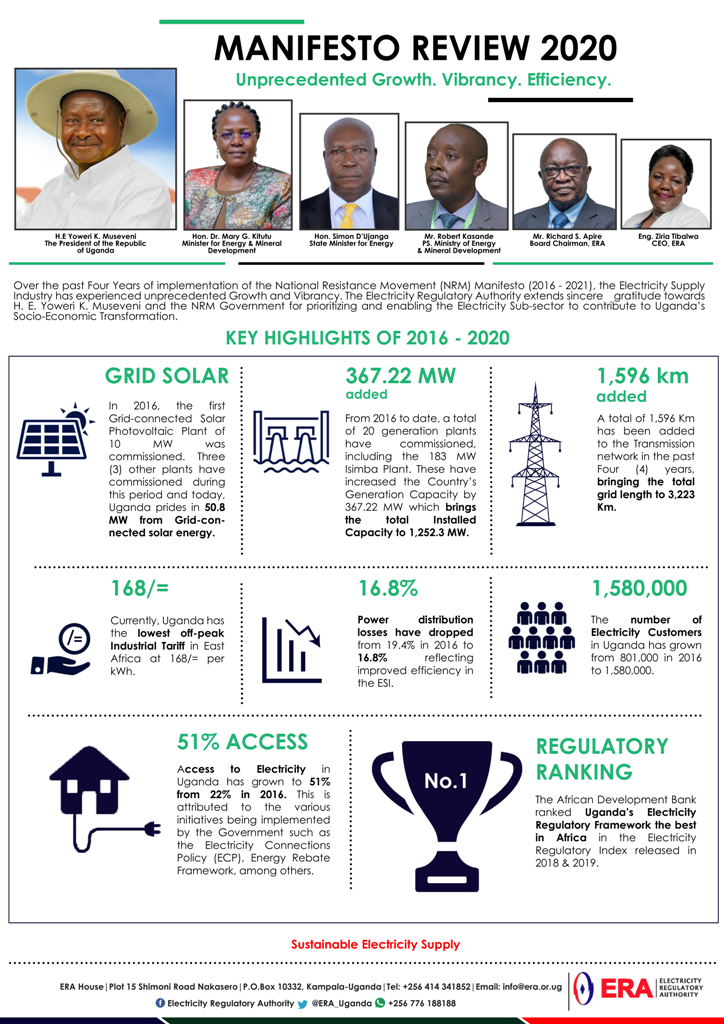
On Energy, Government commissioned electricity transmission projects totaling to 630km. This brings the total length of High Voltage grid coverage to 2258km.
To increase access rate to electricity from the current 28% and also grow the demand, Government is implementing the Electricity Connection Policy 2018 this has led to 239,903 free connections. Total number of customers on the UMEME grid is 1,509,988
Isimba Hydro Power Project (183 MW): The plant was successfully commissioned by H.E, the President of Uganda and Karuma Hydro Power Project (600MW): Construction works have progressed to 92%
AGR Gold Refinery, Entebbe: AGR invested 15M US $ to set up a gold refinery in Entebbe.
In terms of Social Development, the Uganda Women Entrepreneurship Programme (UWEP) has financed 9,660 projects benefiting 120,873 women. Shs7.948Billion recovered reflecting 83.7% of the funds due.390 women groups have repaid 100% of the loan.
Youth Livelihood Programme financed 20,159 projects benefiting 241,799 youth of which 46% are female. The recovery of funds is at 69%. Shs9.232Billion revolved to finance 1,090 Projects benefiting 11,463 youth.
We have supported 32,748 youth under Youth Venture Capital Fund programme worth Shs95.7Billion. Graduate Volunteer Scheme launched and 120 youth allocated in different work places
On Education, a total of 138 primary schools with less than 03 permanent classrooms have been expanded to 884 classrooms have been built and completed over the last three years. Additional of 145 classrooms are under construction bringing a total stock to 933 classrooms
Under Secondary Education, 12 Seed Secondary Schools were completed in first three years, 182 Community Secondary schools were grant-aided. 117 Seed Schools are under construction in Sub-counties and Divisions without a public Secondary School. An additional 100 new Seed Secondary Schools are planned to be constructed starting in FY2020/2021
Coming to Tertiary education, 6 Centres of Excellence have been created under the Albertine Regional Sustainable Development Project (ARSDP); and Uganda Skilling Development Project (USDP).
On the Rehabilitation of Public Universities, All the civil works in the 9 public universities (Busitema University, Gulu University, Kyambogo University, Muni University, Makerere University Business School, Makerere University, Mbarara University of Science and Technology, Uganda Managament Institute (UMI) were completed and facilities handed over.
For health, 271 constituencies have been served with HC IVs, leaving a total of 19 constituencies under construction.
Construction and equipment of 450 Bed Speci alised Women & Neonatal hospital at Mulago was completed and launched by H.E. the President.
To construct a state-of-the-art International Hospital at Lubowa, Project documents for this hospital were completed and signed, Ground breaking was officially done by H.E The President on the 6th April 2017 and Parliament approved promissory notes to guarantee payments to the investor on the 12th of March 2019 and construction commenced.
Completed construction of 10 Theatres/ 16 Maternity Wards and Water Supply including 40,000 Litre Reservoir for 26 HC IVs
Construction of the Kawempe and Kiruddu Hospital was completed and have been designed as Referral Hospitals to decongest Mulago National Referral Hospital.
And the roads, Overall, 1,156km upgraded to tarmac added to the road network against the Manifesto projected 2,205km paved roads hence performing at 52%.
In the last 4 FYs (2015/16-2018/19), 21 road upgrading projects were completed, adding a total of 1052km to the paved national road network.
Town roads upgraded (off shoots); 17.5 km.
On the Upgrade Entebbe International Airport to accommodate increasing traffic, several components and the overall construction progress is at 65% i.e. 100% rehabilitation works for runway 2/30 and its associated taxiways completed; 60% reconstruction works of Apron 4 completed; 90% works for the new cargo center complex for Entebbe Airport completed
Revival of the national airline to enhance tourism; Uganda National Airline Company was registered in January 2018. Procured and delivered four (4) CRJ900 Bombardier aircraft, Launched commercial operations in August 2019 and Pre-delivery payment for 2 Airbus aircraft (A330) was made.
Agriculture has performed well as follows:
- Developed Solar powered irrigation schemes at all the nine (9) Zonal Agricultural Research and Development Institutes (ZARDIs)
- Constructed over 1200 tanks in various regions of the country to enable on farm water harvesting.
- The sector procured 12 heavy earth moving equipment and 284 tractors to be distributed within the District Local Governments
- Bean production stood at 1,008,410 MT with exports of 144, 925 MT worth USD 71.8 million. Cotton production has increased from 20,339MT of lint in FY2015/16 to 37,436MT in FY2017/18, Cassava production has increased from 3,023,450 MT in FY 2015/16 to 3,449,200 MT, and maize has increased with an increasing trend from 2.2 million MT in the Financial Year 2015/16, to 3.2 million MT in 2017/2018. In the same period, the country exported a total of 1,360,973MT worth USD 352.1 million, Rice production increased from 237,390 MT in 2016 to 264,530 MT in 2018 and Rice exports increased from 44,911 MT in 2016 to 52,662 MT in 2018 accounting for USD 20,274,000 and USD 26,900,000 respectively and Coffee is the principal export for Uganda. In the Financial Year 2015/16, coffee production stood at 4.46 million (60 kg) bags and the volume of coffee exports was 3.56 million (60 kg) bags valued at USD 351 million. In the FY 2017/18, coffee production had increased to 5.63 million (60 kg) bags and the volume of coffee exports was 4.45 million (60 kg) bags valued at USD 492 million which represented a 40% increase in value.
On the Security front;
- A Kololo Solar pilot project was completed
- The sector recruited over 26,000 LDUs to complement the regular force in sustaining peace and stability in Kampala and across the Country.
- Installed 4,060 CCTV cameras at 530 sites around Kampala city and major highways
- Completed construction of one (01) block of 60 housing units (part of the 1,020) at Naguru for entitled staff of rank Probationary Police Constable – Inspector of Police (PPC-IP).
- The sector has been able to build capabilities and capacities through acquisition of technical equipment and training
How do you as a Unit track the Manifesto progress?
We have various means; one of them is through the reports which they submit to us. Every quarter, these different MDAs are supposed to submit to us their performance reports as far as manifesto commitments are concerned. We also attend sector reviews, these are also supposed to tell us how the various commitments are doing in terms of work plans, arrangements and budgetary allocation. And the second one is through what we call the validation visits, the field visits where we go and we have clustered the whole country into sub regions so we go into the different sub regions and we are able to appreciate the various different investments as far as the commitments are concerned- how far they have gone. Like now we have so far covered over 120 districts from main sub regions which I think this is over 90% of the total area for the country. So we share with the local leaders the status of the manifesto as reported to us, they also share with us the status of the performance of manifesto, even the sub regions then we do sampling of certain projects that we know are going on in those areas and we find out how they are doing. And the third one is now what we are doing…Manifesto Review… where we are calling now these MDAs to come and present their case as far as implementation is concerned.
How is the citizen engagement in the Manifesto Week?
We engage the citizens through Radio and TV talk shows at the Centre and Local Government level.
We also rely on publications in Newspapers and Electronic Platforms, not forgetting use of social media i.e. Facebook, Twitter, Instagram to spell out the achievements.
Government has an integrated system which avails information on various media and other websites for easy accessibility by the masses online.
What mechanisms have you adopted for continuous publicity and dissemination of Manifesto achievements?
- Developed communication and reporting guidelines for RDCs to ensure customization of reporting
- Continuous monitoring and inspection
- Hold various talk shows
- Continuous printing of the manifesto achievements report
- Hold consultative engagements with leaders and citizens
What should Ugandans expect from this year’s Manifesto review?
I think this time of review is all about stock taking. The point we are trying to bring here is that progress of manifesto should not only be during election time. We are trying to say, all the time Ugandans must be updated on the progress of what we pledged to them because the manifesto is a social contract. So we are fulfilling that responsibility as a Unit but also fulfilling the bigger picture of the President in as far as giving strategic direction of the country is concerned; and also to assure Ugandans that we keep our word as far as the manifesto commitments are concerned. There could be challenges here and there, but it is also important that we explain to them so that Ugandans know and continue to have confidence in the government of today.
At the end of the Manifesto Week will be expected to come up with recommendations on how to improve the implementation of the Manifesto commitments for the remaining period; and also develop a set of proposals on how to strengthen monitoring and evaluation on the implementation of the Manifesto commitments.