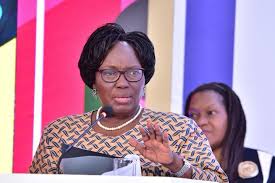

















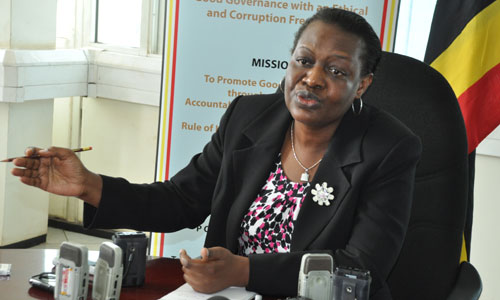
Corruption is one of the biggest enemies of Uganda’s progress and socio-economic transformation in the realisation of national strategic development objectives as underpinned in the National Development Plan and Vision 2040. The Public Lens’ Stephen Bwire sounded out the Government Ombudsman Justice Irene Mulyagonja on the ongoing battle against the corruption monster.
How would you describe your experience of being the Government Ombudsman?

The relationship with the public is the love-hate relationship. For any decision that I make, there are those who will love you and those who will hate you. This has been quite an experience.
What have been your key landmark achievements from the time you assumed office?
Some of the landmark achievements are: the number of staff at the IG has greatly increased over the years and today we have an army of 450 from 320 in 2012/2013. In addition, the budget of the IG has greatly been enhanced over the years and today we have a budget of Ushs 45 billion from 34 billion. Strategically, we have focused more on the prevention approach in the fight against corruption rather than the enforcement over which we have little control because we rely on the courts to give us decisions which are often subjected to appeals at two levels. The preventive approach has enabled us to recover over Ushs 20 billion back to government and save over ushs100 billion. The other strategy that we have introduced that has been very successful is engaging citizens in the fight against corruption through monitoring of government projects. This approach has improved levels of accountability in terms of funds and also in the existence of projects reducing the number of ‘ghost’ projects.
There is general perception that Uganda is losing the war on graft. How true or false is this?
Uganda is not losing the war on graft. A lot of effort has been made by the government through the anti-corruption agencies and putting in place a robust anti- corruption legal regime to eradicate the vice. However, the corrupt have formed syndicates which at times constitute various institutions of government and private individuals to defraud public funds. We as anti-corruption agencies have also formed syndicates to counter their plans and great strides have been made.
How much collaboration is there between the institution of the Inspectorate of Government (IG) and other state and non-state actors in the fight against corruption, and promotion of accountability?
The Inspectorate works very closely with PPDA, Office of the Auditor General, ODPP, Financial Intelligence Authority, State House Anti-Corruption Unit, to mention but a few. We have a framework under Directorate of Ethics and Integrity called the Inter-agency forum where we meet regularly to strategize in the fight against corruption.
In addition, the IG works very closely with Civil Society Organizations. We have signed MoUs with over 40 CSOs to train communities to monitor government projects in Northern Uganda as well as the areas that are hosting refugees.
The fight against corruption can be more successful when partnerships of both the state and non-state actors are formed. This is the 5th strategic objective in the five year Strategic Plan for the IG.
You recently expressed reservation about the creation of a new agency (State House Anti-Corruption Unit) to fight corruption. Wouldn’t be a better idea for such an agency to complement the role of the Inspectorate of Government in the fight against graft?
As mentioned [in 4] above, one of the key institutions that the IG works with is the State House Anti-Corruption Unit.
How would you gauge the public confidence in the institution of the Inspectorate of Government?
I strongly believe that the public confidence in the Inspectorate is high. This is because the biggest number of complaints that the IG investigates come from the public. This is over 3000 complaints annually. The public has brought to the IG cases that are not within our jurisdiction because they feel the IG is the best place to receive services but we turn them away. Even after that some complainants come back and try to make their case fit into our mandate. The public has confidence in the Inspectorate.
Whistle blowers feel they aren’t secure whenever they avail confidential information to you, while some would complain of not being rewarded for their effort. What is your take on this?
The Whistle Blowers Protection Act defines a “whistleblower” as a person, who makes a disclosure of information where that person reasonably believes that the information tends to show among other instances, that a corrupt, criminal or other unlawful act has been committed, is being committed or is likely to be committed; the Act specifies that this disclosure should be made in good faith and also calls for whistle blower to maintain the confidentiality of his or her identity as whistleblower and takes reasonable steps to avoid its discovery.
Unfortunately, most of the whistle blowers do not maintain the confidentiality of their identity and they disclose even to the media that they have lodged a complaint. This makes it very difficult for us to protect them even though we try to do so.
The same Act also specifies who can be rewarded and how. It clearly states that 5% of what is recovered is paid to the whistleblower. Sometimes whistleblowers expect rewards when the funds have not been recovered. We are not able to reward them because it is out of the funds recovered that a reward would come. Parlaiment does not provide IG with a budget line for rewards to whistle blowers.
Talk about the general view that you would mainly go for “small fish” and leave out the “big-time thieves” to walk scot-free?
The challenge is that we have failed to understand who constitute the ‘big’ or ‘small’ fish. I will refer you to the speech by His Excellency the President of Uganda on Anti-Corruption Day 2018. He clearly stated that those in charge of public funds namely, permanent Secretary, Chief Administrative Officers, Town Clerks, Chief Finance Officers, and Sub-County Chiefs are the ‘big fish’ because they control public funds.
And we have many cases where we have arrested these people and prosecuted them in court. Others have been removed from office administratively. In February we arrested the Chief Administrative Officer and Chief Finance Officer of Dokolo District and for us those are big fish.
What strategic challenges do you face in the course of executing your duties as IGG?
Some of the strategic challenges are a breakdown of systems in government institutions. For instance there are no internal complaints handling mechanisms in these institutions and everyone brings their complaints to the IG. This bogs down the inspectorate with a huge case workload.
Poor or no supervision in government institutions which leads to poor or no service delivery. This undermines development of the country.
Is it possible that we shall have a country “free of corruption”?
There is no country free of corruption. That would be in utopia, if at all that exists. However, we can significantly reduce levels of corruption if we reduce public apathy. We need to work together in a coordinated manner determined to eradicate corruption. That is why the Inspectorate of Government has focused on building partnerships because we believe that building strong alliances will help us to eradicate corruption.