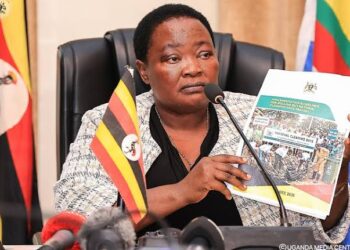







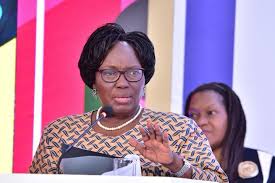
Speaker Rebecca Alitwala Kadaga is the first female speaker of parliament of Uganda. She punched her way to politics on the affirmative card when she contested for Member of Parliament representing the women of Kamuli in 1989 (NRC) to date. She has been at the forefront of championing gender equality andwomen empowerment. The Public Lens’ Stephen Bwire caught up with her in a no-holds-barred interview. Excerpts;-
You have been in the corridors of power for quite long, serving in the various portfolios. How would you describe your experience of being in government?

I started off as a back-bencher for seven years up to 1996 when I was appointed state minister for foreign affairs, then state minister for works and later on state minister for parliamentary affairs. I was elevated to the position of Deputy Speaker in 2001, and thereon I climbed to the helm of the Legislature.Serving as Speaker has enabled me to access other opportunities including serving as Inter-Parliamentary Union President, Commonwealth parliamentarians head, among other regional and international bodies.
The arrival of women at leadership has been gradual. If you look at the structure of government over many years, we had no women ministers. Among the first female ministers we had Hon. Bagaya and Mrs. Senkatuka then after that followed by Mrs. Bitamazire, and then the numbers kept growing. But we have to lead in order to open doors because the structure of our society did not acknowledge the leadership of women; so patriarchy still exists, and one has to navigate that journey through patriarchy to be able to do work.Secondly, you have to be exceedingly good so that no questions are asked about your capacity. So, it has been an interesting journey.
How have you broken-through the barriers to scale to the top in a male-dominated world, considering the positions you have held locally and internationally?
First, it requires a lot of preparation and it didn’t just happen, I have been consistently attending the meetings, but also I have taken many leadership positions both in the Commonwealth and the IPU [Inter-Parliamentary Union]. In the Commonwealth, I started as a branch representative, then I became the chair of the CWP [Commonwealth Parliamentarians] Africa, so I worked on programs that no other Chair had done, and no other region in the Commonwealth had done except Africa. So my work was outstanding. Because of the work I had done in Africa, they thought I should also support them to do the international work and build the women parliamentarians which I did quite well. within the IPUI started as a member and then I became a chair of a standing committee, later I became a member of the executive committee, where I represented the East African region; and for instance when I was in the regional executive, we brought in south Sudan, we brought in Somalia, we brought in new members to the IPU through my leadership in the executive committee. So it has been a journey, but it has been perfected overtime.
As a champion of women empowerment, what are some of the initiatives you have undertaken as Speaker of Parliament to improve the lives of women?
Within Parliament, we have advocated to have daycare facility for the children so that mothers who come there are comfortable. And this applies to all public places, for instance now all the new markets must have a daycare facility so that women in the market can have their children playing while they are doing their work. We have also advocated for other facilities for instance we have proposed that all new roads which are being built should have positions for resting so that if you have been travelling with a small child in a bus, you don’t have to go and take the child to the bush to urinate. We have proposed that all the roads should have those rest areas where there’s a bathroom, there’s a small restaurant, where people can sit, or change the children or something like that, so those are some of the things on infrastructure. Of course we have discussed the buildings for some of the women who are disabled and so on, so we have discussed all those. We have been advocating hard for the people with disabilities, and we recently wrote to the President that the people in the judiciary should be trained in sign language so that they are able to communicate with the people with disabilities.Those are some of the areas we are working on;but on education, we have worked on reduction of taxes on many items that the women use for instance the sanitary towels we removed the taxes that had been re-introduced. At a different level, personally I have worked on the issue of water, in my constituency there’s a lot more water than many other places because the women spend so much time and the children spend so much time walking to look for the water, if there’s a water point, you have thousands of Jerrycans who could stay there day and night, so one of the things we need to do to help the rural woman is to make sure she has water so that she can collect quickly and do her work. There used to be a program on cooking stoves which would enable the people to cook very quickly, I don’t know how far it has spread- it used to be in the ministry of energy, but I don’t hear much about it though this is one of the interventions that would help the rural woman to be able to cook quickly and get time to do other things and maybe to even go and do business. So, also to take their medical services nearer, we still have a challenge on schools. The distances that the children have to walk, sometimes they really have to walk very many miles, so it’s risky for them because they have to start walking early in the morning, they have got to come back late in the night, so all those risks we need to address so that facilities are put nearer where the children can access them quickly maybe 1km or something so that they don’t have to walk long distances. And then of course we have been discussing and trying to improve on the household income, we are trying really hard to ensure that there are more economic activities which women can do in order to earn a living.
Day by day, you have been seen to push for the independence of the Legislature in accordance with the doctrine of separation of powers. Are you satisfied that the institution which you superintend is somewhat independent?
I think we have made progress, you know before the 1995 constitution, the powers heavily gravitated towards the Executive, the Legislature and Judiciary were like small brothers of the Executive, but the Constitution has given us some autonomy,but I have learnt that it’s a constant battle to remind the other branches that don’t step on my feet. This is my parameter, and this is your parameter, don’t step on my feet. So we have made progress because I have been continuously talking about it, and we are gaining ground.
The question of gender parity has lingered on for long. In your tenure in parliament, what have you done to answer this question of gender parity especially in leadership positions?
Other than the constitutional provisions, during my tenure, we were able to amend the rules of procedure to ensure that 40% of the leadership positions in the House are held by women. It was a long struggle, it took us about four years but eventually it was achieved. Now we have 42% and I hope it can grow to equality. The idea is to go 50:50.
There are some people who would argue that you have depended on the affirmative action card as District Woman Representative for so long; that it’s high time you relinquished the seat and go for a constituency where you would tussle it out with men…
The position of District Woman MP is not an easy one; it’s a very big constituency since it covers an entire district. Secondly,as Speaker am able to reach out to all the people without having to first obtain permission from a given area MP within the district.
As Speaker, you belong to the ruling Party where you hold a senior position; how would you balance allegiance to your Party NRM, and at the same carry out your duties as Speaker of Parliament with neutrality?
My biggest call is to serve the people of Uganda. Majority of MPs including those in Opposition are satisfied with the way I handle legislative business. Secondly, NRM is the party in power, am bound to support the policies of my party, if they are for the good of all the people of Uganda.
What is the most memorable event during the time you have been in public service?
For me it’s something which happened way back before I joined politics. I was among the pioneer women lawyers who founded FIDA to help women access legal services and justice. Am proud of that.