













Former Tanzania President Ali Hassan Mwinyi dies at 98
By Fredrick Siminyu
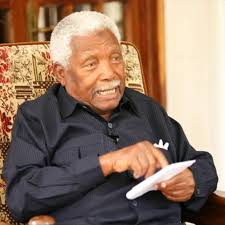
Tanzania’s former President Ali Hassan Mwinyi has died at the age of 98.
The death of the former head of State was announced by President Samia Suluhu Hassan.
Mwinyi, who was the second President of Tanzania, was in office between 1985 and 1995 succeeded the founding president, Mwalimu Julius Nyerere.
Mwinyi died three months shy of his 99th birthday but after being hospitalised on February 24 for a chest illness.
Who was Ali Hassan Mwinyi?
Mwinyi, Ali Hassan was born on May 8, 1925 in Dar es Salaam, Tanzania. Son of Hassan and Asha Sheikh Mwinyi, Ali Hassan Mwinyi spent his youth on the island of Zanzibar, his parents’ birthplace.
He acquired a Diploma from the University of Adult Education, Dublin England between 1954-56.
He was a teacher by profession. He taught at Mangapwani and Bumbwini Primary Schools in Zanzibar.
Further, Mwinyi possesses a certificate of excellence in English Language obtained at the Institute of Regent, England in 1960 and a Certificate of Excellence in Arabic Language he obtained at Cairo, Egypt in 1972-74.
Ali Hassan Mwinyi joined Afro Shiraz Party (ASP) in 1964 and held different positions for the Government of Zanzibar and United Republic of Tanzania such as Permanent Secretary in the Ministry of Education of Zanzibar in 1963.
In 1970 he was Minister of State in the President’s Office of the United Republic of Tanzania and between 1982-83 he was Minister of Health, Home Affairs, Natural Resources and Ambassador of the United Republic of Tanzania in Egypt from 1977 to 1982.
In 1983 he was appointed Minister of State in Vice President’s Office and in 1984 he was elected the President of Zanzibar and Vice President of the United Republic of Tanzania.
Background
President Julius Kambarage Nyerere peacefully passing over the presidency to his hand-picked successor Ali Hassan Mwinyi was a rarity in Africa at that time, it also marked the start of the private sector’s involvementA in the country’s development agenda.
It saw Mwinyi earn the nickname Mzee wa Rukhsa, which in Kiswahili means the elder who permitted almost everything.
Mzee Mwinyi practically reversed all Nyerere’s Ujamaa na Kujitegemea, the socialist-inspired policies that dominated Tanzania’s politics, society, and economy during the 24 years of Nyerere’s tenure. His government moved from one of the most influential and passionate defenders of socialism and self-reliance to a free market economy, referred to as neoliberal capitalism.
In Mzee Mwinyi’s book Mzee Rukhsa: Safari ya Maisha Yangu (loosely translating to “Mister Permission: The Journey of My Life), he says his administration will always be remembered for its great economic reforms, “a task that … was not easy at all, but change was must.”
When Mzee Mwinyi took over the presidency, Tanzania was at the brink of collapse economically. Ujamaa was something of a social success, but economically ruinous. Nyerere had succeeded in creating a sense of unity and effectively removed ethnic politics in a country with more than 120 tribes. But his policies on socialism and self-reliance were short on economic development. Sectors like food production collapsed.
The Kagera War between Tanzania and Idi Amin’s Uganda in 1978-79 and continual attempts to resist assistance from the Bretton Woods institutions saw dramatic cuts in social services.
Mzee Mwinyi opened up the country to investment and trade, which later on paved the way to the introduction of multiparty democracy and freedoms that Tanzania has enjoyed for decades. Negotiating with the World Bank and the IMF, he says, was one of the most difficult tasks he undertook. This was done between 1975 and 1985, with the first programme implemented in 1986.
Mzee Mwinyi explained in his memoir that the second-phase administration found Tanzania with external debt of more than 50 percent of GDP. He started to revive the economy by slowly moving away from Mzee Nyerere’s socialist ideology.
He abolished the Arusha Declaration on Socialism and Self-reliance and established the Zanzibar Declaration that allowed party members to take part in private enterprise.
“Shortly after I came to power, we finalised the negotiations with the international financial institutions and began implementing the so-called Economic Reform Programme,” he wrote.
His government allowed investments in mobile phones for the first time and on March 28, 1995, Mzee Mwinyi officially launched the first mobile phone service provided by Mobitel. At that time 70 percent of the available landline services served only 20 percent of the population.
“We also allowed citizens to own computers and televisions,” he wrote.