














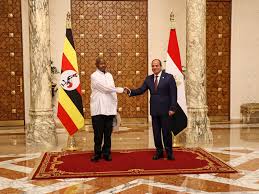
Ugandan President Yoweri Museveni and Egyptian President Abdel Fattah El-Sisi have reaffirmed their nations’ commitment to strengthening ties, placing the River Nile at the heart of a renewed vision for regional cooperation and shared prosperity.
The two leaders addressed a joint press conference in Cairo on Tuesday, August 12, 2025, during the second day of President Museveni’s three-day working visit, held at the invitation of President El-Sisi.
President Museveni began by reflecting on the deep geographical and political bonds linking Uganda and Egypt.

“Uganda and the Great Lakes region are linked to Egypt by the Nile from ancient times. Politically, our closeness began in 1952 when President Nasser took leadership here,” he said.
“Before that, we had little contact, but Nasser, as an Africanist, worked closely with our leaders, Julius Nyerere, Kwame Nkrumah, and supported the anti-colonial movement,” he added. “When we came into government, we started working with the leaders at that time.”
He urged a broader vision in approaching the Nile’s future.
“Sometimes, the problem is the approach. Instead of limiting ourselves to historical rights, we should focus on the global needs of all Nile Basin countries,” he said.
“Prosperity for all, electricity for all, irrigation for all, and clean drinking water for all. If we include these in our framework, we can then use the most scientific and fair methods to achieve them,” President Museveni noted.
He dismissed the perception of Uganda as landlocked, highlighting the natural connection to the Mediterranean via the Nile.
“If there were no problems in Sudan, we would not be called landlocked. We are connected to Egypt because of the Nile.”
On bilateral relations, President Museveni commended Egypt’s recent assistance in supplying foot-and-mouth disease vaccines and welcomed plans to establish a vaccine factory in Uganda.
“I am very happy about that,” he said, emphasizing that trade and production must drive Africa’s progress.
“Business is about two things, producing a good or service, and someone buying it. If leaders don’t understand this, there can be no prosperity. If you buy what I produce, you are supporting me, and vice versa. That’s why I am glad His Excellency is emphasizing business. Together, we will see how to produce, trade, create jobs, and develop electricity and irrigation for our people.”
He also warned African nations against overreliance on European markets.
“Some African countries made the mistake of focusing on trading only with Europe, but that’s risky; they can block you at any time. Why can’t we trade more among ourselves?” he asked.
The two leaders also addressed regional security challenges, including the crises in Libya, Sudan, and Palestine, with President Museveni calling for dialogue and peaceful solutions.
President El-Sisi reaffirmed Egypt’s commitment to the shared destiny of Nile Basin nations.
“The Nile binds us together. The bilateral ties between our two countries have recently witnessed growing cooperation, and I look forward to more partnerships,” he said.
He outlined areas of ongoing collaboration, including water management, agriculture, veterinary disease control, natural resource development, and energy.
He emphasized that Egypt will protect the Nile under international law while supporting development in other Basin countries.
“Egypt has no other water source; we don’t have rainfall. The Nile is life for us. We are not against development in any Basin country, but we call for equitable sharing of water resources. We must coexist and ensure that development does not harm the people who depend entirely on this river,” President El-Sisi stated.
He explained that the Nile carries over 160 billion cubic meters of water annually, with 85 billion cubic meters coming from the Blue Nile, much of it used for agriculture.
“This is why water is extremely critical for Egypt. Our people are deeply concerned about it, and we trust Uganda’s role in fostering agreements among Basin countries.”
President El-Sisi concluded by expressing appreciation to President Museveni.
“I thank President Museveni and welcome him to Egypt. Our discussions have demonstrated great understanding and a shared vision for the future.”
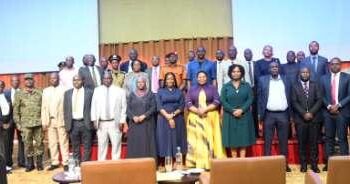
Earlier in the day, Uganda and Egypt signed a series of landmark Memoranda of Understanding (MOUs) covering trade, investment, agriculture, water management, and community development.
Uganda’s Minister of Internal Affairs, Maj. Gen. (Rtd) Kahinda Otafiire, and Egypt’s Minister of Foreign Affairs, Emigration, and Expatriates, Dr. Badr Abdelatty, signed the first agreement to deepen cooperation in governance, security, and diplomacy.
Uganda’s Minister of State for Foreign Affairs, Hon. Henry Okello Oryem, signed a separate cooperation framework with Dr. Abdelatty, focusing on political dialogue and regional coordination.
Hon. Alice Kaboyo, Uganda’s Minister of State for Luwero Triangle and Rwenzori Region, joined Egypt’s Minister of Agriculture and Land Reclamation, Hon. Alaa Farouk, to formalize agricultural technology transfer, land reclamation, and rural development partnerships.
Economic cooperation took center stage as Uganda’s Finance Minister, Hon. Matia Kasaija, and Egypt’s Minister of Investment and Foreign Trade, Hon. Hassan El Khatib, pledged to boost trade, investment, and joint ventures.
Water and environmental protection were also prioritized, with Uganda’s Minister of State for Water and Environment, Hon. Beatrice Anywar, and Egypt’s Minister of Water Resources and Irrigation, Prof. Dr. Hani Sewilam, agreeing to strengthen collaboration in irrigation development, resource management, and ecological sustainability.