
















President Yoweri Kaguta Museveni has reaffirmed Uganda’s commitment to partnering with regional investors, assuring a Nairobi-based investment firm of government support in key infrastructure projects that will accelerate economic transformation.
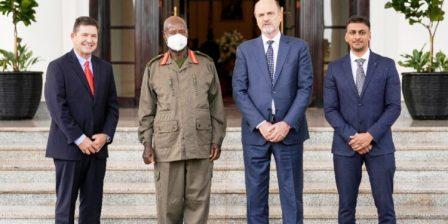
The President made the remarks yesterday at State House, Entebbe, where he hosted a delegation from Rebel Group, an international consultancy and investment firm headquartered in Nairobi, Kenya.
The team was led by Mr. Kyle McCarter, the former United States Ambassador to Kenya, who expressed the firm’s interest in establishing investments in Uganda.

President Museveni warmly welcomed the group and explained that Uganda’s economic environment is ripe for investors seeking long-term, sustainable ventures.
“We can start with infrastructure such as the Kampala–Bombo toll road and the Mpigi bridge. These projects are linked directly to the market and the consumers. As long as the consumers are there, the flow of money will not stop. That is why such investments are sustainable. They create jobs, put money in people’s pockets, and stimulate further spending,” he said.
Reflecting on Uganda’s economic history, President Museveni pointed out that poor policies after independence discouraged investors and slowed the country’s development.
“We lost a lot of time after independence because of policies that were not private sector–friendly. Confiscating private property was a strategic mistake,” he said.
The President stressed that lessons from the past informed the policies adopted by his government when it came into leadership in the 1980s.
“But when we came into leadership in the 1980s. We were clear, We had studied the mistakes of the past, and we had the credibility to say no, we are independent and we are not agents of anyone. If you want true independence, you must create wealth so that you don’t depend on anybody,” he explained.
He outlined Uganda’s economic transformation strategy, which is anchored on four pillars designed to expand opportunities for citizens and attract foreign investors.
“Our first pillar is commercial agriculture, where land must be used productively beyond subsistence farming. The second pillar is manufacturing, which focuses on adding value to our raw materials such as coffee, cotton, copper, and timber,” he said.
“The third area is services, including tourism, hospitality, entertainment, and related sectors, the fourth pillar is ICT, where we must harness technology to drive growth. Everyone must be involved in producing either a good or a service, whether as an owner or as an employee. That is the foundation of wealth,” he added.
The President emphasized that infrastructure investment not only benefits Uganda but is also critical in expanding regional trade within the framework of the African Continental Free Trade Area (AfCFTA).
“This is why I have been advising investors to look at Africa seriously. The Chinese have already seen the potential and are coming in big numbers. But there is even more space for others to participate. Infrastructure such as roads linking Uganda to Rwanda and Congo will not only serve Uganda but the entire region. That is where the real business is,” he said.
Speaking on behalf of Rebel Group, financial consultant Mr. Prashiv Shah commended President Museveni’s vision and pledged that the firm is ready to work with Uganda in multiple sectors.
“In Kenya, we are already combining infrastructure with real estate development, but we are willing to come to Uganda not just for infrastructure but for many other sectors as well. We totally agree with your vision, and we are ready to explore opportunities here. This is a new time for building investments, and we are glad to meet you,” he said.
The discussions between the Ugandan government and Rebel Group signaled a stronger push toward regional partnerships aimed at boosting economic resilience, creating employment, and enhancing connectivity across East Africa.
Looking ahead, analysts note that Uganda’s openness to regional investors could significantly shape the country’s economic trajectory over the next decade.
With infrastructure serving as the backbone of trade and integration, partnerships with firms like Rebel Group are expected to unlock new markets, enhance competitiveness, and position Uganda as a central hub for commerce within the East African Community and the wider African Continental Free Trade Area.