
















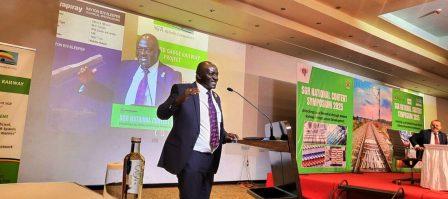
Uganda has placed local empowerment at the center of its €2.7 billion (Shs4.3 trillion) Standard Gauge Railway (SGR) project following the inaugural National Content Symposium held on August 29 at Speke Resort Munyonyo.
The symposium, organized by the Ministry of Works and Transport, brought together policymakers, contractors, and local suppliers to discuss how Ugandans will directly benefit from the 273-kilometer Malaba–Kampala railway line.
Delegates agreed on a bold target of achieving at least 40 percent local content in the project.

This commitment is expected to generate thousands of jobs, create opportunities for skills transfer, and promote economic inclusion as Uganda undertakes one of its largest infrastructure ventures.
Works and Transport Minister, Gen. Edward Katumba Wamala, officially opened the meeting and described the railway as central to Uganda’s economic transformation.
He emphasized that the project represents more than just transport, but a foundation for sustainable growth.
“The SGR is the backbone of a modern economy, one track at a time,” Gen. Katumba declared.
He reaffirmed government’s determination to position Uganda as a leader in East Africa’s infrastructure development while ensuring that international standards are upheld.
State Minister for Works, Musa Ecweru, reinforced the message by calling for nationwide participation and ownership of the project.
“The SGR is not just a transport initiative—it’s a national commitment to inclusion, excellence, and delivery. Every Ugandan deserves to be informed, involved, and empowered,” Ecweru stated.
Contractor Yapi Merkezi led panel discussions on how Ugandan firms and workers can take part in the project.
These discussions highlighted opportunities in technical training, regulatory guidance, and supplier participation.
Officials noted that beyond jobs, the project will lower transport costs, facilitate regional trade with Kenya, and improve Uganda’s competitiveness in the East African market.
Government leaders also framed the SGR as a model for future mega-projects that prioritize local industries and firms.
By placing Ugandans at the center, the initiative is expected to stimulate small and medium enterprises, reduce unemployment, and drive GDP growth.
Despite optimism, participants acknowledged several challenges, including limited capacity among local contractors and gaps in access to information.
Officials, however, pledged to overcome these obstacles through transparency and training programs aimed at preparing Ugandans for full participation.
The SGR is increasingly seen as more than a railway—it is a blueprint for Uganda’s economic independence and a platform for youth and business empowerment.
As Gen. Katumba emphasized, the measure of success will not only be trains on the tracks, but the number of Ugandans equipped to take part in building their nation.
“The SGR is no longer a dream but a reality in motion,” he said. “Its true legacy will be in Ugandans empowered to build their own development journey.”