















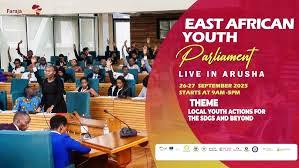
The curtains have closed on the Eighth East African Youth Parliament in Arusha, leaving behind powerful calls for courage, humility, unity, and concrete action.
For two days, young leaders from across the region reflected on their responsibilities in deepening integration, strengthening governance, and building peace within the East African Community.
The gathering was held on September 26 and 27, 2025, under the theme *“Local Youth Actions for the Sustainable Development Goals (SDGs) and Beyond.”*

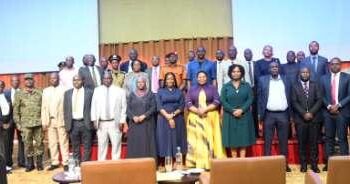
Eighty representatives drawn from Uganda, Kenya, Tanzania, Somalia, South Sudan, Rwanda, Burundi, and the Democratic Republic of Congo (DRC) convened at the East African Legislative Assembly (EALA).
The Clerk of EALA, Alex Obatre, opened the session with a challenge to the delegates to move beyond symbolism and deliver tangible outcomes.
“You have set yourselves targets. You are going to deliberate on this. You come up with recommendations. Where will those recommendations end?” he asked.
“I urge that we move from discussions to communiqués, and these communiqués are pursued to parliaments and to EALA… What standardized documents can we produce from these eight parliaments which we can simultaneously present to all our legislatures?” he added.
He underlined that such communiqués would measure the true impact of the Youth Parliament on regional policy.
“In that way, we will be able to follow whether our resolutions are sinking down, making their way onto the agenda of national parliaments,” he emphasized.
From the very start, the tone was set for a parliament that demanded seriousness, accountability, and vision.
Erik van der Zanden of the Sankara Peace Foundation reminded participants that genuine leadership requires balance.
“The most important attribute of any leader is courage. But courage without humility leads to downfall. If we train ourselves to be humble and courageous, destiny ensures we become great leaders,” he said.
The discussion of inclusion was brought into focus by Stella Nansamba of Akina Mama Wa Africa (AMwA).
She reminded the assembly that youth and women’s involvement in decision-making is not a concession but a fundamental right.
“Effective youth participation is about creating avenues for young people to influence, shape, design, and contribute to policy. Women’s and youths’ meaningful involvement ensures accountability, strengthens democracy, and builds resilience in societies facing numerous crises,” she said.
Her words echoed the urgency for inclusivity in regional processes that often overlook young voices.
Elijah Tipango of the East African Youth Network told delegates to reject tokenism.
“We gather here not as representatives of our countries, but as custodians of our shared dream. You are not here just for photos. We are not the leaders of tomorrow; we are the leaders of today… Any table without a youth, we shall bring this table,” he declared.
The message was clear — youth must be at the heart of decisions shaping the Community’s future.
David Ivan Masajjage, Assistant Director of Communications and Public Affairs at the Parliament of Uganda, urged participants to take advantage of such forums to transform their own lives.
Other speakers carried the same spirit.
Philip Nabyama from the Parliament of Uganda stressed the legislative role of young leaders.
Edmund Akoto of the Kofi Annan International Peacekeeping Training Centre in Ghana added that eloquence without substance does little to change societies.
Representing Faraja Africa Foundation, Joseph Munyangabo encouraged the youth to wield their power responsibly.
He urged them to speak with substance, lead with courage, debate with integrity, and legislate with vision.
The plenary quickly transitioned into business, where delegates debated and passed critical motions.
Uganda’s Ivan Ahurra introduced the first motion, seconded by Ivan Lakisa, calling for the protection of digital rights across the East African Community.
The motion highlighted restrictions on freedom of expression, frequent social media shutdowns, and the high cost of roaming as challenges to young people.
Rwanda’s Jean Felix Rugongo presented another motion that pressed the EAC to operationalize youth participation in the African Continental Free Trade Area (AfCFTA).
The Youth Parliament also adopted a resolution urging governments to strengthen sexual and reproductive health and rights for adolescents and young people, committing to break down barriers that limit access.
Another resolution targeted education, calling for stronger systems that ensure equity, quality, and wider opportunities across all member states.
The house went further to emphasize youth participation in economic development and governance, acknowledging the centrality of young people in shaping regional growth.
Peace and security also featured prominently, with delegates passing a motion to enhance youth-led cross-border cooperation and integration.
At the close of the sitting, Speaker of EALA, Rt. Hon. Joseph Ntakirutimana, offered both caution and encouragement.
“You still have a long way to go… If you do not rise up, if you do not address issues, you get nothing from me,” he said.
Drawing on decades of political experience, he warned the youth about the dangers of clinging to power.
“Some are 90, even 100. Some cannot even walk, but it’s a fact they stay there,” he observed.
He advised delegates to be bold but strategic in their struggle for change.
“Please… fight, but in the way that you remain alive… Use your mind, your brain,” he said.
Yet he ended with reassurance, noting that the older generation is ready to make way for the new.
“We love you. We want you to grow and replace us. And we will always open our doors to you,” he concluded.
The East African Youth Parliament, established in 2017, has grown into a respected platform for amplifying young voices on governance, peace, and development.
This year’s session was supported by the Faraja Africa Foundation, the Parliament of Uganda, EALA, AMwA, and other partners.
As delegates left Arusha, they carried with them the responsibility to ensure that their unity, resolutions, and energy do not remain on paper but are translated into action across East Africa.