



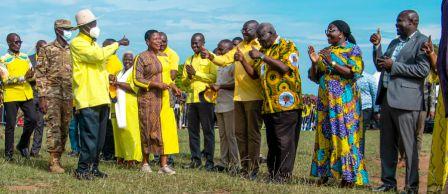
President Yoweri Kaguta Museveni, the National Resistance Movement (NRM) presidential flagbearer in the forthcoming 2026 General Election, intensified his campaign trail across the Lango subregion with massive rallies in Alebtong and Otuke districts.
At Orum Primary School grounds in Otuke, thousands of enthusiastic supporters gathered to hear the Head of State outline his vision for Uganda’s future. The President painted a picture of a country on the verge of an economic breakthrough, driven by the long-awaited oil revenues expected in 2026.
He assured the cheering crowd that Uganda’s oil wealth would be channeled towards transforming critical infrastructure, improving schools, and expanding electricity coverage rather than being wasted on luxury imports.

“Under my government, oil money will never be used to import whisky and wigs from China or perfumes and such things,” President Museveni declared, drawing laughter and applause.
“That oil money will help us transform infrastructure—roads, railways, electricity, and some of the schools,” he added firmly.
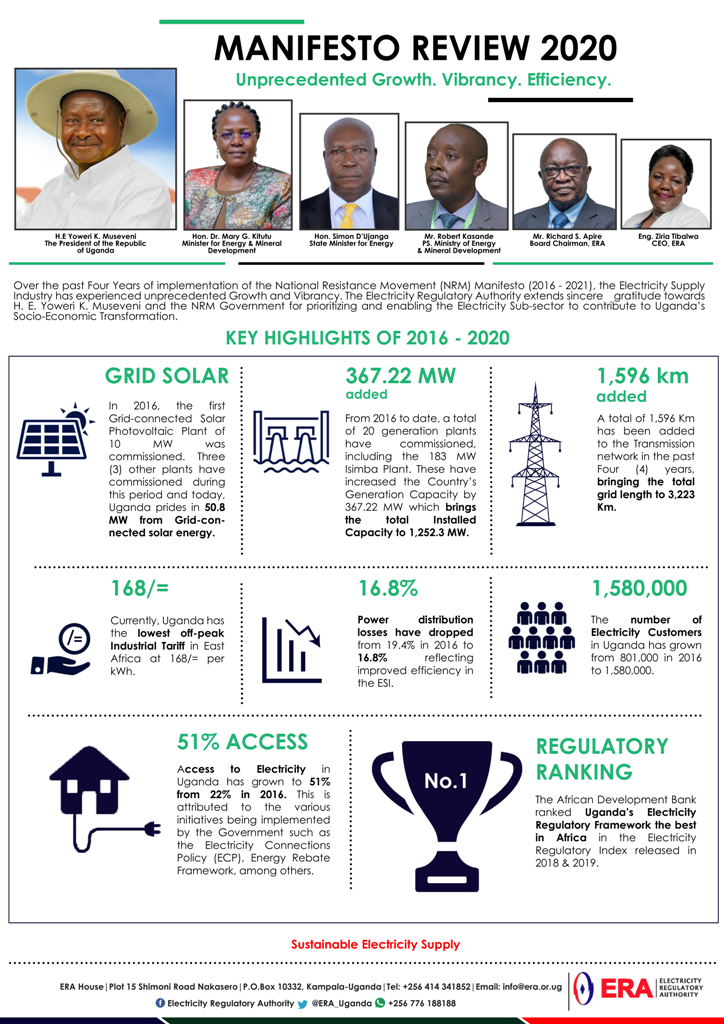
The President acknowledged the visible progress made in rural electrification, noting that even in Otuke, once isolated, electricity lines now stretched across the countryside.
“We have done quite a bit on the issue of electricity. This part had no electricity, but I can see the wires now,” Museveni observed.
Turning to the road network, however, he admitted that more needed to be done. He cited the Lira–Aloi–Patongo–Abim road as one of the critical routes still in poor condition.
“That road must be tarmacked, and we shall tarmac it,” the President pledged.
He explained that delays in infrastructure development had been due to competing priorities, especially during Uganda’s wars against insurgencies.
“Some people may say we have delayed, but the delay was because we had many things to deal with. Remember, the money we were spending on the army to fight Kony would have been used for this work. Fortunately, NRM is here, and now with petroleum coming, it will be quicker and easier,” he assured.
He pointed to the Tororo–Mbale–Soroti–Dokolo road, the Rwenkunyu–Apac–Lira Road, and the Kitgum connection as examples of completed projects achieved even without oil revenue. With petroleum money, he promised, more roadworks would be prioritized, including Soroti–Amuria–Obaranga–Otuke.
“We are going to stop the indiscipline of starting things and not completing them. Soon you will see machines working on these roads with good murram as we wait for tarmacking,” he emphasized.
Focus on Wealth Creation and Household Income
Shifting focus from infrastructure, President Museveni warned that development alone would not eradicate poverty unless households improved their incomes.
“Even if you tarmac the road, are you going to sleep on the road at night?” he asked, to the amusement of the crowd. “You will go back to your home and find the poverty you left in the morning waiting for you.”
The President revisited his long-standing campaign for modernized farming, reminding the people that since the 1960s, he had mobilized Ugandans to abandon subsistence farming in favor of commercial production.
He recalled that by 1995, he had already demonstrated practical ways to eliminate rural poverty, which were later enshrined in the NRM’s 1996 manifesto through the “Four-Acre Model.”
Using giant screens, Museveni showcased testimonies of farmers who had transformed their livelihoods by following NRM advice.
He cited the story of Engineer Okello from Amolatar, who invested in livestock and earned UGX 480 million in net profits. He also highlighted the case of Opio Vicky from Lira, who started with UGX 1 million from the Parish Development Model (PDM) and grew into a successful farmer selling produce to South Sudan.
Another example was Rose from Oyam, who used UGX 1 million in PDM funds to buy piglets and goats, eventually turning them into a thriving enterprise.
“All they did was to listen to the NRM advice,” Museveni stressed.
He urged Ugandans to embrace programs like PDM, Emyooga, and the GROW initiative for women to break the chains of poverty.
The President announced plans to inject an additional UGX 15 million per parish specifically for local leaders, since the existing UGX 100 million revolving fund excluded them.
“So, I appeal to you, please, defend this PDM. Don’t allow thieves to steal your money. We must finish those thieves,” he warned.
He also promised a graduate support fund for university students struggling to find employment after two years of graduation, citing the high burden on parents who pay tuition through private sponsorship.
“In Kampala, we have already started with ghetto youths, boda boda riders, taxi operators, and roadside vendors. After elections, we shall expand further,” he revealed.
Cattle Compensation and Healing Historical Wounds
Museveni also addressed the issue of cattle compensation for families in Lango, Teso, and Acholi who lost their herds during conflicts and insurgencies.
“Recently, I came and consulted you to have a new approach of giving each household 5 cows each,” he said.
“While some people had some reservations about this idea, the wananchi voiced their support, saying that Museveni is right. I have now got reports from Ateso and Lango—they’re all supportive. I’m waiting for Acholi, but I have already instructed the government to start planning for it. We may not do it at once, but with time we shall complete the process.”
Celebrating Peace in Otuke
Reflecting on Otuke’s history, the President reminded residents of the struggles they had endured.
“When I came into government in 1986, this area was in endless struggle with rebels and cattle rustling,” he recalled. “We disarmed the rustlers, fought Lakwena, fought Kony and Otti, and brought peace here.”
He noted that Otuke once hosted the NRM war headquarters at Barlege camp, from where operations against the Lord’s Resistance Army were coordinated.
“Today, we celebrate peace. Nobody can disturb it. I am glad to be back in Orum when it is peaceful,” Museveni said proudly.
Voices of Support from NRM Leaders
The President’s message was echoed by senior NRM officials present at the rally.
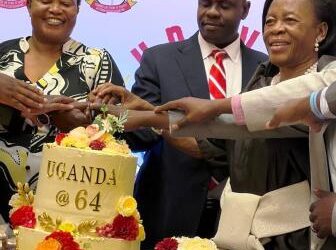
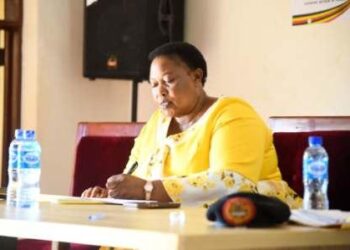
Speaker of Parliament Anita Among reassured residents that the NRM government would address their concerns.
“The people of Otuke are very happy that you got them out of the camps. They are not going to join a protest vote because you are going to improve their roads, increase PDM money, and bring more development,” she said.
Vice President Jessica Alupo urged the people to safeguard peace and progress by continuing to support Museveni and the NRM.
Government Chief Whip Denis Hamson Obua reminded the crowd of Otuke’s historical importance.
“This was once the gateway to all insecurities—cattle rustling, LRA insurgency. You camped here and brought peace. Now we have sustainable peace in the whole of Lango,” he said.
Otuke County MP Julius Acon Bua, also the NRM district chairperson, promised overwhelming electoral support.
“We have peace in Lango. We hope to give you 90% of the votes in 2026,” he assured.
Other senior leaders, including NRM Secretary General Richard Todwong, ministers, MPs, and Central Executive Committee (CEC) members, joined the rally to underscore the campaign’s significance.
Looking Ahead to 2026
The rallies in Otuke and Alebtong followed Museveni’s earlier launches in Amolatar and Dokolo, where he presented the NRM’s 2026–2031 manifesto under the theme: “Protecting the gains as we make a qualitative leap into a high middle-income status.”
In Otuke, the President urged voters not only to re-elect him but also to support all NRM candidates at every level to ensure smooth policy implementation.
“With all these ideas and plans, I am here with the leaders of NRM to ask you to vote for NRM, vote for all NRM flagbearers, and you can be sure of whatever we have talked about,” Museveni concluded.
The President’s campaign trail in Lango continues on Friday, with rallies scheduled in Kwania and Apac districts.