













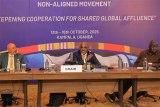
Uganda has called on members of the Non-Aligned Movement (NAM) to take a more assertive role in shaping a fairer and more inclusive global system, as the country’s Foreign Affairs Minister, Gen Jeje Odongo, opened the NAM 19th Midterm Ministerial Meeting in Kampala.
The high-level gathering, held at Speke Resort Munyonyo, brings together foreign ministers and representatives from member states to review progress made since Uganda hosted the 19th NAM Summit in January last year.
Opening the meeting, Gen Odongo underscored Uganda’s dedication to strengthening NAM’s voice in international affairs and its commitment to advancing the shared goals of developing nations.
“As Chair of the Non-Aligned Movement Coordinating Bureau, Uganda remains steadfast in upholding the Movement’s principled positions and in promoting the collective interests of our Member States on the global stage,” he said.
He pledged that Uganda would continue steering NAM toward unity, revitalization, and greater influence in global decision-making.
“We are fully committed to revitalizing NAM, reinforcing its unity and solidarity, and ensuring that our voice continues to influence international dialogue and decision-making,” Odongo told the delegates.
The minister positioned NAM not merely as an observer of world politics, but as a key platform through which developing countries can advocate for justice, peace, and equality.
He reaffirmed that the Palestinian question remains a moral and political cornerstone of the Movement’s mission.
“Our long-standing, principled positions on this matter, carefully developed over the past six decades, must be preserved, defended, and advanced,” he asserted.
He stressed that NAM must continue pushing for justice for the Palestinian people through active participation in global forums, particularly the United Nations, to enforce international and humanitarian law.
“This includes continued engagement in relevant fora, particularly within the United Nations system, and concerted efforts to uphold international law, including international humanitarian law, and implement relevant UN resolutions,” Odongo explained.
Calling for an end to all forms of domination and occupation, Gen Odongo urged the Movement to maintain unwavering solidarity with Palestine.
“We must persist in our support to end all forms of colonialism, oppression, occupation, domination, and apartheid in the occupied Palestinian territory,” he said.
While welcoming recent diplomatic initiatives and ceasefire efforts, Odongo noted that they only offer short-term relief unless backed by concrete humanitarian and political progress.
“The recent diplomatic efforts and ceasefire offer a momentary respite from the harrowing images of the past two years. However, sustained focus is urgently needed on the delivery of humanitarian assistance and on advancing practical steps towards the implementation of the Two-State Solution,” he emphasized.
Beyond political issues, the minister called for NAM to reassert itself economically by boosting South–South cooperation and reducing dependence on traditional global powers.
He observed that developing countries continue to face obstacles such as restrictive trade systems and limited access to technology and financing.
“The global trading system is becoming increasingly restrictive, with tariff and non-tariff barriers continuing to deny our countries a fair share of international trade,” Odongo noted.
“These challenges are compounded by the growing technological divide, which hampers our industrial development and capacity for value addition,” he added.
However, Gen Odongo pointed to the growing strength of trade among developing nations as evidence that NAM can redefine global economic partnerships.
Citing UNCTAD data, he highlighted that South–South merchandise trade expanded from US$0.6 trillion in 1995 to US$5 trillion in 2017, and more than doubled from $2.3 trillion to $5.6 trillion between 2007 and 2023.
“This trend presents new opportunities for developing countries to reduce dependency on traditional partners, enhance regional integration, and secure more favourable trade and financing terms,” he said.
He noted, however, that much of this trade occurs within Asia, urging for stronger interregional collaboration to ensure that Africa, Latin America, and the Caribbean also benefit fully.
“Nonetheless, the full potential of South–South trade remains untapped—particularly in interregional exchanges. Currently, the majority of South–South trade is intra-Asian. Strengthening interregional cooperation among Asia, Africa, Latin America, and the Caribbean will be critical to unlocking new avenues for economic growth and mutual benefit,” he explained.
By the close of his address, Gen Odongo had set a clear agenda for the Kampala meeting — one focused on amplifying the collective voice of developing nations, defending principles of justice, and advancing shared prosperity through cooperation and solidarity.
Through Uganda’s leadership, the Non-Aligned Movement is being urged to reclaim its role as a moral force and a practical advocate for a more balanced world order that leaves no nation behind.