
















Uganda and Bangladesh have taken a significant step towards strengthening their diplomatic and cooperative relations.
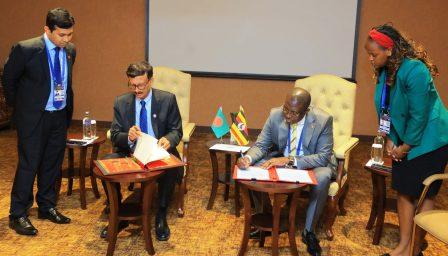
On the sidelines of the 19th Non-Aligned Movement (NAM) Ministerial Review Conference, held yesterday afternoon, the Ministry of Foreign Affairs of the Republic of Uganda and the Ministry of Foreign Affairs of the People’s Republic of Bangladesh signed a Memorandum of Understanding (MoU) on Bilateral Consultations.
The MoU represents a mutual commitment to enhance friendly cooperation between the two nations and to foster collaboration across multiple sectors.

Its primary objective is to expand bilateral cooperation in key areas, including political, economic, cultural, and educational engagements, while also facilitating regular dialogue on regional and international issues of mutual interest.
Speaking on behalf of Uganda, Hon. John Mulimba, Minister of State for Regional Affairs, highlighted that the MoU provides a structured platform for the two countries to engage in periodic consultations.
“This agreement allows our nations to exchange views and coordinate on matters of regional and global significance,” Hon. Mulimba said.
The MoU stipulates that consultations will be conducted at least once every two years, alternating between Dhaka and Kampala.
It also allows for meetings to take place at international venues such as the United Nations Headquarters in New York, Geneva, or any other forum agreed upon through diplomatic channels.
H.E. Touhid Hossain, Foreign Advisor for Foreign Affairs of the People’s Republic of Bangladesh, underscored the importance of regular diplomatic engagement in building trust and deepening mutual understanding between the two countries.
“This framework ensures that Uganda and Bangladesh will continue to strengthen their relations through structured dialogue, promoting cooperation in areas of common interest,” H.E. Hossain said.
The signing of the MoU reflects the broader trend of South-South cooperation, as both Uganda and Bangladesh seek to leverage their shared experiences in development, trade, and international diplomacy.
This agreement is expected to pave the way for joint initiatives in trade facilitation, educational exchange programs, cultural collaboration, and coordinated approaches to regional peace and security challenges.
According to diplomats, the MoU also serves as a formal mechanism for the two countries to share perspectives on pressing global issues, including climate change, sustainable development, and economic resilience.
The initiative demonstrates Uganda’s ongoing commitment to strengthening strategic partnerships beyond its immediate regional context.
Similarly, Bangladesh views the MoU as a stepping stone towards expanding its diplomatic footprint in Africa while learning from Uganda’s experiences in regional integration and development planning.
The signing ceremony, attended by senior diplomats and officials from both countries, marked a milestone in Uganda-Bangladesh relations, reinforcing a shared vision of cooperation and mutual benefit.
By institutionalizing regular consultations, both nations are set to create a sustainable framework for dialogue and collaboration that will extend into political, economic, cultural, and educational sectors.
This MoU not only strengthens bilateral ties but also positions Uganda and Bangladesh as proactive players in fostering South-South cooperation in global diplomacy.