














Members of Parliament have issued a strong call to government to urgently strengthen and enforce Uganda’s road safety policies following a string of fatal crashes that have claimed hundreds of lives in recent months.
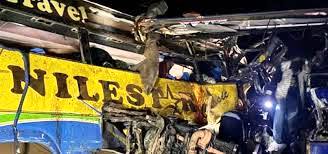
The appeal follows the horrific road accident along the Kampala–Gulu highway on October 22, 2025, which left 46 people dead in what authorities have described as one of the deadliest transport tragedies in recent years.
Lawmakers said the latest incident should serve as a national wake-up call, exposing long-standing weaknesses in road management, enforcement, and regulation that continue to make Uganda’s roads among the most dangerous in East Africa.

Chairing the plenary sitting on Tuesday, October 28, 2025, Deputy Speaker Thomas Tayebwa condemned the growing recklessness among drivers of heavy trucks, accusing many of them of operating with total impunity and disregard for human life.
“I was nearly crushed by a Sino truck driver; he came for me and hit the car behind me, thereafter parked and ran away. We talked to the owners, but they were arrogant. They think people should get off the road for them. These trucks carrying sand and cows will finish people,” Tayebwa said.
The Deputy Speaker noted that the increasing number of overloaded trucks and poorly maintained heavy vehicles on major highways has contributed significantly to road damage and rising fatalities.
He urged the Ministry of Works and Transport to intensify regulation of large vehicles and ensure accountability for errant drivers.
Buhweju County MP, Francis Mwijukye, expressed concern over the destruction of rural roads and bridges caused by overloaded trucks that exceed permissible weight limits.
He appealed to government to empower local governments to develop and enforce bylaws restricting the movement of heavy trucks in vulnerable areas.
“These heavy trucks have destroyed almost all bridges in our villages. In my constituency alone, they have so far spoilt five bridges. The ministry should find a way of getting districts to come up with bylaws on how to regulate the trucks,” Mwijukye said.
Wakiso District Woman MP, Ethel Naluyima, blamed the absence of proper road signage at known black spots for the rising number of fatal accidents.
She urged the Ministry of Works and Transport to undertake a comprehensive nationwide road safety audit and mark all high-risk areas with clear warning signs.
She said the failure to put in place visible and standardized road signage continues to endanger lives, particularly along major highways and rural feeder roads.
Legislators also proposed that government introduces a strict penalty system for repeat traffic offenders, including a mechanism to track the driving permits of individuals with multiple offenses.
They said creating a clear database of high-risk drivers would enable authorities to suspend or revoke permits before accidents occur.
In a related appeal, Elderly Persons’ Representative, Joy Waako, called for the immediate enforcement of the policy requiring all long-distance passenger buses to deploy two drivers per route.
She said the regulation would help reduce fatigue-related crashes, which often increase during the festive season.
“We are entering the festive season and government should take precaution. People drive at terrific speeds because the more journeys drivers make, the more money they are paid. For long journeys let us enforce the policy that each bus carrying passengers should deploy two drivers,” Waako said.
The legislators urged the Ministry of Works and Transport to work closely with the Uganda Police, the Uganda National Roads Authority (UNRA), and local governments to harmonize road safety enforcement and close regulatory loopholes that allow reckless drivers to escape punishment.
They also called for more funding for road maintenance, improved inspection of public service vehicles, and modernization of road monitoring technology such as speed cameras, traffic sensors, and vehicle tracking systems.
Uganda continues to grapple with alarming road safety statistics. According to the Uganda Police Annual Crime Report (2024), the country registered 25,107 road traffic accidents, representing a 6.4 percent increase from 2023.
Out of these, thousands involved motorcycles, buses, and trucks—often linked to speeding, overloading, driver fatigue, and poor mechanical conditions.
Experts attribute the trend to inadequate driver training, poor road infrastructure, and limited enforcement of safety standards.
Many vehicles, especially trucks and commuter taxis, operate without regular inspection, while enforcement officers often lack the resources and manpower to ensure compliance.
Uganda’s road safety framework is guided by the National Road Safety Policy (2017), which emphasizes multi-sectoral coordination among key agencies.
However, implementation has been slow due to budget constraints and limited institutional capacity.
Civil society organizations have long advocated for the establishment of an autonomous National Road Safety Authority to coordinate education, enforcement, and research — a proposal Parliament is once again pushing for in light of the Kampala–Gulu tragedy.
As Parliament debates new interventions, the victims’ families continue to mourn, and Ugandans remain anxious about the dangers that await them each time they travel.
Lawmakers say the time for routine condolences is over — what the country now needs is action, accountability, and a sustained commitment to safer roads for all.