
















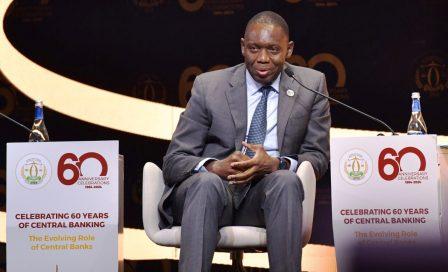
Bank of Uganda (BoU) Governor Dr. Michael Atingi-Ego has been awarded an impressive A– rating in the 2025 Global Finance Central Banker Report Cards, placing him among Africa’s most trusted and effective monetary policymakers.
The recognition marks a major milestone for Uganda’s central bank, which continues to gain international respect for its disciplined approach to economic management under Atingi-Ego’s stewardship.
The Global Finance report which is an annual publication that evaluates central bankers across the world, scores leaders on their success in controlling inflation, maintaining currency stability, fostering growth, and promoting transparency.

Uganda’s inclusion among the top-ranked African economies underscores the country’s growing credibility within the global financial community and highlights the steady hand guiding its central bank through a challenging regional environment.
A Technocrat Turned Stabilizer
Appointed Governor of the Bank of Uganda in February 2025 after serving four years as Deputy Governor, Dr. Atingi-Ego assumed office at a critical time.
The country was emerging from the ripple effects of global inflationary pressures, foreign exchange volatility, and post-pandemic recovery strains.
Since taking the helm, Atingi-Ego has demonstrated a calm, data-driven leadership style that prioritizes economic stability and long-term growth. His tenure has been marked by cautious but decisive monetary policies that balance inflation control with credit expansion and private-sector growth.
Uganda’s economy is projected to expand by 6.5 percent in 2025, according to recent forecasts by both the BoU and the Ministry of Finance.
Private-sector lending has improved, while non-performing loans have fallen—an indication of rising confidence in Uganda’s banking sector and improved risk management by financial institutions.
Commitment to Stability and Growth
In August 2025, the BoU’s Monetary Policy Committee maintained the Central Bank Rate (CBR) at 9.75 percent, signaling confidence in the prevailing economic trajectory. Speaking to The Observer shortly afterward, Dr. Atingi-Ego reaffirmed the institution’s focus on safeguarding Ugandans from the impact of global price shocks while encouraging domestic investment and trade.
“Our aim,” he said, “is to shield households from external shocks while supporting investment and trade.”
That philosophy has helped anchor Uganda’s economy amid external headwinds. Inflation, which edged up slightly to 3.8 percent in July, remains among the lowest in the East African Community (EAC).
Meanwhile, the Ugandan shilling has earned international recognition for its relative stability—ranking among Africa’s most resilient currencies according to multiple economic analyses.
Uganda Back in World Bank’s Good Books
Uganda’s growing reputation for sound fiscal management received a further boost when the World Bank lifted its two-year lending suspension, citing improved governance, fiscal reforms, and stronger institutional oversight.
For Uganda, the decision represents not just renewed financial access but also global confidence in the BoU’s macroeconomic direction.
The move is expected to support key infrastructure projects and expand social sector financing, fueling further economic activity.
For borrowers and investors, this development promises a more predictable financial environment, characterized by stable prices, lower borrowing costs, and easier access to credit—conditions that are crucial for private-sector growth and employment creation.
Standing Tall Among Regional Peers
Within the East African region, Dr. Atingi-Ego’s performance places Uganda at the forefront of monetary excellence.
Kenya’s Dr. Kamau Thugge also earned an A grade, maintaining a 9.5 percent policy rate as the Kenyan economy grew by about 5.2 percent.
Tanzania’s Emmanuel Tutuba received a B rating amid stable 6 percent growth, while Rwanda’s new central bank governor Soraya Hakuziyaremye continues to find her footing in office.
In contrast, Ethiopia’s Eyob Tekalign has faced persistent challenges, battling double-digit inflation and ongoing foreign exchange constraints.
These comparative rankings reflect the distinct stability of Uganda’s macroeconomic landscape, which analysts attribute to Atingi-Ego’s balanced mix of prudence, policy clarity, and communication transparency.
Championing Digital Inclusion and SME Growth
Beyond macroeconomic policy, Dr. Atingi-Ego has made financial inclusion a central pillar of his leadership. Under his direction, the BoU has championed digital payments adoption, bringing millions of Ugandans—particularly in rural areas—closer to formal financial services.
He has consistently emphasized that economic growth must translate into real gains for ordinary households.
Through partnerships with commercial banks and fintech innovators, the BoU has sought to enhance access to credit for small and medium-sized enterprises (SMEs), recognizing their role as the backbone of Uganda’s employment and innovation ecosystem.
Driving Regional Financial Integration
Dr. Atingi-Ego has also been a vocal advocate for regional monetary cooperation. One of his key proposals has been the creation of a regional payment interlinkage system connecting Kampala, Nairobi, and Kigali.
The initiative aims to cut transaction costs, reduce currency conversion delays, and boost cross-border trade efficiency—steps that align closely with the East African Community’s long-term goal of economic integration and the broader ambitions of the African Continental Free Trade Area (AfCFTA).
Economists believe that once implemented, the system could significantly enhance intra-African commerce and support regional businesses by enabling faster and cheaper transactions across borders.
A Legacy of Prudence and Progress
As Uganda’s economy gathers momentum, Dr. Atingi-Ego’s leadership stands as a symbol of continuity, professionalism, and reform-minded governance.
His pragmatic approach to policy has not only earned him an A– rating on the global stage but also reinforced confidence among investors, development partners, and citizens alike.
Under his stewardship, the Bank of Uganda has reaffirmed its central mission: to safeguard monetary stability, nurture financial inclusion, and ensure that economic progress reaches every Ugandan household.
With an economy on an upward trajectory and growing international recognition, Dr. Michael Atingi-Ego’s tenure marks a new chapter for Uganda—one defined by prudence, innovation, and enduring stability.