





President Yoweri Kaguta Museveni has pledged a sweeping development package for Katakwi District, promising major infrastructure, water, health, and education projects aimed at accelerating economic growth and improving livelihoods in the region.
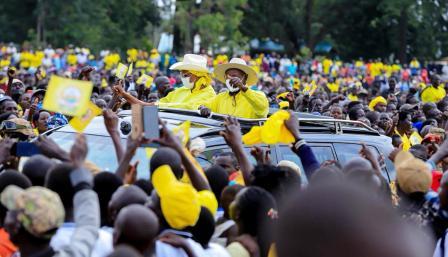
The announcement came during his campaign rally at Booma Grounds in Katakwi, where the National Resistance Movement (NRM) Presidential Candidate outlined his administration’s commitment to enhancing connectivity, boosting agricultural productivity, and delivering quality social services as part of the NRM’s broader vision for inclusive national transformation.
General Museveni revealed plans to construct and tarmac two strategic roads — the Soroti–Amuria–Lira Road and the Lira–Toloma Road — to facilitate the smooth movement of goods and services and stimulate trade across the Teso and Lango sub-regions.
He emphasized that improved road infrastructure is central to unlocking rural economies, reducing transportation costs, and connecting farmers to markets.
“These roads are not just for transport; they are lifelines of our economic revolution,” Museveni said, explaining that better connectivity will also attract investment and strengthen local enterprise.
He warned local government leaders against tolerating poor workmanship in public works, citing the Shs 1.3 billion annual road maintenance fund allocated to districts.
“We must end shoddy work in government projects,” Museveni cautioned. “If money is provided, it should produce visible and lasting results.”
Expanding Access to Water and Irrigation
The President assured residents that his next term will prioritize access to safe and clean water, announcing plans to complete the Angule Small Scale Irrigation Project in Toroma Sub-County and to drill more boreholes across 208 villages.
He also pledged to extend piped water systems to small towns and to scale up irrigation projects to enhance agricultural resilience amid changing weather patterns.
“These projects are not promises; they are part of our ongoing mission to ensure every Ugandan has access to clean water and reliable irrigation,” Museveni said.
The new commitments build on completed works such as the Ongongoja Irrigation System, the Ongole Small Scale Irrigation Project in Usuk, and flood mitigation valley tanks in Ngariam, Palam, Magoro, and Okuronyo sub-counties.
Currently, 342 of Katakwi’s 550 villages have clean water access — a figure Museveni said his administration intends to increase significantly.
Strengthening Education and Skills Training
In his address, Museveni urged local leaders to enforce universal education and eliminate illegal school charges that prevent children from attending government schools.
He highlighted the achievements of the Presidential Industrial Skilling Hubs, which offer free vocational training to youth who dropped out of school, and promised to expand such programs across the country.
“The NRM believes in practical education that creates jobs and wealth,” Museveni noted. “We shall continue equipping young people with skills to work, innovate, and earn.”
He further promised to increase the number of government-aided schools in Katakwi beyond the current 78 primary and 10 secondary schools, citing education as the foundation of long-term development.
Health Sector Upgrades
Turning to healthcare, President Museveni announced plans to upgrade several health centers in Katakwi District from HCII to HCIII status, including facilities in Aakum, Omodoi, Opeta, Okocho, Akurao, and Ongongoja.
He added that new HCIIIs will be constructed in Amusia, Getom, Okore, and Angodingod Sub-Counties, while surgical theatres under construction at Toroma HCIV and Katakwi General Hospital will be completed.
“Healthcare must be available and functional in every corner of Uganda,” Museveni said, stressing the importance of accessible medical services for rural communities.
Livestock Restocking and Economic Empowerment
In a major announcement for pastoral communities, the President unveiled a cattle restocking program targeting Teso, Acholi, and Lango sub-regions, aimed at compensating families who lost livestock during insurgencies and cattle raids.
He said the initiative would help rebuild household wealth and restore economic stability.
“The people of Teso suffered for years because of cattle raids, but now we are bringing justice and recovery through this restocking program,” Museveni declared.
He condemned past corruption scandals in which Shs 159 billion meant for compensation was allegedly misappropriated by private lawyers, urging the community to remain vigilant against exploitation.
“Corruption must not stand in the way of people’s recovery,” he said. “The beneficiaries of PDM and Emyooga have shown that when funds are used honestly, families can rise out of poverty.”
Calls for Unity and Continued Support
First Lady Maama Janet Kataha Museveni encouraged the residents of Katakwi to remain united and support the NRM’s development agenda, emphasizing the need for strong voter turnout.
“Let us protect the progress we have made by voting for the NRM and ensuring continuity of the programs transforming our communities,” she said.
NRM National Vice Chairperson (Female) Anita Among lauded the President for restoring security in Teso and praised his role in promoting mindset change among the Karamojong, a key step in ending cattle rustling.
Vice President Jesca Alupo highlighted Katakwi’s achievements under the NRM, citing improved roads, expanded healthcare, and increased access to electricity as proof of the government’s effective service delivery.
She credited Museveni for spearheading human capital development programs such as universal education and free skilling centers, which she said were “empowering families and transforming livelihoods.”
Party Discipline and District Achievements
NRM Vice Chairperson for Eastern Region, Calvin Echodu, and NRM Electoral Commission Chairperson, Dr. Tanga Odoi, representing the party’s Secretary General Richard Todwong, both urged party members to maintain unity and discipline ahead of the 2026 elections.
They emphasized that internal cohesion within the NRM was critical to sustaining the party’s development agenda.
At the conclusion of the rally, Katakwi District NRM Chairperson John Robert Okirol presented a detailed report outlining the district’s ongoing development projects, including road construction, water access initiatives, and education infrastructure upgrades.
The rally ended with renewed optimism among residents, who hailed the President’s pledges as a new chapter in Katakwi’s transformation journey — one anchored in improved infrastructure, social equity, and sustainable growth.