












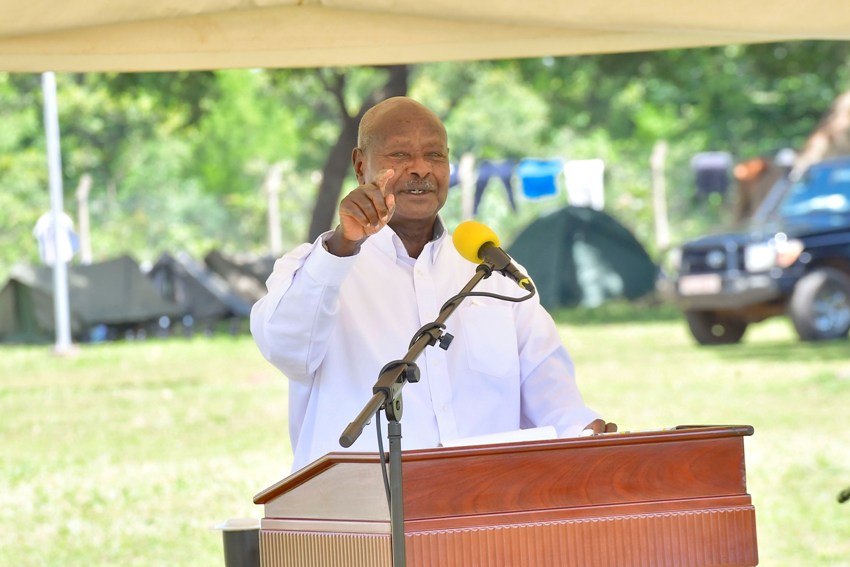
CONGRATULATIONS MR. PRESIDENT AND WANANCHI!
“Uganda is going to become a first world country in the next 50 years. We shall become a middle-income country in the next few years. Our GDP per capita is today US$ 580. With value addition to our oil, our coffee, our cotton, our fruits, our maize, our leather, our beef, etc., this GDP per capita would rise to US$ 2,700 even at the present level of raw-material production. To become a middle-income economy, you need to have a GDP per capita of at least US$ 1,000. This we can quickly achieve now that we are solving the problem of electricity. Therefore, in the next 50 years, if we follow the NRM line, Uganda will become both a middle-income country and a first world country”. (Yoweri K. Museveni, 9th October 2012).
The President made the above statement 10 years ago. Reaching the threshold of middle-income status (lower middle as of now), is no mean achievement in the face of daunting challenges and shocks to the economy – without mentioning structural impediments! “Middle-income status”, a World Bank category, is a very important reference and nodal point in the progress of a country in the development trajectory.
Warmest congratulations to you, Mr. President! Warmest congratulations to Wananchi!
We have accordingly decided to devote our piece today entirely to sharing excerpts from the President’s State of the Nation Address last week – excerpts that underline our Strategic Ideological and Policy Trajectory as we focus on the Challenge of Take-Off.
“In spite of all these, the Ugandan economy … will be standing at US$ 45.7 billion by the exchange rate method and at USD 131.6 billion by the PPP method. This means that the GDP per capita is now $1046 … the entrance points for the lower middle-income status, is USD 1036. We have now passed that figure. Congratulations. However, to be declared a middle-income country, you need to sustain this for two to three consecutive years. I am confident, we shall over perform …
… This is where our industrial linkage with Agriculture comes in. Our strategy is that anything agricultural that is not consumed fresh, should be processed industrially so that it is preserved to be able to reach distant markets and also to add value to the raw-materials …
It is this haemorrhage that the NRM opposed from the beginning in the point 5 of the NRM’s 10 points programme already referred to. We oppose this haemorrhage in all the raw materials: milk, cotton, skins and hides, timber, iron ore (obutare), copper (ekikomo), gold, tin, lithium, wolfram, petroleum, etc. It is this haemorrhage that is responsible for the stagnation of Africa … The continued export of raw materials by Africa is the new form of slavery. Export of value in exchange for no value (mirrors, combs for our ignorant chiefs in exchange for slaves) or for little value like now – 10% value of the final product. The export of raw-materials and slaves for the last 600 years is the cause of this stunting (okuningama) …
Apart from the huge expansion of the Agricultural Sector and the concomitant expansion of the Agro-Industrial sector, there are industries that we are promoting based on our minerals: Oil and Gas (Refinery, Petro-chemicals, fertilizers); Iron-Ore (Steel – Kabaale); Copper (the 11 electrical industries – cables, transformers, electrical appliances); Lithium (electrical car batteries); Niobium (ingots, bars, billets, rods); Tin (tin plates, buckets, cooking utensils); Coltan (laptops, medical equipment, smartphones); Wolfram (electric filaments, ammunition); etc., etc. …
The four sectors – Commercial Agriculture – big or small, intensive or extensive; Industries – big or small, including SMES and Artisanship; Services (Transport, Tourism, Hotels, Entertainment, professional services e.g., doctors, etc.); and ICT; if aggressively pushed, will cause massive social-economic transformation …
The industries of electric and conventional automobiles (buses, mini-buses, trucks, motorbikes, etc.), the Pathogenic Economy (vaccines, pharmaceuticals, for humans and livestock), Space Science, Energy (including nuclear energy) etc., have each, at least, a nucleus already laid down, as I speak today …
How has the NRM brought Uganda to the door-step (ekisasi) of the middle-income status from such a low base and in spite of so many challenges? The following are the reasons:
1. The correct ideology of the NRM rejecting the sectarian ideas of the past actors, insisting on Patriotism, Pan-Africanism, Social-Economic Transformation and Democracy …
2. A strong Army that has ensured peace within Uganda, all the challenges notwithstanding.
3. A strong Private Sector, encouraged by the correct, pro-private sector policies of the NRM; most of the surpluses referred to above, have been generated by the private sector …
4. The correct Pan-Africanist ideology of the NRM that saw the revival of the East African Community, the creation of COMESA and the Abuja Treaty of 1991, that, eventually, saw the birth of the CFTA (the Continental Free Trade Area). Today, Uganda exports goods and services (2020/2021) worth: USD 1.27143 billion to EAC, USD 1.67271 to COMESA and USD 2.03397 billion to CFTA …
5. The correct NRM policy of emphasizing science in education and prioritizing the better payment of government scientists if we do not yet have enough money to pay everybody. Africa was colonized and enslaved and people were exterminated, dominated or marginalized, not because they lacked story-tellers, comedians, musicians, witchdoctors and priests, kings and queens, soldiers, farmers, etc.; but because they lagged behind in Science and Technology …
6. The correct strategy of the NRM of developing the infrastructure – the roads, the railway, the electricity, the piped water, the telephones, the internet etc. The crucial roles of infrastructure are to enable (e.g., electricity) and connect (e.g., roads, railways, telephones) the producers of goods and services and their consumers and do so cheaply – so that the product is not overpriced and, therefore, competitive in the market …
The people that should be discriminated are the unrepentant Comprador Bourgeoisie …
China developed because of the clear vision of Mao Zedong and Deng Xiaoping. Mao Zedong helped China by pointing out the positive alliance of the four classes: National Bourgeoisie, Peasants, Proletariat and Patriotic Petty Bourgeoisie against the parasitic Comprador (agent) Bourgeoisie that were working as foreign agents for other people’s interests.” (Yoweri K. Museveni, 7th June 2022).
K. David Mafabi
Senior Presidential Advisor/Political Affairs (Special Duties)
State House