













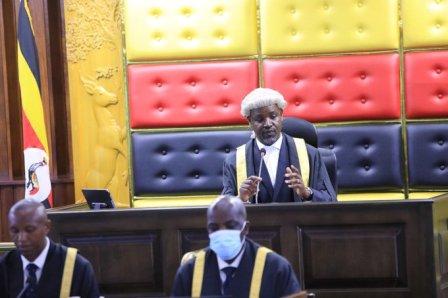
The Parliament of Uganda has directed the Committee on Education and Sports to investigate and report within two weeks on two formal petitions submitted by teacher unions over persistent disparities in salaries among educators.
The petitions, lodged by the Uganda National Teachers’ Union (UNATU) and the Uganda Technical and Vocational Trainers’ Union (UTVTU), highlight long-standing grievances regarding unequal remuneration between teachers of science and arts subjects in public institutions.
Presiding over the parliamentary sitting on Monday, 20 October 2025, Deputy Speaker Thomas Tayebwa informed the House that the Speaker of Parliament, Rt. Hon. Anita Among, had received the petitions on Wednesday, 8 October 2025, and immediately referred them to the appropriate committee for scrutiny.

“The instructors presented their grievances to the legislature, and the Speaker exercised her authority under Rule 31(7) of our standing procedures, directing the appeals to the relevant committee,” Tayebwa explained.
The announcement came amid renewed anxiety among Members of Parliament (MPs) over the ongoing consequences of the industrial action staged by arts teachers, which continues to disrupt learning across government-funded schools.
Hon. Sarah Opendi, the Woman MP for Tororo District, voiced concern about the impact of the strike on learners during a critical academic term, emphasizing the urgent need to close the salary gap between science and arts teachers.
“It is truly regrettable to observe children wandering in villages instead of attending classes. Even after the strike was suspended, the motivation of arts teachers to instruct remains low. Children in private institutions are progressing, while those in public schools are falling behind,” Opendi lamented.
Her remarks reflected a growing public outcry over the unequal treatment of educators, a disparity that many argue has undermined morale and compromised the quality of education in public schools.
Adding to the debate, Hon. Joseph Ssewungu (NUP, Kalungu West County) expressed worry over the academic prospects of students preparing for national examinations, such as the Primary Leaving Examinations (PLE), given the prolonged teaching gaps in essential subjects like English and Social Studies.
“The national examination body determines grading based on the curriculum provided to the pupils. Primary seven candidates have not been engaging in studies but will still be evaluated after the PLE. Parents work diligently to pay tuition, yet their children are not learning; this problem must be addressed with urgency,” Ssewungu stressed.
He further observed that many students were resorting to self-study using educational supplements printed in newspapers, which he described as inadequate.
“This difficulty ought to be resolved permanently. The identical matter surfaced during the Ninth Parliament, and a decision was reached that educators’ compensation would be increased incrementally. We can adopt a similar methodology,” Ssewungu suggested.
The Leader of the Opposition in Parliament, Hon. Joel Ssenyonyi, also weighed in on the matter, urging the Ministry of Finance, Planning and Economic Development to take immediate financial steps to resolve the impasse.
“The Minister of Finance can commit to presenting an additional funding proposal, as numerous supplementary schedules are introduced here every financial year. The core issue is that the government must offer the instructors a concrete commitment,” Ssenyonyi asserted.
However, Deputy Speaker Tayebwa cautioned that the Finance Minister could only make such assurances after meeting with the parliamentary committee handling the petitions from the teacher unions.
“The committee is mandated to convene with the Ministries of Education, Public Service, and Finance. Rule 86(4) of our Rules of Procedure is clear on anticipation; any matter currently under committee review cannot be debated on the floor of the House,” Tayebwa clarified.
The forthcoming committee report, expected within two weeks, is anticipated to shape Parliament’s next course of action on one of the most pressing labour disputes in Uganda’s education sector.
Observers note that this development could mark a decisive moment in the government’s long-running struggle to balance wage structures among public servants, particularly within the teaching profession, where pay inequalities have repeatedly triggered industrial unrest and strained relations between educators and the state.