












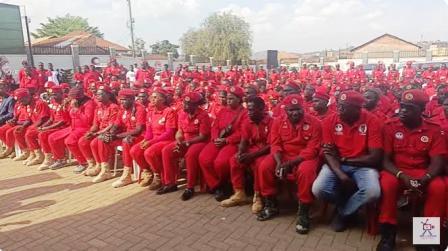
President Yoweri Kaguta Museveni’s campaign trail in northern Uganda has gained fresh momentum following the defection of 159 members of the opposition National Unity Platform (NUP) to the ruling National Resistance Movement (NRM).
The event, held during the President’s campaign stop in Lamwo District, marked a major political realignment in the Acholi Sub-region—an area that has increasingly become a focal point in the buildup to the 2026 general elections.
The defectors, described as local NUP coordinators, mobilizers, and grassroots opinion leaders, officially declared their allegiance to the NRM in a ceremony attended by local leaders and party officials.

They said their decision was motivated by a growing conviction that President Museveni’s government offers greater prospects for peace, stability, and economic advancement compared to the untested promises of the opposition.
Speaking during the ceremony, President Museveni warmly welcomed the new members, praising their decision as a courageous and patriotic choice.
“I want to thank you for choosing the side of progress and stability,” the President said. “Our mission in the NRM has always been to transform Uganda from poverty to prosperity through peace, education, and development. I invite you to work with us as we continue building a stronger, united, and modern nation.”
The President used the opportunity to highlight the government’s ongoing efforts to modernize rural communities through targeted interventions in infrastructure, education, and wealth creation.
He said that under the NRM, Uganda has moved from years of turmoil to a period of steady growth and transformation—progress that must be safeguarded by all citizens.
Museveni reiterated that the NRM’s approach to governance is guided by practical development rather than political rhetoric. He encouraged the new members to embrace production, cooperative work, and community mobilization as key pillars of national prosperity.
“We do not deal in promises. We deal in results,” Museveni said. “Our roads, schools, and health facilities are improving. Our people are being empowered through programs like the Parish Development Model (PDM) and Emyooga. This is the real change Uganda needs.”
Speaking on behalf of the defectors, the group’s leader expressed gratitude to President Museveni and the NRM for welcoming them with open arms.
“We realized that securing the gains we already have is better than waiting for promises that may never come,” he said. “The NRM has delivered on many of its pledges, and we believe it is the right home for us.”
He emphasized that the group’s decision was made after long reflection and engagement with NRM local leaders, who demonstrated commitment to addressing the needs of ordinary citizens through tangible projects and service delivery.
Local NRM officials in Lamwo also celebrated the development, describing the defection as a testament to the growing public confidence in the ruling party’s leadership.
They pledged to integrate the new members into party structures and ensure that their voices contribute to community-based initiatives and policy implementation.
Political analysts have described the mass defection as a strategic gain for the NRM and a worrying setback for Robert Kyagulanyi Ssentamu, popularly known as Bobi Wine.
They argue that while the NUP rose rapidly to national prominence in 2021, it has struggled to consolidate grassroots structures—especially in rural regions like northern Uganda, where the NRM continues to enjoy strong organizational reach.
Observers note that the NRM’s emphasis on economic empowerment through the PDM, industrial hubs, and youth skilling programs has enabled it to reconnect with communities that had been showing signs of opposition sympathy.
This defection follows a series of similar events across other parts of the country, reflecting what some commentators describe as a “quiet political shift” from symbolic activism to pragmatic development politics.
For Bobi Wine and the NUP, the Lamwo defection underscores the growing challenge of maintaining cohesion, funding, and grassroots mobilization in the face of the NRM’s extensive rural presence.
In previous public addresses, Bobi Wine has urged his supporters to remain firm, insisting that the struggle for change requires persistence and sacrifice.
However, internal divisions, limited resources, and state pressure have made it increasingly difficult for the opposition to sustain momentum ahead of the 2026 elections.
Meanwhile, Museveni’s visit to Lamwo was part of a broader northern Uganda campaign circuit aimed at consolidating support in a region once deeply affected by insurgency but now central to the government’s reconstruction and development agenda.
The President’s interaction with local communities and reception of defectors were seen as symbolic victories in the NRM’s ongoing effort to reinforce its political base in the north.
As Uganda heads toward the 2026 polls, the defection of 159 NUP members to the NRM reflects a shifting political landscape—one where performance, service delivery, and grassroots organization are increasingly determining voter loyalty.
While the ruling party celebrates new converts as a validation of its enduring appeal, the opposition faces an uphill battle to restore confidence among disenchanted supporters, rebuild structures, and craft a message that resonates beyond urban centers.
The political winds in Lamwo, once considered open to opposition persuasion, now appear to be blowing firmly in the NRM’s favor—setting the tone for an election season that will test the resilience, strategy, and reach of Uganda’s major political players.