







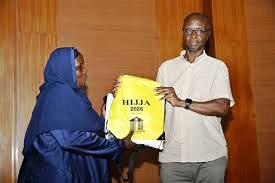
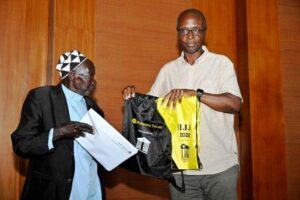
A wave of excitement, gratitude, and spiritual anticipation swept through hundreds of Muslim families as Yoweri Kaguta Museveni extended a significant gesture of support by sponsoring 150 Ugandan Muslims to undertake the sacred Hajj pilgrimage to Mecca.
The pilgrimage, one of the five pillars of Islam, is a lifelong obligation for Muslims who are physically and financially able, yet for many believers, the cost has remained a major barrier.
This year’s fully funded opportunity has therefore opened a door of faith for many who had long prayed for such a chance.
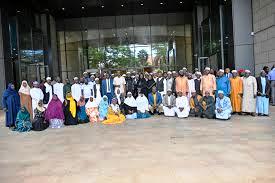
The delegation of pilgrims is scheduled to travel in two groups on May 7 and May 12, 2026, under the coordination of Faruk Kirunda, who will lead the mission.
The first group of 90 pilgrims was officially flagged off in Kampala by Moses Byaruhanga at the Office of the Prime Minister Conference Hall.
Byaruhanga used the occasion to highlight the President’s continued support for the Muslim community, emphasizing that the initiative is fully funded and transparent.
“Instead of the usual 100 slots, the President has this time round sponsored 150 Muslims for Hajji,” he said.
He explained that each pilgrim’s journey costs an average of Shs21 million, bringing the total support to over Shs3 billion.
He also reassured beneficiaries that the process was carefully managed in partnership with the Uganda Muslim Supreme Council, with regional leaders involved in selecting deserving pilgrims.
“State House has worked hand in hand with the Uganda Muslim Supreme Council to ensure that the beneficiaries are effectively selected,” he said.
He cautioned the pilgrims against falling victim to fraudsters, stressing that the offer is entirely covered by the President.
He also linked the gesture to broader government efforts aimed at economic empowerment within the Muslim community.
He pointed to initiatives such as Islamic banking and interest-free financial support through SACCOs for Imams and Muslim leaders across the country.
He explained that the funds are interest-free and designed to align with Islamic principles while boosting household incomes.
Beyond financial support, he encouraged Muslims to explore economic opportunities tied to religious practices, including livestock farming for the Hajj season.
“They usually come around April looking for white goats and sheep to be slaughtered during Eid Al-Adha. The market is there,” he said.
As the pilgrims prepare for their journey, Faruk Kirunda urged them to remain focused on the spiritual purpose of their pilgrimage.
“There’s a difference between tourists and pilgrims. You shouldn’t go there to be a tourist,” he advised.
He warned that failure to follow guidelines in Saudi Arabia could lead to serious consequences.
“Don’t try to take anything which doesn’t belong to you, you will face the law in Saudi Arabia and we may not come back with you after Hajj if you break the law,” he cautioned.
He also emphasized discipline, hygiene, and respect as key values that pilgrims must uphold to preserve the image of Uganda.
On her part, Mariam Namayanja reiterated that the program is inclusive and non-discriminatory.
“This Hajj offer is not discriminatory. All eligible Muslims irrespective of their political background can benefit because this is a national program,” she said.
She further called on the faithful to use the opportunity to pray for peace and stability in Uganda.
“Last time we prayed and we had peaceful elections. We should now pray for our President and our country so that it continues to be peaceful,” she noted.
For many beneficiaries, the moment was deeply emotional and personal.
Mayimuna Nababi from Mukono expressed overwhelming joy at being selected.
“I thank President Museveni for the Hajj offer. I didn’t expect it but Allah has made it for me. I’m so happy,” she said.
Sheikh Kassim Kigozi from Butambala shared a similar story of gratitude after previously missing out.
“I’m so happy that I’m going for Hajj, all courtesy of President Museveni. I thank him so much,” he said.
Aisha Kyakuwa from Makindye described the gesture as a sign of genuine support for Islam.
“We thank you, Your Excellency, for this offer. We pray that Allah gives you a healthy life,” she said.
Religious leaders also commended the initiative, noting its impact on strengthening faith and community cohesion.
Sheikh Isa Keli Pedo, the District Kadhi of Kotido, urged Muslims to appreciate the President’s continued support.
“I’m really grateful and I urge all Muslims to appreciate the person of the President for the support towards Muslims,” he said.
This latest gesture builds on a long history of engagement between President Museveni and Uganda’s Muslim community.
Since coming to power in 1986, Museveni has consistently promoted freedom of worship, ensuring that all religious groups operate without discrimination.
His government has supported the reconstruction of mosques, facilitated religious pilgrimages, and engaged Muslim leaders in national dialogue.
He has also backed the establishment of Islamic financial systems to accommodate believers who avoid interest-based transactions.
Beyond Islam, Museveni has extended similar support to other religious communities, including Christians and traditional faith practitioners.
He has emphasized that Uganda’s strength lies in its diversity, where different beliefs coexist peacefully under a secular state framework.
His administration has maintained policies that protect cultural practices, provided they align with national laws and human rights standards.
These efforts have helped position Uganda as a country where religious freedom is both protected and practiced widely.
As the 150 pilgrims prepare to embark on their spiritual journey to Mecca, their departure symbolizes more than a religious obligation.
It reflects a broader commitment to inclusivity, faith, and national unity, values that continue to shape Uganda’s social fabric.