














The voting register was supposed to settle every argument in Solo B village.
Instead, it ended up in pieces on the ground.
By the time officials called off the Local Council One election there, and in two neighbouring villages, blood had already been drawn and a country-wide exercise meant to restore grassroots democracy had produced one more cautionary tale.

The Electoral Commission cancelled the LC1 polls in Solo B village in Western Division, Buwumba village in Dabani sub-county, and Buhamuna village in Buhehe sub-county, all in Busia district, after chaos broke out among voters at the polling stations.
A Register Torn to Pieces
The trouble, officials say, started the moment presiding officers tried to do the one thing the whole exercise depends on, verifying who was actually allowed to vote.
In each of the three villages, some voters turned violent and blocked presiding officers from using the voters register at all.
Godfrey Budaha, the incumbent LC1 chairperson in Buhamuna and the ruling NRM party’s candidate there, gave the most detailed account of how bad it got.
He alleges that his opponent and the opponent’s supporters stormed the polling station during register verification, grabbed the document from the presiding officer, and tore it into pieces.
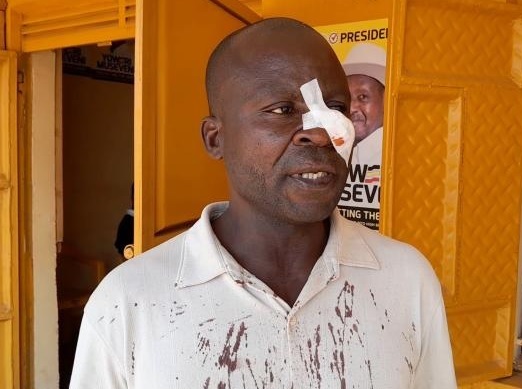
Budaha says he was assaulted in the melee and sustained serious injuries to his face.
He has since filed an assault case at Busia Central Police Station and petitioned the ruling NRM party office in the district, demanding a fair rerun of the exercise.
He was not the only one hurt trying to keep order.
Sylvester Offiti, the Buhehe sub-county community development officer, says he was struck on the head with a stick while attempting to intervene in the chaos, and has since reported the case to police.
Kacibert Bwire, another assault victim, offered a different explanation for what set off the violence in Buhamuna in the first place.
He said the trouble began when supporters of independent candidates realized that most of their names were missing from the voters register.
He placed some of the blame on security officials, arguing that too few personnel had been deployed to the polling station to keep the situation under control.
Officials Respond, and a Rerun Is Promised
Wilberforce Lwagula, the Busia district NRM party administrator, confirmed that the party has registered its concerns over the chaos in all three villages.
He said the party intends to engage the Electoral Commission to push for the elections to be repeated in the areas where the disorder occurred.
Even amid the disruption, Lwagula struck an upbeat note about the party’s overall performance across the district.
He said the NRM is winning with almost 95 percent of contested seats district-wide, a margin he clearly saw as reason for confidence despite the localized setbacks.
On the Electoral Commission side, Flavia Ajambo, the commission’s supervisor attached to Western Division, confirmed that cases of chaos were registered in the affected areas.
She said the decision to cancel the polls there followed advice from her superiors once the scale of the disruption became clear.
Esther Wamboka, the Busia district assistant returning officer, defended the process that had triggered the unrest, insisting that presiding officers were simply following Electoral Commission guidelines requiring voters to be verified against the register.
She condemned the unlawful acts committed by residents in the three villages and confirmed that a fresh election will be organized there.
A Long-Delayed Democratic Exercise, Now Playing Out Nationwide
What happened in Busia did not happen in isolation.
The Local Council One elections nationwide were themselves the product of an extraordinarily long wait, one that stretches back a generation.
Uganda last held LC1 and LC2 elections in 2001, meaning village chairpersons across the country served on expired mandates for roughly seventeen years before the polls were finally revived on 10 July 2018, a day the government declared a public holiday so voters could take part.
Even after that 2018 exercise, the terms of the newly elected village leaders expired again in July 2023, and rather than organize fresh elections immediately, the Ministry of Local Government extended those terms six separate times through statutory instruments, citing budget constraints, before finally settling on 28 July 2026 as the new nationwide polling day.
That is the same day, according to Electoral Commission timelines, on which villages including Solo B, Buwumba, and Buhamuna went to the polls.
Cost has always been part of the story behind these long delays.
Uganda’s more than 60,800 villages made a secret-ballot election prohibitively expensive by some estimates, which is why Parliament amended the law to allow voters to queue publicly behind their preferred candidates instead, a cheaper but more exposed method of voting that critics have long argued invites exactly the kind of register disputes and intimidation seen in Busia.
Busia’s troubles were far from the only disruption reported around the country on polling day.
In Jinja City, chaos erupted at Alidina cell in Central Jinja East ward after an election supervisor read out the names of absent voters, only for those voters to be barred from entering the polling venue once they arrived later, sparking clashes that police had to step in to calm.
In Wakiso District’s Bamutakudde village, residents rejected the voters’ register outright, claiming it contained the names of people who did not actually live there, stalling the vote for hours.
In Kawempe Division in Kampala, violence broke out after residents rejected results announced by Electoral Commission officials, prompting security forces to use tear gas and, according to one report, live bullets to disperse the crowds.
Similar tension was reported in Mbale City, where youth groups protested the register verification process, and in Gomba District, where violence halted voting altogether at one polling station.
Electoral Commission Chairperson Justice Simon Byabakama had framed the entire exercise, ahead of polling day, as far more than a routine administrative formality.
He described local councils as the bedrock of community safety and social cohesion, telling reporters that the LC1 council carries a legal mandate to ensure law and order prevails in its area, the very mandate now in question in the three cancelled Busia villages.
What Comes Next
For Solo B, Buwumba, and Buhamuna, the immediate path forward is a rerun, one that both the ruling party’s local leadership and the Electoral Commission’s own officials say they intend to organize.
Whether that repeat exercise avoids the same flashpoints, a contested register, thin security deployment, and candidates unwilling to accept the process, will likely determine whether Busia’s villages get the clean mandate the rest of the country is now voting to restore.
For a country that waited seventeen years to hold these elections once, then endured six further delays before finally getting back to the polls, the stakes of getting the rerun right extend well beyond three villages in the east.