














President Yoweri Kaguta Museveni has spent much of this term repeating a single phrase to Ugandans in every corner of the country.
He has reaffirmed his “no more sleep” campaign message, calling on Ugandans, public officials and political leaders to embrace hard work, fight corruption and accelerate wealth creation.
Addressing Parliament earlier this year, the President was careful to explain what he meant by the phrase.

He clarified that his message was not simply “no sleep” as some critics had interpreted it, but rather “no more sleep” in the sense of ending complacency, corruption and poor performance in public service.
That message travelled from the floor of Parliament all the way to a church compound in Kamuli District this week, carried by one of the President’s most trusted lieutenants.
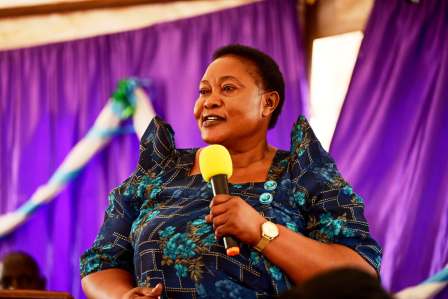
The Minister for the Presidency, MP for Budiope West and Director for Busoga SDA Women Field, Hon. Babirye Milly Babalanda, stood before hundreds of Seventh-day Adventist faithful at the close of a week-long camp retreat at Kiige SDA Church.
Her message to them was, in essence, the President’s own instruction translated into the language of faith.
Greetings From the Top, a Message From the Pulpit
Babalanda opened her remarks the way she typically does at such gatherings, by relaying goodwill from the highest offices in the land.
She delivered greetings from H.E. President Yoweri Kaguta Museveni, the First Lady and Minister of Education and Sports, Mama Janet Kataaha Museveni, Permanent Secretary in the Office of the President Hajji Yunus Kakande, and the entire staff of the Office of the President.
She then turned to commend the SDA leadership in Kamuli for the substance of the week itself, a period devoted to prayer, Bible study and fellowship.
“This is the kind of moral foundation our nation needs. But faith must go hand in hand with work,” she told the congregation.
She reminded worshippers that the NRM government, under President Museveni’s stewardship, has guaranteed freedom of worship and treats religious institutions as genuine partners in national development, unity, and moral transformation.
Turning Pulpits Into Platforms for Wealth Creation
Babalanda did not stop at praising the spiritual character of the retreat.
She urged pastors and church leaders to use their pulpits not only to preach salvation, but to mobilize their congregations around government wealth-creation programmes designed to fight poverty at the household level.
“The government has established several wealth creation programmes, like the Parish Development Model – PDM, Emyooga, Youth Livelihood, Operation Wealth Creation – OWC, GROW, etc. Our role now is to ensure these resources are used with integrity, unity, and hard work to create wealth and jobs at the household level,” she said.
This is a message she has carried to congregations before, having delivered a nearly identical appeal at a similar SDA retreat in Namayingo District only days earlier, where she challenged worshippers to treat wealth creation, hard work and saving as practical weapons against poverty.
The Four-Acre Model Comes to Kamuli
Central to Babalanda’s appeal was a direct call on the people of Kamuli to embrace President Museveni’s 4-Acre Model Concept, a household-level strategy for rural transformation that the President has been promoting at rallies across the country.
Under the model, the first acre is set aside for coffee or cocoa to generate long-term cash income.
The second acre goes to fruit trees such as oranges, mangoes, and passion fruit.
The third acre is reserved for food crops, including maize, beans, cassava, sweet potatoes and vegetables.
The fourth and final acre is dedicated to animal pasture to support zero-grazing dairy farming.
Babalanda also encouraged smaller backyard enterprises suited to families without much land, proposing poultry farming for eggs among Muslim and SDA households, and piggery among non-Muslim households, in line with the President’s guidance as champion of the wealth-creation drive.
A Message Repeated Across the Region
What made Babalanda’s appearance in Kamuli notable was not its novelty, but its consistency with a pattern she has followed across the greater Busoga sub-region this term.
Days earlier in Namayingo District, she had urged another SDA congregation to move beyond prayer into practical income-generating activity, framing wealth creation as something churches should preach “alongside the gospel.”
Weeks before that, in Kaliro District, she had rallied residents attending a family thanksgiving service to reject corruption and adopt the same 4-Acre Model she raised in Kamuli.
And in her formal supervisory role, she had told Resident District Commissioners and security officers gathered in Mukono that the success of government programmes should never be measured by the money disbursed, but by the number of households lifted out of poverty and the number of young people engaged in productive enterprises.
Fighting Corruption, Working Hard
Babalanda tied her appeal in Kamuli directly back to the President’s own instructions for this term of government.
“This term, the President has tasked us with two things: Fighting corruption and working hard. There must be ‘No Sleeping’. As Christians, our hands must work as much as our voices praise. That is how we shall defeat poverty,” she emphasized.
The phrase echoes the same “Kisanja of No More Sleep” language she has used with government officials, where she has described the slogan not as campaign rhetoric but as an actual policy directive demanding closer monitoring of projects, faster response to citizens’ concerns, and tougher action against corruption.
A Minister Shaped by the Field
Babalanda’s insistence on pairing prayer with hard work is rooted in a career built almost entirely at the grassroots.
Her political journey began as a village mobilizer for the National Resistance Movement, work that eventually earned her appointment as Deputy Resident District Commissioner for Busia District.
That posting placed her directly in the business of service delivery and community trust-building long before she rose to head the Office of the National Chairman at Kyambogo and, eventually, to lead the Ministry of the Presidency itself.
Close to a decade in senior positions within the Presidency has put her at the center of overseeing how government wealth-creation schemes actually reach households, with her office strengthening the monitoring role of RDCs, RCCs and their deputies over projects ranging from schools and health centres to Emyooga and the Parish Development Model.
That record has made her one of the more consistent public voices repeating the President’s poverty-fighting message to communities, whether the audience is a church congregation, a bereaved family, or a room full of security officers.
Cement as Commitment
Babalanda’s visit to Kiige SDA Church was not limited to words.
In a tangible show of support for the congregation, she contributed 100 bags of cement toward the church’s ongoing construction project.
The gesture drew appreciation from a retreat that had brought together hundreds of SDA faithful from across Kamuli District for a week of spiritual renewal, prayer, and fellowship.
As the week closed, Babalanda’s parting message to the congregation was less a farewell than a charge, one that mirrored President Museveni’s own call for a nation whose leaders and citizens alike stop sleeping on the work still to be done in the fight against poverty.