
















Kampala woke up this week to a familiar face in an unfamiliar chair.
Ambassador Adonia Ayebare, the soft-spoken diplomat who spent nearly a decade representing Uganda at the United Nations headquarters in New York, has formally taken the reins of the Ministry of Foreign Affairs.
His assumption of office this morning was not a quiet administrative formality.

It was the culmination of a journey that began in a modest newsroom in Entebbe and wound its way through some of the world’s most sensitive diplomatic corridors.
A Handover Steeped in Symbolism
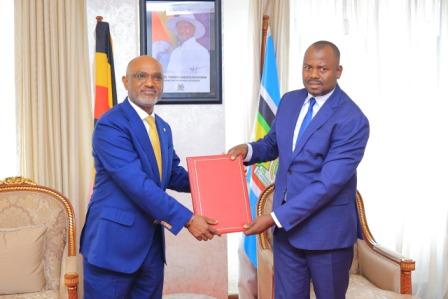
The formal transfer of instruments of office took place at the Ministry of Foreign Affairs, where Ambassador Ayebare received the mantle from Hon. Haruna Kasolo Kyeyune, who had held the fort as Acting Minister since 22nd June 2026.
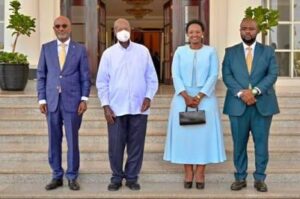
The ceremony followed his swearing-in a day earlier, on 11th August 2026, at State House, Entebbe, where he subscribed to the Oaths of Allegiance and of Minister before President Yoweri Museveni.
Hon. Kasolo used the occasion to welcome his successor warmly.
He noted the vast experience Ambassador Ayebare brings to the Ministry.
He expressed confidence that with this experience and energy, the Ministry will perform better and deliver results in fulfilling its core mandate, including promoting bilateral and multilateral relations, attracting foreign investors to Uganda, and securing markets for Ugandan products.
Hon. Kasolo also used the moment to reflect on his own brief but consequential tenure.
He cited the coordination of the repatriation of 1,030 Ugandans from South Africa as one of his key achievements, a mission carried out following xenophobic threats and attacks against African nationals in that country.
For his part, Ambassador Ayebare struck a note of gratitude rather than triumph.
He thanked Hon. Kasolo for holding fort during the past few weeks.
He commended him for ensuring continuity in bilateral relations, consular services, and the implementation of Uganda’s international obligations during the transition.
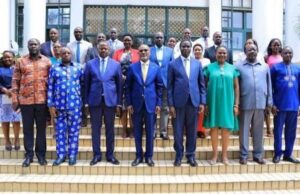
Senior officials and heads of department filled the room, listening closely as the new Minister began sketching out his priorities for the portfolio.
The Journalist Who Became a Diplomat
Long before television cameras and UN General Assembly podiums, Adonia Ayebare was a working journalist chasing stories in Entebbe.
Born on 18th October 1966, he cut his professional teeth editing a modest-circulation newspaper called The Marketplace, located a short drive from State House.
He commuted to that newsroom in a Volkswagen Golf, a detail that now reads almost quaint against the backdrop of his current office.
The paper’s owner, Ernest Kakwano, who had once headed the defunct Coffee Marketing Board, is remembered fondly by the Museveni family for helping smuggle army chief General Muhoozi Kainerugaba and his sister out of Uganda during the early years of the anti-Obote rebellion.
That early proximity to power would prove formative.
Ayebare went on to earn a Bachelor of Arts in Mass Communication from Makerere University in 1993.
He did not stop there.
He later added two master’s degrees, one from Long Island University and another from the Fletcher School of Law and Diplomacy at Tufts University, followed by doctoral studies at both Indiana University and Rutgers University, and a certificate in International Security from Harvard’s Kennedy School of Government.
Few Ugandan diplomats carry that depth of academic grounding into their work.
Building a Career in the World’s Toughest Rooms
Ambassador Ayebare’s diplomatic career formally began in 2001, when he was appointed Uganda’s Principal Adviser and Special Envoy to the Burundi peace process, a role he held until 2008.
Between 2002 and 2005, he simultaneously served as Uganda’s Ambassador and Head of Mission to both Rwanda and Burundi, placing him at the heart of the Great Lakes region’s most delicate post-conflict negotiations.
According to his official biography with Uganda’s Permanent Mission to the United Nations, he worked with mediation teams in Burundi, Somalia and Sudan for over ten years, accumulating practical experience in conflict prevention and mediation that few of his peers can match.
In 2005 he was transferred to Uganda’s mission at the United Nations, beginning a long institutional relationship with the world body.
Before rising to the top diplomatic post in New York, he served as Deputy Permanent Representative and Chargé d’Affaires of Uganda to the UN, and separately as Director of the Africa Program at the International Peace Institute in New York.
From January 2013 until March 2017, he served as Senior Adviser on Peace and Security at the African Union’s Permanent Observer Mission to the United Nations.
That steady climb through overlapping roles in peacekeeping, mediation, and multilateral diplomacy eventually positioned him for the assignment that would define the next chapter of his career.
Nine Years Steering Uganda’s Voice at the UN
Ambassador Ayebare served as Uganda’s Permanent Representative to the United Nations in New York from 2017 to 2026, a tenure of roughly nine years that made him one of the longest-serving and most experienced voices Uganda has ever sent to Turtle Bay.
Uganda’s plusnews.ug described him as widely regarded as one of Uganda’s most experienced diplomats on multilateral affairs, noting that he had been central to the country’s global diplomatic engagements throughout that period.
In that capacity, he represented Uganda across the entire UN system and coordinated the country’s multilateral engagements on issues ranging from peace and security to sustainable development.
His profile grew further during Uganda’s Chairmanship of the Non-Aligned Movement between 2024 and 2025, a period during which he played a central coordinating role from New York.
He steered the Movement’s engagement at the United Nations, mobilized consensus positions among member states on multilateral reform, sustainable development, and peace and security, and worked to keep Kampala aligned with the wider NAM bloc during the 19th NAM Summit hosted by Uganda in January 2024.
That summit, held on Ugandan soil, was widely seen as a diplomatic showcase for President Museveni’s government, and Ambassador Ayebare’s coordination work in New York was central to its success on the global stage.
Trusted by Museveni, Elevated to Cabinet
President Museveni’s decision to bring Ayebare into government was not a sudden one.
He had previously appointed the ambassador as an ex-officio member of Cabinet while he was still serving in New York, a move confirmed when he was sworn in by then Vice President Jessica Alupo.
That early elevation signalled the level of trust the President placed in his judgment on foreign affairs, long before the formal Cabinet reshuffle for the 2026–2031 term brought him home to replace Jeje Odongo as substantive Minister.
Observers have described the appointment as Kampala’s intention to strengthen its international diplomacy at a time when Uganda continues to play prominent roles in regional peace initiatives, the Non-Aligned Movement, the Group of 77 and China, and African Union processes.
Economic Diplomacy as the New Doctrine
In his inaugural remarks setting out priorities for the Ministry, Ambassador Ayebare made clear that Economic and Commercial Diplomacy would sit at the centre of his agenda.
He anchored the Ministry’s work in ECD as the foremost instrument for national transformation.
He directed that all Uganda Missions Abroad be realigned to drive the ATMS Strategy, an acronym covering Agro-industrialization, Tourism, Minerals including Oil and Gas, and Science, Technology and Innovation.
Economic and Commercial Diplomacy, he indicated, would become the Ministry’s primary lens for measuring the value of Uganda’s foreign relationships going forward, a shift that suggests missions abroad will increasingly be judged on the investment, trade, and market access they help unlock rather than ceremonial diplomacy alone.
A Diplomat for a New Chapter
Ambassador Ayebare’s rise from a small Entebbe newsroom to the helm of Uganda’s foreign policy machinery captures something distinctive about his career: a journalist’s instinct for narrative and persuasion, fused with decades of hard-won experience in mediation, multilateral negotiation, and coalition-building.
He now inherits a Ministry whose mandate spans consular protection of Ugandans abroad, the country’s standing within the African Union and Non-Aligned Movement, and the increasingly urgent task of translating diplomatic goodwill into investment and trade.
Whether his years of quiet coalition-building at the United Nations translate into tangible economic returns for Uganda will likely become the defining measure of his tenure at home.
ary contribution to the national tenfold growth strategy to expand Uganda’s economy to USD 500 Billion by 2040. Missions will be assigned explicit commercial mandates to attract strategic investment, promote value-added exports, secure market access, and project Uganda as a competitive trade and logistics hub in the region.
Ambassador John Leonard Mugerwa, representing the Permanent Secretary, welcomed Amb. Ayebare and affirmed the Ministry staff’s readiness to support the Minister in steering the Ministry to greater heights. He highlighted some of the key achievements recorded in recent years, including the acquisition and renovation of Uganda’s Missions abroad, and the expansion of the Ministry’s reach in advancing Economic and Commercial Diplomacy.