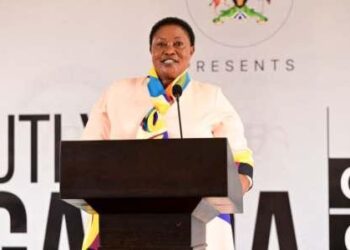















The Minister for the Presidency, Hon. Babirye Milly Babalanda, has told the leaders who run Uganda’s governance and security machinery to bring discipline, realism and measurable results to the next national budget.
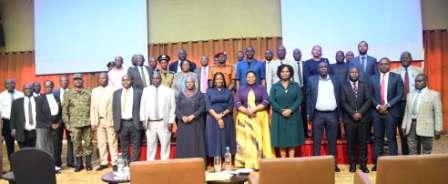
She spoke at Munyonyo Speke Resort while opening the Steering and Political Leadership Committee meeting of the Governance and Security Programme (GSP).
The meeting was convened to prepare the Budget Framework Paper for Financial Year 2027/28.

Ministers, Permanent Secretaries, Accounting Officers and heads of Ministries, Departments and Agencies (MDAs) under the Programme sat in the same room.
Her message was that every budget proposal must be credible, realistic and results-oriented, and must be aligned to the Fourth National Development Plan (NDP IV) and the Tenfold Growth Strategy.
A New Term, A Renewed Mandate
Babalanda opened by congratulating fellow Ministers on their appointments and reappointments for the 2026-2031 term of the National Resistance Movement (NRM).
She said the appointments reflect the confidence of H.E. the President and the people of Uganda.
She urged the Ministers to serve with renewed commitment, patriotism and integrity.
She also commended Permanent Secretaries, Accounting Officers and technical teams for their dedication to implementing Government policies and programmes.
The Clock Is Already Ticking
Babalanda described the FY 2027/28 budget process as timely and strategic.
It follows the First Budget Call Circular issued by the Ministry of Finance, Planning and Economic Development.
She reminded the leaders that the process is anchored in Article 155 (1) and (2) of the Constitution.
It also rests on Section 12 (1)-(3) of the Public Finance Management Act, Cap. 171.
Approved draft budget estimates must reach the Ministry of Finance by Thursday, 15th October 2026.
That leaves only a few days.
“I call upon all political and technical leaders to treat this deadline with the urgency it deserves,” she said.
Politicians Steer, Technocrats Build
The Minister drew a clear line between the two groups in the room.
Political leaders, she said, must provide clear policy direction that reflects the aspirations of Ugandans.
Accounting Officers and technical teams must turn those priorities into plans that are technically sound, properly costed and implementable, with clear accountability mechanisms.
In her view, neither side can succeed without the other.
Breaking Out of Institutional Silos
Babalanda urged MDAs to embrace the programmatic approach to planning and budgeting.
This approach asks institutions to work together towards shared national outcomes instead of guarding their own turf.
She put the principle in plain terms.
“Our focus should not simply be on how much money each institution receives, but on the results we collectively deliver and the difference our interventions make in the lives of Ugandans,” she said.
She noted that governance, peace, security, rule of law, accountability and the fight against corruption are interconnected.
No single institution, she said, can achieve them in isolation.
She therefore called for stronger coordination and harmonized priorities.
She also asked for regular meetings of the Political Leadership Committee, supported by effective technical engagements.
The review of the draft Vote estimates was guided by the NDP IV Coordination Guidelines, 2025, issued by the Right Honourable Prime Minister.
The guidelines emphasize coordination at three levels: the Technical Working Group, the Steering Committee and the Political Leadership.
Why the Tenfold Strategy Sits at the Centre
Babalanda said the Programme’s work must remain firmly aligned to NDP IV and the Tenfold Growth Strategy.
The strategy seeks to grow Uganda’s GDP from USD 50 billion to USD 500 billion in 15 years.
The Ministry of Finance records that NDP IV is the fourth of six national development plans meant to deliver Uganda Vision 2040, and the first under the ten-fold growth strategy.
Its stated goal is higher household incomes and employment for sustainable socio-economic transformation, under the theme of sustainable industrialization for inclusive growth, employment and wealth creation.
Cabinet approved the plan’s strategic direction in March 2024, and the strategy’s baseline was the USD 50 billion economy of FY 2023/24.
Babalanda argued that numbers like these cannot be reached by investment in productive sectors alone.
She said the target also requires a peaceful and secure country, effective institutions, predictable enforcement of the law, efficient public administration and accountable leadership.
That is why the Governance and Security Programme matters to the growth story.
Budget proposals, she said, must show how resources will contribute to these objectives.
They must also show how they will contribute to the Programme Implementation Action Plans (PIAPs) across all 18 NDP IV programmes.
The Sceptics’ Test: Execution
Economists and commentators have been candid about how hard the target is.
One Daily Monitor commentary called the Tenfold Strategy a national execution challenge, not merely an economic target.
The same writer argued that Uganda cannot finance a USD 500 billion economy on a narrow formal tax base.
At a Ministry of Finance Economic Summit hosted with NTV Uganda, experts pointed to the need to reduce budget cuts and to assess the impact of tax exemptions.
Another analysis said that success will depend less on the ambition of the target than on the quality of execution.
Babalanda’s insistence on costed, accountable and results-focused budgets speaks directly to that test.
Corruption: “Zero Tolerance”
The Minister said the fight against corruption must remain central.
She explained that corruption diverts resources, undermines public trust and weakens institutions.
Her prescription was specific.
“We must demonstrate zero tolerance for corruption by strengthening preventive controls, upholding ethical standards, promoting transparency in public procurement and expenditure, and addressing misconduct through established legal mechanisms,” she said.
A Presidency Cutting the Fat
Babalanda said the meeting comes at a time when H.E. President Yoweri Kaguta Museveni has intensified efforts to reduce unnecessary expenditure and eliminate wastage.
She pointed to his firm stance against corruption.
She also pointed to the scaling down of national ceremonies, such as the recently concluded Independence Day celebrations.
According to the Minister, the President has guided that Government must improve efficiency in service delivery through continuous monitoring.
Leaving the Office for the Field
The sharpest part of her address was a challenge to leaders to step out from behind their desks.
“I urge all of us to become field-based leaders who regularly engage with realities on the ground, monitor programme implementation and ensure Government interventions like PDM, Emyooga and the 4-Acre Model deliver intended results. We must not remain in our offices while implementation challenges persist in the field,” she said.
The three programmes she named are central to Government’s wealth-creation drive.
The Parish Development Model (PDM) is a strategy for organizing and delivering public and private sector interventions for wealth creation and employment at the parish level, the lowest economic planning unit.
When the President explained the model to NRM legislators, he said Emyooga focuses on popular ventures such as carpentry, hairdressing and metal fabrication, while the parish model focuses on people involved in agriculture.
The Four-Acre Model promotes diversification, with one acre for coffee, one for fruit trees, one for staple household crops and one for pasture for livestock.
Field supervision matters because these programmes have faced real implementation problems.
The President once ordered an investigation into alleged extortion in the allocation of PDM funds in Kiryandongo district.
At the 2026 Uganda National Agricultural Show in Jinja, the Uganda Development Forum set up model parish farms, partly to address misuse of funds by some beneficiaries.
Babalanda’s call for leaders to monitor programmes in person responds to concerns of this kind.
She added that there is no time for complacency.
Leaders, she said, must remain vigilant, proactive and results-oriented.
Closing: From Resolutions to Results
In her closing remarks, Babalanda thanked participants for their active participation and their commitment to strengthening the Programme’s performance.
She urged institutions to take the agreed actions seriously.
She asked them to ensure budget priorities are aligned to national objectives.
She also asked them to complete preparations within the stipulated timelines.
“Let us leave with a renewed sense of duty, unity of purpose and determination to deliver on our mandates. The success of the Governance and Security Programme depends on our collective commitment and willingness to turn resolutions into tangible results,” she said.
She expressed confidence that the Programme would make a meaningful contribution if it follows the President’s guidance and embraces collaboration and purposeful leadership.
That contribution, she said, would extend to NDP IV, the Tenfold Growth Strategy and the wider national development agenda.
What Comes Next
With the 15th October deadline only days away, the leaders who left Munyonyo now face the harder task of turning the meeting’s resolutions into costed budget proposals.
Whether those proposals deliver the “tangible results” the Minister demanded will show in what reaches the parishes, the programmes and the people.