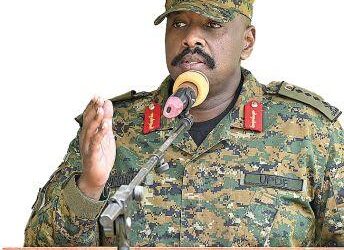













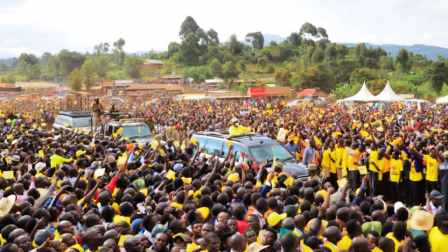
President Yoweri Kaguta Museveni, the National Resistance Movement (NRM) Presidential Candidate, has launched his campaign in the Sebei Sub-region with a strong pledge to confront the area’s persistent environmental and infrastructural challenges.
The President emphasized a forward-looking approach that blends community education, infrastructure investment, and climate resilience to safeguard lives and promote sustainable development.
Addressing a large crowd at Amanang Secondary School playgrounds in Bukwo District, President Museveni announced a groundbreaking plan to sponsor a delegation of local leaders and farmers from Bukwo to Europe to benchmark how mountain communities around the Alps have successfully managed steep terrain and prevented environmental disasters.

“I will sponsor a group of people from Bukwo to go to Europe and see how communities around the Alps Mountains live and use mountainous land sustainably,” Museveni said. “We must learn how to manage our terrain properly to stop disasters like the recent landslides that killed 20 people.”
Learning from the Alps: A New Model for Mountain Conservation
The President’s proposal marks one of the most innovative environmental management strategies in recent years, emphasizing experiential learning and the transfer of global best practices.
The Alps—stretching across countries such as Switzerland, Austria, and Italy—are renowned for balancing mountain conservation with productive land use, modern agriculture, and tourism.
Museveni said that by studying these models firsthand, Ugandans could learn practical methods to mitigate the impact of climate change and prevent tragedies such as the deadly landslides that recently struck the Elgon region.
“The soils on the slopes of Mount Elgon are not suitable for agriculture or permanent settlement,” he explained. “These mountains are valuable national resources that must be preserved and managed for tourism and environmental protection.”
He called on residents to stop encroaching on fragile ecosystems and to embrace modern terracing, tree planting, and sustainable settlement planning to protect both the environment and human lives.
Environmental Challenges and the Need for Sustainable Land Use
Mount Elgon and the surrounding Sebei highlands are among the most ecologically fragile areas in Uganda. For decades, the combination of deforestation, overpopulation, and unregulated cultivation on steep slopes has exposed communities to frequent landslides and flash floods.
According to the Office of the Prime Minister, more than 100 people have died in Elgon-related landslides over the past five years, while thousands have been displaced.
Environmentalists have long warned that without stronger conservation efforts and alternative livelihood options, the disasters could intensify with climate change.
Dr. Grace Turyatunga, a climate resilience researcher at Makerere University, notes that Museveni’s proposed benchmarking program could mark a turning point in local environmental education.
“Community leaders in places like Bukwo and Bududa need hands-on exposure to how mountain communities elsewhere have adapted,” she said. “Learning from the Alps could inspire homegrown innovations in terracing, forestry, and tourism that balance conservation with economic activity.”
Infrastructure and Health Development Commitments
President Museveni also unveiled a wide-ranging development plan for Bukwo and the greater Sebei Sub-region, anchored on health, infrastructure, and education reforms.
He pledged to upgrade Bukwo Health Centre IV into a fully-fledged General Hospital to ensure that residents no longer have to travel long distances for advanced medical care.
“The people of Bukwo deserve quality health care within reach,” Museveni said. “We are going to upgrade Bukwo Health Centre IV to a hospital and construct more facilities where needed.”
The President added that the government will expand piped water coverage, increase electricity access, and tarmac major road networks to enhance trade and connectivity. These investments, he said, would unlock Bukwo’s potential as an agricultural and tourism hub.
Reliable infrastructure, Museveni noted, is the backbone of economic transformation. “When we build roads, bring electricity, and ensure access to clean water, we create the environment for the private sector to thrive,” he said.
Reforming Education and Building Human Capital
On education, Museveni reaffirmed his government’s policy of rationalizing schools under the Ministry of Education framework. He said every parish should have at least one primary school, while every sub-county must have a secondary school to ensure equitable access to learning.
“In every parish, there should be a primary school, and in every sub-county, there should be a secondary school,” he emphasized. “This will help us utilize resources better and ensure that all children can easily access education.”
He also reiterated his commitment to free education and vocational training through skilling hubs, which aim to equip young people with hands-on abilities for self-employment and industrial growth.
“In these skilling hubs, I train young people for just six months, and they become useful to society, producing goods we used to import from Italy and China,” Museveni said.
Wealth Creation and Local Accountability
Turning to economic empowerment, the President urged residents to focus on household wealth creation through commercial agriculture, value addition, and participation in government programs such as the Parish Development Model (PDM) and Emyooga.
“Government will continue implementing programs like the Parish Development Model and Emyooga to support you,” he said. “But every family must work hard and participate in the money economy. That is how we build prosperity.”
Museveni also challenged local leaders to strengthen accountability mechanisms, ensuring that funds allocated to parishes and districts are used for intended purposes.
“The local councils are your eyes and ears,” he stated. “Use them to monitor how money is spent. We created this system so that you can hold officials accountable.”
He warned that corruption remains a serious obstacle to effective service delivery and called for community vigilance to ensure public funds benefit citizens directly.
“Resist corruption and make sure government resources benefit the community,” Museveni said. “If public funds are used properly, the entire district will develop faster.”
A Message of Hope and Stability
As he concluded his speech, President Museveni reminded the people of Sebei that peace and stability remain the foundation upon which all development rests. He urged residents to maintain unity and reject divisive politics that could derail progress.
“Our greatest achievement as the NRM has been bringing peace to Uganda,” he said. “Because of peace, we can now talk about development, education, health, and wealth creation. Nobody should take that peace for granted.”
He reaffirmed his government’s commitment to continued investment in the Sebei Sub-region, adding that stability, proper land management, and community cooperation are key to transforming mountainous areas into centers of opportunity.
Background: Sebei’s Development Journey and the Road Ahead
The Sebei Sub-region, comprising Bukwo, Kapchorwa, and Kween districts, occupies Uganda’s eastern highlands along the Kenya border. Known for its breathtaking landscapes, fertile volcanic soils, and cool climate, the region is home to the Sebei people—renowned for their athletic excellence and agricultural resilience.
Despite its natural beauty, Sebei faces persistent development challenges, including limited road access, inadequate health facilities, and frequent landslides. Government efforts have included the construction of the Kapchorwa–Suam Road, the expansion of rural electrification programs, and support for coffee and dairy farming cooperatives.
In 2020, Bukwo was identified by the Ministry of Water and Environment as one of the country’s priority districts for climate resilience interventions due to high environmental vulnerability.
Ongoing projects such as the Mount Elgon Ecosystem Restoration Programme and the Uganda Climate Smart Agriculture Initiative are working to reduce disaster risk through reforestation and community awareness campaigns.
Development analysts note that President Museveni’s campaign launch in Bukwo is not just political but symbolic—signaling renewed attention to a region that has long struggled with both environmental degradation and underdevelopment.
Dr. Michael Wasike, an environmental policy expert at Makerere University Business School, says the President’s plan for European benchmarking could bridge the gap between scientific knowledge and community practice.
“People here need to see for themselves how others with similar geography thrive,” Dr. Wasike said. “It’s one thing to hear about conservation, but quite another to witness sustainable mountain farming and tourism in action. That kind of exposure could change mindsets permanently.”
A Renewed Social Contract
President Museveni’s message in Bukwo was one of hope, resilience, and partnership. He portrayed his next term as a period for deepening the NRM’s social contract with Ugandans—where government provides infrastructure and policy direction, while citizens take ownership of wealth creation and environmental stewardship.
The Sebei Sub-region, long seen as a symbol of Uganda’s environmental fragility, may now become a model of adaptation and growth if the proposed initiatives are implemented effectively.
Museveni’s promise to blend local empowerment with global learning encapsulates his broader campaign message: that Uganda’s transformation depends on both preserving what nature has given and innovating with what the world can teach.