
















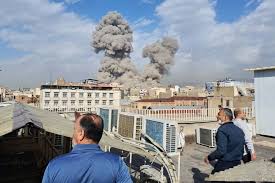
Kampala Moves Swiftly as Tehran Burns
Uganda has issued an urgent advisory to its citizens in Iran following a dramatic escalation of hostilities in the Middle East.
The Ministry of Foreign Affairs has ordered the withdrawal of all non-essential staff from Uganda’s embassy in Tehran.

Ugandan nationals have been advised to leave Iran immediately if they can do so safely.
Those unable to leave have been urged to remain indoors as tensions spiral following a major military confrontation involving the United States and Israel on one side and Iran on the other.
The advisory follows reports that on February 28, joint U.S. and Israeli strikes killed Iran’s Supreme Leader, Ayatollah Ali Khamenei.
Tehran responded swiftly with retaliation, pushing the region into what analysts describe as the most dangerous phase of confrontation in decades.

Uganda’s Official Position
Permanent Secretary Bagiire Vincent Waiswa confirmed that Uganda’s diplomatic footprint in Tehran has been scaled down significantly.
He said consular services are now severely limited as alternative arrangements are explored.
“We are monitoring the evolving situation in the Middle East with grave concern and urge all parties to exercise restraint, prioritize dialogue, and avoid further escalation,” Waiswa said.
“Safety is our top priority. Ugandans who can leave Iran should do so through any possible means.”
He added that those who remain in Iran should stay indoors, inform trusted community leaders of their whereabouts, and follow credible media updates.
The ministry warned that evacuation updates may remain limited while hostilities persist and airspace disruptions continue.
How Decades of Mistrust Led to War
The roots of the Iran–United States conflict stretch back more than seventy years.
In 1953, a CIA-backed coup removed Iran’s Prime Minister Mohammad Mossadegh after he nationalized the country’s oil industry.
The coup restored the Shah to power, deepening resentment among many Iranians toward Washington.
In 1979, the Iranian Revolution overthrew the Shah and established the Islamic Republic under Ayatollah Ruhollah Khomeini.
Later that year, Iranian militants seized the U.S. Embassy in Tehran and held American diplomats hostage for 444 days.
That crisis severed diplomatic ties between the two nations. Hostility deepened over Iran’s nuclear ambitions.
The United States and its allies accused Tehran of pursuing nuclear weapons. Iran insisted its nuclear program was for peaceful energy purposes.
The 2015 Joint Comprehensive Plan of Action temporarily eased tensions by limiting Iran’s nuclear activities in exchange for sanctions relief.
However, the United States withdrew from the agreement in 2018 and reimposed sanctions. Tensions escalated further in 2020 when the U.S. killed Iranian General Qassem Soleimani in a drone strike.
Iran responded with missile attacks on U.S. bases in Iraq. Meanwhile, Israel has long viewed Iran as its most significant regional threat.
Israel accuses Tehran of arming and financing groups such as Hezbollah and Hamas. Iran denies direct aggression but openly opposes Israel’s existence as a state.
In mid-2025, Israeli strikes on Iranian-linked targets triggered a 10-day exchange of fire.
The February 28 assault marked the most dramatic escalation yet, reportedly aimed at dismantling Iran’s nuclear infrastructure and senior leadership.
The Current State of the War
Retaliatory missile and drone strikes have since targeted military installations and strategic assets.
Airspace across parts of the Middle East remains disrupted. Oil markets have reacted sharply amid fears of supply interruptions through the Strait of Hormuz.
Diplomatic efforts are underway through regional intermediaries, but no formal ceasefire has been announced.
Security analysts warn that prolonged fighting could destabilize neighboring states and threaten foreign nationals across the region.
What This Means for Uganda
Uganda maintains a policy of non-alignment and diplomatic engagement in global conflicts. Kampala has positioned itself as a voice for restraint and dialogue.
However, Uganda’s leverage in influencing the conflict remains limited to diplomatic appeals. Precise figures for Ugandans currently in Iran are unclear.
Many nationals travel independently and do not formally register with embassies.
Data from the Ministry of Gender, Labour and Social Development shows that more than 250,000 Ugandans migrated to the Middle East between 2016 and 2024.
Most traveled for domestic and professional employment.
Saudi Arabia hosts the largest share, followed by the United Arab Emirates and Qatar.
Smaller but significant numbers are engaged in trade and study in Iran.
Prolonged instability in the Middle East could have serious economic consequences for Uganda.
Remittances from Ugandans abroad contribute significantly to the country’s import-dependent economy.
Rising global oil prices could further strain Uganda’s cost of living and trade balance.
A Nation Watching from Afar
For families with relatives in Iran, the crisis is deeply personal. For policymakers in Kampala, it is both a humanitarian and economic concern.
For the wider world, it represents a dangerous turning point in one of the longest-running geopolitical rivalries of modern times.
As Uganda calls for calm, its citizens in Iran face an uncertain and rapidly evolving security landscape.