












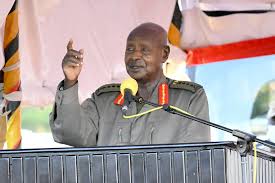
A powerful reflection on Uganda’s liberation history took center stage as Yoweri Kaguta Museveni paid tribute to Caleb Akandwanaho, describing him as a living symbol of sacrifice, patriotism, and transformation.
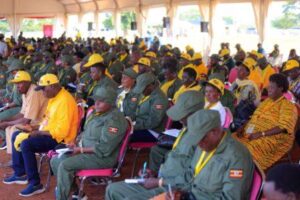
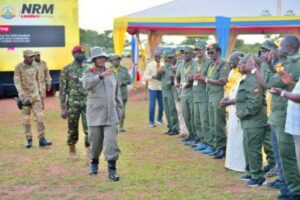
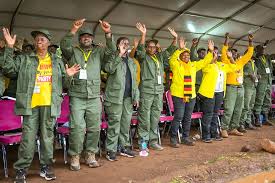
The President delivered the remarks during the ongoing National Resistance Movement retreat at the National Leadership Institute Kyankwanzi, where leaders gathered to reflect on ideology, governance, and national development.
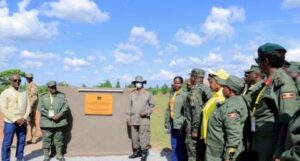
The occasion was marked by the laying of a foundation stone for the Gen. Salim Saleh School of Research and the Walter Rodney Block, a project intended to preserve liberation history and promote ideological education.

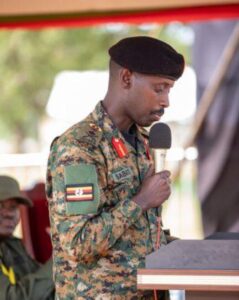
Museveni used the moment not only to honor Saleh but also to narrate his journey from a young schoolboy to one of the key figures in Uganda’s liberation struggle.
“People like Saleh should act as good examples to you young people to show you what patriotism means and how what you do can help your country,” Museveni said, urging leaders to draw lessons from history.
He recounted that Saleh joined the armed struggle at a remarkably young age, abandoning formal education to take part in the fight against dictatorship.
“Saleh joined us in the war against Idi Amin in 1976 when he was just 16 years old,” Museveni explained.
He added that the young Saleh had run away from school at Kako and crossed into Tanzania, where he joined other fighters committed to ending oppressive rule.
“He ran away from school at Kako and joined us in Tanzania together with other fighters like Ivan Koreta,” Museveni said, illustrating the boldness and determination that defined Saleh’s early years.
The President went on to highlight Saleh’s role during the critical years between 1979 and 1986, a period marked by continued instability and armed resistance.
“Between 1979 and 1986, he did a lot of good work, especially during the 1981–1986 war,” Museveni noted.
He emphasized that Saleh was not merely a participant but a commander who led major operations that shaped the outcome of the struggle.
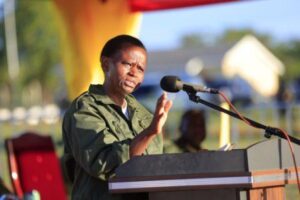
“Saleh commanded many of the big battles, including the battles of Masindi, Kabamba, Masaka, and Kampala,” Museveni said, pointing to his central role in securing victory for the National Resistance Army.
These battles, according to historical accounts, were pivotal in dismantling successive regimes and paving the way for the eventual capture of power in 1986.
Museveni’s recollection painted a picture of a young fighter who matured into a disciplined commander, contributing both strategically and operationally to the liberation cause.
He explained that after the guns fell silent, Saleh transitioned from military engagement to economic empowerment initiatives aimed at improving livelihoods.
“After the war, he became very much involved in wealth creation,” Museveni said, highlighting a shift from combat to development.
He noted that Saleh has since dedicated his efforts to supporting agricultural transformation and economic activities, particularly in northern Uganda.
“He is now busy with development, working with others in areas like coffee and playing a very active role in the north,” Museveni added.
The President also referenced development projects linked to Saleh’s initiatives, including efforts to promote industrial and agricultural growth in areas such as Kapeka.
“That development in Kapeka was started by Saleh. I am very glad that this is a good idea, and I commend you,” he said, acknowledging the long-term impact of such initiatives.
Museveni used the platform to draw a broader lesson for leaders, stressing that patriotism must translate into both sacrifice and service beyond conflict.
He warned against corruption, describing it as a threat that undermines the very ideals fought for during the liberation struggle.
“The corrupt are now in danger and will be dealt with. You cannot underestimate us. You will see what will happen,” he cautioned.
He called on Members of Parliament to take a leading role in fighting corruption by maintaining integrity in their duties.
“You in Parliament are now on the frontline. You should not accept bribes. If you have problems, come and tell us, but don’t take bribes,” Museveni emphasized.
He further warned that those found culpable risk losing their positions, reinforcing the government’s stance on accountability.
“We are going to finish this corruption,” he declared firmly.
The President also likened the retreat to a process of ideological renewal, drawing parallels with religious devotion.
“Christians go to church every Sunday to renew their faith, and Muslims go to the mosque many times a day. It is important that cadres also come to the seminary to renew their commitment,” he said.
Beyond Uganda, Museveni highlighted the importance of regional unity as a pathway to sustainable development.
He argued that fragmented markets and policies limit economic growth across the continent.
“We cannot achieve prosperity with fragmented markets, policies, and infrastructure,” he said, calling for deeper integration.
He paid tribute to African leaders such as Julius Nyerere and Benjamin Mkapa for their role in advancing regional cooperation.
“The whole of the East African Community should move towards full integration,” he added.
The development of the new research facility was further explained by NALI Director, Col. Okei Rukogota, who described it as a hub for ideological and intellectual growth.
“Your Excellency, this complex will promote African culture and provide a forum for ideological struggle, complete with a modern multimedia auditorium and studios for both physical and online engagement,” Rukogota said.
He noted that the facility would preserve the history of liberation while advancing studies in what he termed “Musevenomics.”
“It will be an arena for Musevenomics studies and will honour Gen. Saleh’s contribution—from mobilization during the war to the practical implementation of economic transformation programmes such as SACCOs and community development initiatives,” he added.
The Head of Public Service, Lucy Nakyobe, reinforced the message of patriotism, warning that national development cannot be achieved without it.
“Without patriotism, Uganda cannot achieve its development goals. All public servants must love their country and serve with commitment,” she said.
She revealed that ideological training at Kyankwanzi has been made mandatory for new public servants to instill discipline and national values.
“All new entrants into public service must undergo a two-week induction here,” she noted.
Nakyobe raised alarm over corruption in recruitment processes, describing it as unacceptable and dangerous.
“There have been complaints about people buying jobs. This is unacceptable,” she said.
She warned that corruption, if left unchecked, could grow into a systemic threat.
“Corruption is growing under our watch, and if we do not stop it now, it will become a monster that will destroy the country,” she cautioned.
Health Minister Jane Ruth Aceng highlighted progress in the health sector while emphasizing prevention as the most effective strategy.
“Our population is large, and we cannot meet all treatment needs. The solution is prevention—through proper nutrition, exercise, and healthy living,” she said.
She also pointed to advancements in specialized care, including organ transplant services at Mulago National Referral Hospital.
“So far, Mulago has carried out over 12 transplant surgeries, and all recipients and donors are alive and well,” she revealed.
Through the day’s discussions, the legacy of Gen. Salim Saleh emerged not just as a story of war, but as a continuing journey of national service, bridging Uganda’s past struggles with its present and future aspirations.