













Behind the government announcement of emergency evacuation flights lies a story decades in the making — of broken promises, hardening anger, and a June 30 deadline that has turned the continent’s richest democracy into its most dangerous destination for African migrants
Here in Uganda, a family is in tears after receiving the news that no family should have to receive — the confirmation that their son, their brother, their husband, was killed far from home.
Uganda’s Ambassador to South Africa, Paul Amoru, speaking via Zoom at a press briefing at the Uganda Media Centre in Kampala on Sunday, confirmed that one Ugandan national had been killed in an attack in KwaZulu-Natal Province.

The deceased was identified as Niwamanya Wilber, also known as Ayenebyona Joseph.
Ambassador Amoru conveyed the government’s condolences to the bereaved family and said preparations were underway to repatriate the deceased’s body to Uganda.
The death of Niwamanya Wilber is not simply a statistic. He is the human face of a crisis that has been building for decades — the consequence of a country that promised its citizens liberation from oppression but has spent thirty years struggling to deliver on that promise, and has increasingly allowed ordinary people to direct their frustration at the most visible and most vulnerable outsiders in their midst: other Africans who came in search of the same things.
The Announcement
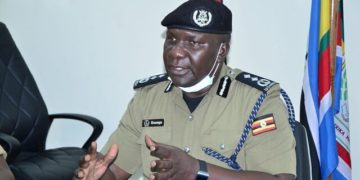
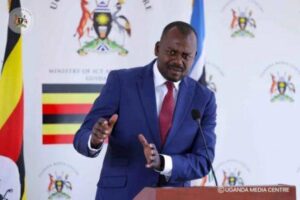
Speaking at the Uganda Media Centre in Kampala on Sunday, Acting Minister of Foreign Affairs Haruna Kyeyune Kasolo said President Yoweri Kaguta Museveni had directed the government to immediately begin arrangements for the safe evacuation of Ugandan citizens affected by the deteriorating security situation in South Africa.
Kasolo said the Ministry of Foreign Affairs, working in collaboration with the Office of the Prime Minister, the Ministry of Internal Affairs, the Ministry of Works and Transport, the Uganda High Commission in South Africa, and leaders of the Ugandan community in South Africa, was finalising an evacuation plan expected to commence within the next few days.
According to the minister, 746 Ugandan nationals had so far voluntarily registered for government-assisted evacuation due to growing security concerns. He added that more Ugandans were expected to register, while others had already left South Africa independently following a reported June 30, 2026 deadline allegedly issued by vigilante groups targeting foreign nationals.
Kasolo said several African countries had also begun evacuating their citizens from South Africa in response to the escalating violence.
He explained that Uganda’s evacuation plan includes registering affected nationals across South Africa’s provinces, transporting them to designated assembly centres, issuing emergency travel documents where necessary, and coordinating with immigration authorities to facilitate their departure.
The minister further revealed that in partnership with the Ministry of Works and Transport, the government was arranging for Uganda Airlines to operate special charter flights for the evacuation exercise, with the Government of Uganda fully funding the cost of the flights.
“In the meantime, the Government of Uganda continues to engage the Government of the Republic of South Africa to ensure the security and safety of Ugandan nationals who remain in the country,” Kasolo said.
A Country That Was Supposed to Be Different
To understand why Uganda is now having to fly its citizens home from South Africa, one must first understand what South Africa was supposed to become — and what it is still struggling to be.
When Nelson Mandela walked out of Victor Verster Prison on February 11, 1990, after 27 years of imprisonment, the watching world did not merely see one man’s freedom. They saw the beginning of the end of apartheid — the institutionalised racial segregation system that had governed South Africa since 1948 and which had made the country a global symbol of racial oppression.
The African National Congress, which had fought for liberation while many of its leaders lived in exile, had been supported financially, diplomatically, and physically across the African continent — in Uganda, in Tanzania, in Zambia, in Zimbabwe, in Angola, and in Mozambique — by countries that sacrificed their own economic relationships with Pretoria to stand on the right side of history.
When majority-rule democracy finally arrived in South Africa in April 1994, with Mandela’s election as president, the expectation was not simply political freedom — it was structural transformation. The Rainbow Nation, as Archbishop Desmond Tutu called it, was supposed to deliver economic dignity and social mobility to millions of Black South Africans who had been systematically excluded, dispossessed, and impoverished under apartheid’s machinery.
More than thirty years later, that transformation remains incomplete.
A significant portion of land and wealth remains concentrated in minority ownership structures. Unemployment, especially among the youth, remains persistently high. Informal settlements continue to expand around major cities.
This gap between political freedom and economic reality is central to many of South Africa’s internal tensions.
The Economics of Rage
The numbers that underpin the current crisis are stark.
South Africa’s unemployment rate hovers around 33 percent — among the world’s highest. For young Black South Africans, the figure exceeds 45 percent.
This is the soil in which xenophobia grows.
South Africa’s unemployment rate remains above 30 percent, with poverty and inadequate service delivery disproportionately affecting township communities. In this environment, foreign nationals are frequently blamed for taking jobs, straining public services, and undercutting local businesses.
South Africa’s official unemployment rate is one of the worst in the world, with youth unemployment at over 60 percent. Anti-immigrant groups blame foreigners for crime and unemployment, but the data shows neither problem can be blamed solely on immigration — both are rooted in years of economic stagnation and government mismanagement.
Many scholars trace the roots of anti-immigrant sentiment to migration systems established during apartheid. Under apartheid, migrant labour from neighbouring countries was carefully controlled to meet economic demands while preventing long-term settlement and integration. Although South Africa transitioned to democracy in 1994, critics argue that many aspects of the administrative and bureaucratic framework governing migration remained intact.
More than thirty years after the end of apartheid, many Black South Africans continue to experience poverty, unemployment, and social exclusion. The promise of liberation brought hope for a more just and inclusive society, but for many people, that hope remains only partly fulfilled.
Long experiences of exclusion and humiliation can create frustration, resentment, and insecurity. When people feel that society has failed them, they often search for explanations — and sometimes they search for someone to blame. Migrants then become an easy target.
A Cycle of Violence With Deep Roots
The violence of 2026 did not erupt without warning. South Africa has been through this before — repeatedly, and with deadly results.
Since 2008 — when 62 people, including 21 South Africans, 11 Mozambicans, 5 Zimbabweans, and 3 Somalis, were killed — South Africa has been grappling with intermittent but widespread xenophobic harassment and violence against African and Asian foreign nationals, whether refugees, asylum seekers, or both documented and undocumented migrants.
Sporadic waves of violence erupted against foreign nationals in 2015, 2019 — primarily targeting Nigerian nationals — and 2021-2022, with the rise of vigilante groups like Operation Dudula, meaning “force out” in Zulu.
Since 2024, the country’s deteriorating socioeconomic conditions, including an unemployment rate of over 43 percent, coincided with the rise of anti-immigrant activism and the formation of newer vigilante groups like March and March. These groups scapegoat foreign nationals as the cause of South Africa’s economic woes, poor service delivery, and high rates of crime, despite studies that disprove these claims.
What distinguishes the 2026 wave from its predecessors is not simply its intensity — it is the degree of organisation behind it, and the political legitimacy it has been allowed to accumulate.
“Mabahambe” — They Must Go
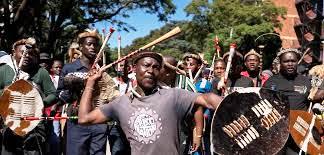
For months, mobs of anti-immigrant protesters, many brandishing sticks, have been marching through the streets chanting “Mabahambe” — a Zulu phrase meaning “They must go.”
In April and May 2026, a citizen-led movement, March and March, organised demonstrations against undocumented migrants in major cities including Pretoria, Johannesburg, and Durban, with violent and sometimes fatal results.
In May 2026, armed demonstrations erupted against what protesters described as “illegal foreigners.” In Johannesburg, demonstrators would identify whether a bystander was a foreigner before attacking them.
Some protesters claim to perform “arrests” and say they have the right to check immigration papers, although they have no legal authority to do so. Foreign-owned businesses have been attacked, people chased from their homes, and several migrants have been killed.
Mpho Makhubela, a member of the Consortium for Refugees and Migrants in South Africa and an activist in the Kopanang Africa Against Xenophobia coalition, noted the opportunistic nature of these groups. “Vigilante groups feed off the country’s frustrations and socioeconomic rights regression, unemployment, and lack of efforts to address the equity gaps that we have as a country,” he said. “The reality is that the country has been faced with the enormous task of addressing the legacies of apartheid.”
The founder of March and March, Jacinta Ngobese-Zuma, has repeatedly made inflammatory statements against foreign nationals, particularly Nigerians, blaming them for crime and other social vices in South Africa — claims not supported by evidence.
Fiery South African politician Julius Malema disclosed that over 90 percent of convicted criminals in South African prisons were South Africans, not foreign nationals.
South African President Cyril Ramaphosa gave a national television address earlier this month in an attempt to defuse tensions, saying some protest groups were exploiting the immigration issue to advance their own political agendas and that “illegal immigration is not the cause of our social and economic difficulties.”
But Ramaphosa also conceded that there had been failures in South Africa’s border control.
The June 30 Deadline: Legally Meaningless, Practically Lethal
The date that has been haunting millions of African migrants across South Africa carries no legal weight whatsoever.
March and March, along with other anti-immigrant groups, spent months organising marches through Johannesburg, Pretoria, Durban, and Cape Town, demanding that undocumented foreign nationals leave South Africa by June 30. The groups have no legal authority to enforce any deadline, and government officials repeatedly said the ultimatum has no standing in law.
But the movement has driven real violence: foreign-owned businesses have been attacked and looted across multiple provinces, migrants have been chased from their homes, and at least several people have been killed. Five Mozambicans were killed in Mossel Bay, and a series of attacks on Ethiopian-owned businesses were reported in Gauteng province.
The June 30 deadline, though legally meaningless, has given the movement a focal point that risks turning into a flashpoint, with police warning that any violence after the date passes will be met with force. The crisis also casts a shadow over South Africa’s global standing just weeks after it hosted World Cup group matches — the country is one of three co-hosts of the 2026 tournament alongside the United States and Canada — and as several African governments have publicly condemned Pretoria’s handling of the situation.
The latest census figures from 2022 show there were 2.4 million foreign nationals who had immigrated to South Africa’s population of 62 million — less than 4 percent of the population.
That 4 percent has been made responsible, in the narrative of the anti-immigrant movement, for the unemployment of more than 30 percent. The arithmetic does not add up. But fear and rage rarely consult arithmetic.
A Continent Packs Its Bags
The response from African governments to the June 30 deadline has been a remarkable and painful reversal — the children of liberation returning home from the country their parents helped to free.
With the June 30 ultimatum drawing near, African nations including Malawi, Nigeria, Ghana, Zimbabwe, and Mozambique have mounted emergency evacuations of their nationals.
More than 3,000 Malawians, including hundreds of children, have been staying in an open field in South Africa’s port city of Durban after fleeing escalating anti-immigrant threats and attacks.
One Malawian mother, Sayiba John, 33, who fled Nazareth township with her husband and three children and whose daughter, a Grade 2 pupil, was forced to abandon her school exams, put the situation with devastating simplicity: “They said we must go. We have no choice in the matter. It’s better our government take us away from here than to face the anger of the South Africans.”
Nigeria repatriated a first group of 260 nationals. Ghana, Mozambique, and Malawi have carried out similar operations. Five Mozambicans were killed in Mossel Bay, and more than 150 Malawians were bussed out of the Western Cape province.
Ghana organised early evacuation flights for approximately 300 to 1,000 citizens from Johannesburg to Accra, and provided for their upkeep on arrival. Mozambique repatriated between roughly 700 to 800 citizens. Zimbabwe also evacuated many of its citizens fleeing intimidation and violence. Countries like Kenya and the Democratic Republic of the Congo offered voluntary repatriation support for their nationals.
The African Union has called on South Africa to guarantee the safety of all foreign nationals within its borders.
What Ugandans Are Living Through
The Ugandan community in South Africa is not large in the way that the Zimbabwean or Malawian communities are. But it has grown steadily over the years as Ugandans sought opportunities in sectors ranging from trade to professional services in Johannesburg, Pretoria, Cape Town, and Durban.
Many arrived legally. Many built businesses. Many put down roots. Many are now being told, by mobs with sticks and by viral social media posts, that they do not belong.
The Acting Minister confirmed that one Ugandan — Niwamanya Wilber, also known as Ayenebyona Joseph — was killed in KwaZulu-Natal, where the violence has been most concentrated.
The 746 Ugandans who have voluntarily registered for evacuation represent those who have made the difficult calculation that staying is no longer worth the risk.
Others have not yet registered. Some remain, by choice or circumstance, in a country that is rapidly becoming hostile territory for anyone who speaks with the wrong accent or runs a business that a neighbour has decided they should not be running.
Uganda’s Response
The Ugandan government’s evacuation plan is both logistically and diplomatically structured.
The plan includes registering affected nationals across all of South Africa’s provinces, transporting them to designated assembly centres, issuing emergency travel documents where necessary, and coordinating with immigration authorities to facilitate their departure.
In partnership with the Ministry of Works and Transport, Uganda Airlines will operate special charter flights for the evacuation exercise, with the government meeting the full cost.
Kasolo’s message to the remaining Ugandan community in South Africa was direct and urgent: the government has urged all its citizens in South Africa to remain in close contact with the Uganda High Commission and to follow official guidance as evacuation arrangements are finalised.
But the minister was also clear that Uganda’s response was not simply to withdraw and wash its hands of the situation.
“The Government of Uganda continues to engage the Government of the Republic of South Africa to ensure the security and safety of Ugandan nationals who remain in the country,” Kasolo said.
A Fracture in African Solidarity
The crisis in South Africa is not simply a bilateral issue between Pretoria and Kampala, or Pretoria and Abuja, or Pretoria and Lilongwe.
It is a fracture in the idea of African solidarity that the continent’s liberation struggle was built upon.
South Africa’s struggle against apartheid was supported by governments and citizens across Africa.
The same continent whose countries housed ANC freedom fighters, sheltered Mandela’s comrades, and defied economic pressure from the apartheid regime is now watching as South Africa’s most economically frustrated communities turn their anger on African migrants.
Critics argue that xenophobia diverts attention away from structural inequality and toward vulnerable outsiders. If Black South Africans blame Nigerian shopkeepers or Zimbabwean labourers, they are not confronting the deeper issue: the enduring economic architecture left behind by colonialism and apartheid.
As EFF leader Julius Malema put it plainly, challenging the logic of the anti-immigrant protesters: “You say Zimbabweans take your jobs. Nigerians take your jobs. You march, close shops and beat up people. Tell us after doing that how many jobs have you created.”
Unemployment, poverty, inequality, and weak governance remain the real drivers of public frustration. Blaming migrants may provide a convenient political narrative, but it does not solve these underlying challenges.
For the family of Niwamanya Wilber, waiting for his body to be returned to Ugandan soil, none of that political analysis brings comfort.
For the 746 Ugandans waiting to board a charter flight home, what matters is simpler: that they get out safely, and that the country which was supposed to be Africa’s beacon of liberation does not add more names to the list of the dead.