

















From stolen engines and drowning fishermen to oil-rich border disputes and transnational trafficking routes, Uganda’s water bodies have long needed a security response that matches the scale of the threat. The IGP says the fleet upgrade is only the beginning
Uganda is a country defined by water.
Its southern border runs along the northern shore of Lake Victoria — the world’s second-largest freshwater lake, shared with Kenya and Tanzania, sustaining over 40 million people and generating an estimated $600 million annually in fish exports.

To the west, Lake Albert sits along the contested border with the Democratic Republic of Congo, at the heart of Uganda’s emerging oil and gas frontier.
Yet despite the economic and strategic weight of these water bodies, Uganda’s marine security has long struggled to match the scale of the threat it faces.
In 2024, Uganda’s Marine Police recorded 190 maritime offences — an 8 percent increase from 176 cases in 2023. Drowning led with 119 cases, representing 62 percent of total water offences, followed by robbery on water with 34 cases.
In Buvuma District, at least 40 outboard engines were stolen from fishermen, while community leaders in Kyotera District reported 90 engines stolen. Fishing communities became so desperate that they petitioned the army directly, describing the situation as “a matter of life and death,” and sought permission to form their own vigilante groups.
The lake is vast and hardly policed, a condition that has given rise to illegal operations spanning environmental crime, transnational trafficking of narcotics and small arms, and outright robbery of fishermen who have no meaningful recourse.
It is into this environment that the Uganda Police Force has just delivered nine new speed boats — and announced plans that go far beyond the vessels themselves.
The Commissioning at Kigo
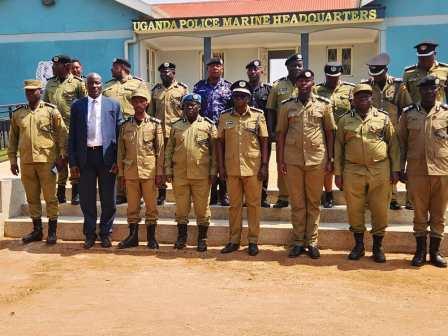
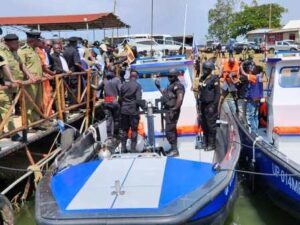
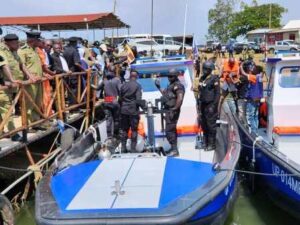
On Thursday, Inspector General of Police Abaas Byakagaba stood at the Uganda Police Marine Headquarters in Kigo and commissioned nine newly acquired speed boats into service.
The vessels will not all remain on Lake Victoria.
Byakagaba said they will be deployed to strategic locations including Lake Kyoga, Lake Albert, Butiaba, and Ntoroko — a deployment map that reflects the geographic spread of Uganda’s maritime security challenges from the oil-rich western frontier to the central waterways.
He further disclosed that five additional speed boats are expected next month, bringing the total planned acquisition in this cycle to fourteen vessels.
Director of Operations, Assistant Inspector General of Police Frank Mwesigwa, said the newly commissioned boats will significantly improve the police’s ability to respond swiftly to emergencies and security incidents on Uganda’s water bodies.
Byakagaba urged marine personnel to handle and maintain the new vessels professionally to ensure they remain operational for many years.
He also revealed that police management intends to adjust its budget to construct proper shelters for both new and existing marine vessels, to protect them from harsh weather conditions and prolong their lifespan.
According to the IGP, the new boats will play a key role in safeguarding Uganda’s social and economic development by strengthening the fight against maritime crime and improving security across the country’s water bodies.
The Case for a Marine Training School
The most significant announcement at Kigo was not the boats themselves — it was what Byakagaba said would follow them.
The IGP revealed that the Uganda Police Force is planning to establish a Marine Training School, designed to equip personnel with specialised skills to effectively fight maritime crime and improve safety on Uganda’s lakes and waterways.
He said officers who complete the training will receive professional certification — an elevation of marine policing from a posting to a recognised profession, with credentials that reward the specialised knowledge that water-based law enforcement demands.
The principle driving the school proposal is straightforward: equipment without training is a depreciating asset, while training without equipment leaves officers unable to act.
A Marine Training School would address both sides permanently — producing certified officers who understand navigation, maritime law, emergency rescue, surveillance techniques, and the specific criminal patterns of Uganda’s lake environments.
The announcement places Uganda alongside a growing regional trend.
In Tanzania, the United States government has invested in a Marine Police College as part of a broader initiative, recognising that improving officer training standards and maintenance facilities for patrol vessels is what creates a force ready for 24-hour surveillance — not simply the acquisition of boats.
What the Unit Looks Like From the Inside
The Commandant of the Marine Unit, Commissioner of Police Sulaiman Kirungi, used the commissioning ceremony to give a candid account of what the unit needs beyond the speed boats.
He said the Marine Unit currently has a workforce of 415 personnel serving across the country — a number that, spread across Uganda’s four major lakes and numerous waterways, stretches operational coverage considerably.
He highlighted the immediate pressure created by 100 newly deployed probationer constables assigned to the unit, saying additional support is urgently needed to train these officers for maritime operations — making the proposed Marine Training School not just aspirational but operationally critical.
Kirungi also raised the question of accommodation and welfare, calling for improved housing and logistical support for officers posted to remote lakeside locations.
His most pointed appeal concerned land and infrastructure: he called on police management to facilitate the construction of proper vessel docks and to secure dedicated land for the Marine Unit, rather than continuing to rent docking facilities from private island owners — a dependence that creates both logistical vulnerability and unnecessary recurring cost.
Oil, Borders, and the Strategic Stakes
The urgency behind Uganda’s marine security investment extends well beyond fishing theft and drowning statistics.
Uganda’s interest in marine security sharpened significantly after an incident in August 2007, when Congolese troops on the disputed Rukwanzi Island in Lake Albert shot and killed oil prospectors conducting surveys on the Ugandan side of the lake — a stark demonstration that Uganda’s western water border is a sovereignty and resource protection imperative, not merely a fisheries question.
Officials have also noted that Uganda’s main Entebbe International Airport sits on a peninsula in Lake Victoria, giving maritime security a direct connection to national counterterrorism planning. A presidential directive designated the Marine Police as the leading force on Uganda’s waters, with all other security agencies permitted to operate on the lakes only with authorisation from the Inspector General of Police.
With Uganda’s oil production in the Albertine region moving closer to full commercial operation, the strategic importance of Lake Albert will only increase — making the Marine Unit’s capacity a matter of national economic security.
Safety on Water and Road: A Connected Message
Speaking on public safety more broadly, the IGP drew an explicit connection between the Marine Unit’s expanded capacity and the wider question of safety consuming public attention in Uganda.
He cited the recent fatal road accident involving King David Junior School in Kapchorwa District — the crash at Chekwatit Hill that claimed 24 lives, the majority of them children — saying the tragedy underscores the need for enhanced safety measures across all sectors, whether on roads or on water.
The parallel was deliberate. Just as school buses carry children who trust that the systems around them are safe, fishing boats and passenger ferries carry communities who trust that Uganda’s water bodies are policed.
“Our Marine Unit is fully prepared to respond swiftly and effectively to any incident on Uganda’s waters. Ensuring the safety of our citizens and upholding law and order on our lakes and rivers remains our top priority,” the IGP said.
The boats are now in the water.
The school, if it comes, will determine whether the officers inside them are truly ready for everything the water holds.