












Uganda has stepped up its commitment to regional disease control after President Yoweri Kaguta Museveni pledged comprehensive support to the Democratic Republic of Congo (DRC) in its latest battle against Ebola, while proposing the establishment of specialized Ebola treatment centres inside eastern Congo to stop the deadly virus before it reaches neighbouring countries.
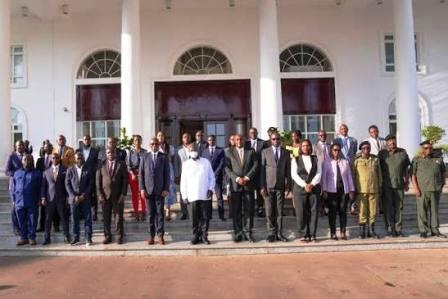
The proposal emerged during a high-level meeting at State House Entebbe on Wednesday evening between President Museveni and the Democratic Republic of Congo’s Minister of Public Health, Hygiene and Social Welfare, Dr. Kamba Mulanda Samuel Roger.
The Congolese minister was delivering a special message from President Félix Tshisekedi concerning the worsening Ebola situation in eastern DRC and the need for stronger regional cooperation.

The meeting brought together senior Ugandan government officials responsible for health, security and border management, underlining the importance Uganda attaches to preventing another major regional health emergency.
Uganda Extends Medical Expertise to Its Neighbour
During the discussions, President Museveni reaffirmed Uganda’s willingness to stand with its western neighbour by providing medical treatment, technical expertise and operational support to strengthen the Congolese response.
“I reaffirmed Uganda’s readiness to support our brothers and sisters in the DRC through treatment, technical expertise and close regional cooperation,” President Museveni said.
The President emphasized that infectious diseases know no borders and therefore require coordinated regional action rather than isolated national responses.
He stressed that protecting communities in eastern Congo ultimately protects Ugandans living along the busy border shared by the two countries.
According to the Office of the President, Uganda is prepared to work hand in hand with Congolese authorities to ensure that the outbreak is brought under control before it escalates further.
Treatment Centres Near Communities Could Save Lives
One of the most significant proposals made by President Museveni was the construction of dedicated Ebola treatment centres inside eastern Democratic Republic of Congo.
The President argued that locating treatment facilities close to affected communities would dramatically reduce the movement of infected patients across long distances in search of medical care.
Such centres, he noted, would make it easier for patients to receive immediate treatment while allowing health workers to isolate cases more quickly.
“I also proposed establishing Ebola treatment centres inside eastern DRC to ensure early treatment closer to the affected communities and help contain the disease at its source,” President Museveni said.
Health experts have long maintained that early diagnosis and prompt isolation are among the most effective tools for controlling Ebola outbreaks.
By treating patients near their homes, authorities can also strengthen contact tracing and reduce opportunities for further transmission.
Uganda has already indicated that it is ready to deploy health specialists and technical teams to support these facilities should the proposal be implemented.
Uganda’s Experience Shapes the Proposal
President Museveni noted that Uganda’s own recent encounter with Ebola demonstrated the value of acting quickly.
“Uganda contained its recent Ebola cases through early detection, treatment and strict public health measures,” the President stated.
The country’s response relied heavily on rapid identification of suspected cases, extensive contact tracing, strict screening at border entry points, laboratory testing and prompt isolation of infected individuals.
Rather than completely shutting down economic activity, Uganda strengthened surveillance at major border crossings while allowing essential cargo to continue moving under strict health controls.
These interventions enabled health authorities to interrupt transmission chains before they expanded into widespread community outbreaks.
A Long Record in the Fight Against Ebola
Uganda is widely regarded as one of Africa’s most experienced countries in managing Ebola outbreaks.
Since the country’s first major outbreak in 2000, successive governments under President Museveni have invested heavily in disease surveillance systems, laboratory capacity, emergency response units and specialised treatment facilities.
The devastating outbreak in Gulu District in 2000 became a turning point for Uganda’s public health system.
Lessons learned from that epidemic led to the development of stronger emergency preparedness structures that have since been activated whenever Ebola or other dangerous infectious diseases have threatened the country.
During subsequent outbreaks in districts such as Bundibugyo, Kibaale, Kasese, Mubende and other areas, Uganda refined its approach by combining rapid laboratory diagnosis, aggressive contact tracing, community mobilisation, public education and strict infection prevention measures.
President Museveni has consistently emphasised the importance of science-based decision-making during epidemics.
His administration has repeatedly urged the public to cooperate with health authorities, report suspected cases early and avoid practices that increase transmission, including unsafe handling of patients and bodies of Ebola victims.
During Uganda’s most recent outbreak, the government intensified screening at airports and border posts, strengthened surveillance in high-risk districts and mobilised security agencies alongside health workers to support response operations.
The President also maintained regular communication with the nation, assuring citizens that the government possessed the capacity to control the outbreak while urging calm and adherence to Ministry of Health guidelines.
Health officials have frequently credited Uganda’s previous outbreak experience for enabling quicker detection and faster containment compared with many countries encountering Ebola for the first time.
Regional Cooperation Becomes More Critical
The latest initiative reflects growing recognition that diseases such as Ebola cannot be defeated through national efforts alone.
Uganda and the Democratic Republic of Congo share an extensive and highly active border crossed daily by traders, transporters, families and humanitarian workers.
This constant movement makes close cooperation between the two governments essential.
Joint surveillance activities, information sharing and coordinated emergency responses have become increasingly important in preventing cross-border transmission.
President Museveni’s proposal seeks to strengthen these collaborative efforts by addressing infections at their point of origin before they spread into neighbouring countries.
The Current Ebola Situation in DR Congo
The Democratic Republic of Congo is currently battling one of its most challenging Ebola outbreaks in recent years.
According to the World Health Organization, sustained transmission has continued in several affected areas, with hundreds of deaths reported and thousands of confirmed infections.
Health experts say the response has been complicated by insecurity in some regions, community mistrust, limited healthcare infrastructure and difficulties tracing contacts.
Medical humanitarian organisations have warned that treatment capacity needs urgent expansion as new infections continue to emerge in multiple locations.
These challenges have reinforced calls for stronger regional and international support to prevent the outbreak from expanding further.
Strengthening Regional Health Security
Officials say the discussions at State House demonstrated the growing partnership between Uganda and the Democratic Republic of Congo in addressing shared public health threats.
Beyond the immediate Ebola response, the meeting highlighted the broader importance of investing in resilient health systems capable of responding rapidly to future epidemics.
For Uganda, helping neighbouring countries strengthen their disease control capacity is increasingly viewed not only as humanitarian assistance but also as an important investment in the country’s own health security.
As Ebola continues to challenge communities in eastern Congo, President Museveni’s proposal to establish treatment centres closer to affected populations represents a preventive strategy aimed at containing infections at their source while reinforcing regional solidarity in the face of one of Africa’s most dangerous infectious diseases.