













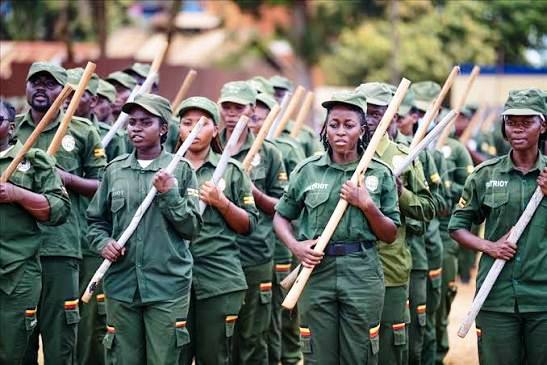
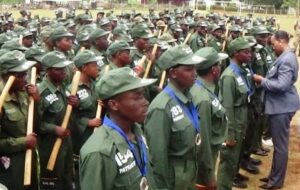
Two hundred and seventy students stood in formation at Leaura School of Nursing and Midwifery in Bugweri District, and by the time the parade ended, they were no longer just nursing trainees.
They were graduates of a two-week programme the government now insists every new student in the country must complete.
Uganda’s Patriotism Secretariat has directed all secondary schools and higher institutions to ensure newly admitted students undergo patriotism training, describing the exercise as compulsory under a presidential directive meant to instil love of country, discipline, and responsible citizenship.

A Pass-Out Ceremony With a Bigger Message
The directive was delivered at Leaura School of Nursing and Midwifery by Pamela Watuwa, the Patriotism Secretariat’s Communication and Public Relations Officer, who represented Secretariat Coordinator Hellen Sekku at the event.
Before the formal pass-out, Watuwa inspected the trainees’ parade, watching as the students performed marching drills, military-style routines, and acrobatic displays that drew visible enthusiasm from the local leaders and guests in attendance.
The institute’s Patriotism Patron, Tadeo Nantamu, said the trainees had picked up practical skills in leadership, discipline, patriotism, and teamwork, competencies he said could open doors for them in Uganda’s security agencies and wider public service.
Sauleima Lule, Director of Leaura School of Nursing and Midwifery, framed the training in terms specific to her students’ future careers, saying it helps shape disciplined and compassionate health workers committed to serving patients professionally.
She commended President Yoweri Museveni for introducing the patriotism programme in the first place.
Local officials used the ceremony to press the same point home.
Bugweri Resident District Commissioner Bamuli Magala urged the graduates to put their new lessons into practice, arguing that discipline and patriotism would set them apart from their peers.
Bugweri County MP Sadala Wandera encouraged the students to stay committed to national development, and pledged to keep supporting vulnerable students in accessing education.
Watuwa closed the ceremony by reiterating the government’s expectation that every secondary school and higher institution organize similar training for newly admitted students, in line with the presidential directive.
She also cautioned the graduates against falling in with negative peer groups that could pull them toward criminal activity or other misconduct, before awarding certificates and medals to mark their completion of the course.
Where the Programme Actually Came From
The scene in Bugweri is a small, local instance of something that began nationally seventeen years earlier.
In 2009, President Museveni launched a strategic national programme to inculcate norms and values of patriotism in students and youth across all of Uganda’s secondary schools, a move that led directly to the establishment of Patriotism Clubs in schools nationwide.
That original initiative grew into the National Secretariat for Patriotism Corps, a department under the Office of the President tasked with promoting patriotism ideology across Uganda’s education system.
The Secretariat’s own stated mission is ambitious: to counter what it calls ideological distortion, to universalise patriotism training from primary school through university, and to make patriotism mainstreaming mandatory in every school and institution in the country.
Legally, the programme’s advocates root it directly in Uganda’s 1995 Constitution, which they argue commands every citizen to be patriotic and loyal precisely because it treats rights and duties as inseparable.
Practically, that has meant a curriculum covering Uganda’s history and cultural heritage, civic duties, leadership, and community engagement, delivered through a mix of classroom instruction, community service, leadership workshops, and heritage tours.
The course is no longer treated as a soft extracurricular add-on.
Hellen Seku, now Commissioner of the National Secretariat for Patriotism Corps, has stated plainly that the course is officially recognised under Uganda’s education curriculum and is examinable in schools.
“This programme is compulsory and a government programme that is examinable,” Seku has said.
“If you deny it in your schools, you deny Ugandan children important information and exposure beyond the classroom,” she added.
What Students Say They Actually Take From It
The government’s case for the programme rests heavily on official framing, but some of the strongest testimony has come from students themselves.
At a recent patriotism pass-out ceremony for more than 2,500 participants at King’s College Budo, head prefect Mwesigwa Amos spoke on behalf of his fellow graduates about what the training had changed in them.
“It is nurturing us into people of integrity, unity, discipline, acceptance, and love, thus protecting the gains of our country, Uganda,” Mwesigwa said.
He described the week-long course as having deepened students’ understanding of patriotism, national identity, leadership, discipline, teamwork, and the importance of serving the country selflessly.
“We have learned that patriotism is not merely about rights, but about actions that promote peace, integrity, responsibility, and national development,” he said.
That framing, of patriotism as something practised rather than merely felt, echoes what Vice President Jessica Alupo told headteachers gathered for a separate Patriotism Development Course aimed at integrating the subject more deeply into school curricula.
“Education is not just about textbooks and exams,” Alupo said.
“It is about molding responsible citizens who love their country and are committed to its progress,” she added.
Reaching the Teachers, Not Just the Students
Government has increasingly recognised that changing what students learn requires first changing how teachers teach.
In September 2025, President Museveni personally passed out 1,372 secondary school teachers from the Greater Mbarara and Ntungamo regions who had completed a patriotism course at Ntare School under the theme “Transforming Teachers’ Lives Through Patriotism.”
Seku told the President that the training had been organised after a number of teachers themselves requested it, believing they needed the exposure to become effective change agents for their students and surrounding communities.
Museveni, who has referred to himself in Secretariat communications as the programme’s “Chief Patriot,” used the occasion to thank Seku and her instructors for what he called keeping the fire of patriotism burning in the hearts of the country’s young people.
First Lady and Minister of Education Janet Museveni, who serves as the programme’s Deputy Patron, has argued that teachers carry outsized influence in this effort, noting that the time a teacher spends with a child is valuable in shaping what it means to love one’s country.
A Programme Still Expanding
Seventeen years after its launch, the patriotism programme shows no sign of settling into routine.
Government has continued rolling out fresh cohorts of trainees, from headteachers in the Western Region to nursing students in Bugweri, each pass-out ceremony reinforcing the same message that patriotism is now treated as core curriculum rather than optional civic enrichment.
Supporters point to testimonials like Mwesigwa’s as evidence the programme is genuinely shaping how young Ugandans see their responsibilities to one another and to the country’s peace and stability.
For the 270 graduates who left Leaura School of Nursing and Midwifery with certificates and medals around their necks, the immediate test will be whether the discipline and teamwork drilled into them over two weeks survives contact with the wards, communities, and workplaces they are now headed toward.