







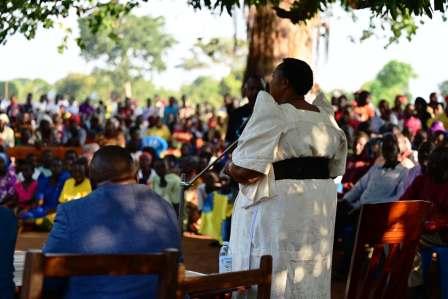
A dusty stretch of road in Nkondo Sub-county carried an unusual visitor this week.
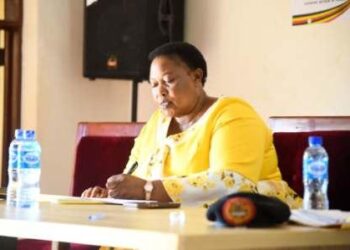
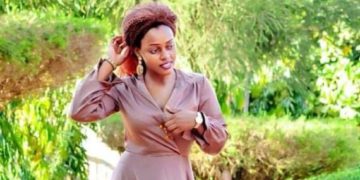
Minister for the Presidency Hon. Babirye Milly Babalanda, who also represents Budiope West in Parliament, walked into Iringa West Parish not with a campaign message, but with a scorecard.
She had come to check on money.

Specifically, she had come to check on the Parish Development Model funds that government has been pouring into households across her own constituency.
The visit unfolded in a place she knows intimately, since Iringa West sits inside the very constituency she represents in the House.
Greetings From State House, Then Straight to Business
Before she got to the numbers, the Minister carried a message.
She conveyed regards from President Yoweri Kaguta Museveni to the people of Budiope West.
She passed on greetings from the First Lady and Minister of Education and Sports, Maama Janet Kataaha Museveni.
She relayed goodwill from the Permanent Secretary of the Office of the President, Hajji Yunus Kakande, and from the entire staff of the Office of the President.
Then she turned to the reason she had actually come.
She reminded the gathering that PDM is not just another government scheme among many.
She described it as the core flagship programme through which President Museveni intends to move Ugandan households out of subsistence and into the money economy.
“Do Not Marry a Second Wife With This Money”
It was here that the Minister’s tone sharpened.
She had a warning specifically for the men in the audience.
She urged beneficiaries not to divert PDM capital into what she called irrelevant pursuits, singling out the practice of men using the money to marry second wives.
Instead, she said, the funds must be handled with integrity and hard work, channelled toward building sustainable wealth and real jobs.
She then turned her attention to the people meant to guide that process on the ground.
“I call on district technical staff, political leaders, and PDM SACCO leaders to provide proper guidance, supervision, and accountability so that our people succeed in enterprises like agriculture, poultry, and small-scale trade,” she said.
It is a message rooted in a wider concern that has followed the programme since its earliest days.
Government’s own implementation guidelines for the model list transparency, accountability and results among its founding principles, precisely because past wealth-creation schemes had struggled with exactly the misuse the Minister was warning against.
A Word of Praise for the Technical Team
Not every part of her message was corrective.
Hon. Babalanda commended the technical team of Buyende District, led by the Chief Administrative Officer, for the effort they had put into the programme so far.
She tasked them with staying the course, specifically on three fronts.
They must continue training beneficiaries.
They must continue supporting proper record keeping.
And they must continue helping farmers and traders find real markets for what they produce.
Two Priorities for This Term: Corruption and Poverty
The Minister used the Nkondo visit to frame the government’s broader agenda for the current term.
She told residents that this term, government is focused on two things above all else.
The first is fighting corruption.
The second is working hard to end poverty.
She said monitoring tours like this one will continue, precisely to ensure that service delivery actually reaches the people it is meant for, as Uganda works toward its ambition of reaching upper middle-income status.
What the Numbers Actually Show
That ambition is not simply rhetorical.
Parliament has been told that PDM remains government’s most important intervention for eliminating subsistence and expanding participation in the money economy, described as a structural transformation programme whose objective is to move households from subsistence to commercial production, from survival to enterprise, and from poverty to prosperity.
The scale of the funding behind that ambition has grown steadily since the programme launched.
Over the past five years, government has transferred Shs 4.4 trillion to all 10,589 parishes nationwide as revolving capital, with PDM funds expected to reach over four million beneficiaries.
The digital tracking system built around the programme tells a similar story of scale.
In just over two years since launching, the system has tracked over Shs 2.7 trillion sent to PDM Savings and Credit Cooperatives, with Shs 2.5 trillion reaching more than 2.5 million beneficiaries directly.
The problem the programme was designed to solve remains a large one.
According to the 2019/2020 Uganda National Household Survey, 39 percent of Ugandan households, approximately 16 million people, were still living in the subsistence economy at the time PDM was conceived.
Individual success stories have begun to surface from different corners of the country.
In Masaka City, the Gayaza Nabowa Piggery Group invested PDM funds into piggery farming, enabling members to earn income and support their families, while the Kirimya Poultry B Youth Group used government support to expand poultry activities, and in Kampala, youth groups have used Emyooga SACCO funding to move into boda boda transport, tailoring and small retail trade.
Not every assessment of the programme has been glowing, and Uganda’s own economic researchers have flagged real risks.
Government’s own implementation architecture places the PDM Secretariat under the Ministry of Local Government, coordinating seven pillars ranging from production and marketing to financial inclusion and mindset change, an ambitious structure that critics say still depends heavily on the discipline of local leaders to succeed.
Museveni’s Own Words on the Programme
President Museveni himself has spoken about PDM and its sister programmes repeatedly during tours across the country, often in blunt, homespun language.
Visiting beneficiaries during a wealth creation tour, he described the logic behind the funds in the simplest terms he could find.
“Is the Quran against a grant? This is a grant from the Government of Uganda to your Parish people. It only moves in rounds within you. The only interest we imposed is for checking inflation. PDM and Emyooga are medicine for fighting poverty among the low-income earners,” he said.
On another tour, he framed getting out of poverty as almost entirely a matter of choice and guidance.
“It is easy to get out of poverty here in Uganda. The Parish Development Model and commercial agriculture are some of the simple ways as you can see. To have goats, chickens, cows, others look after pigs, then you grow crops, all those are sources of money. Therefore, poverty here is ignorance when people don’t know what to do and when they get the wrong guidance,” he said.
He has also used the programme to draw a sharp line about who is responsible for eliminating poverty at the household level.
“Poverty is yours. Tonteka mubwavu bwo, nze sili mwavu,” he told supporters, a Luganda phrase loosely translating to a challenge that Ugandans should not attach their poverty to him, since he himself is not poor.
At times, the President has framed PDM funding as so urgent that it has taken priority over other visible infrastructure.
“We would have done this road… but we had to divert money to PDM, because it is not correct to have a tarmac road when poverty is nearby. That is why we have to direct shs 2 trillion per year to PDM and Emyooga program,” he said during a tour of Lango sub-region.
He has repeatedly tied wealth creation to participation, insisting there is no room for bystanders.
“When it comes to wealth creation, we don’t want spectators. With football or athletics, you have sportspeople and spectators, but with wealth creation, everyone must be a player,” he said during a campaign stop in Oyam District.
Backyard Projects, Tailored to Faith and Household
Back in Nkondo, Hon. Babalanda translated the President’s broader vision into something households in Budiope West could act on immediately.
Acting in line with the President’s directive as champion of the wealth creation drive, she urged households to adopt specific backyard enterprises.
She recommended poultry farming for eggs for Muslim households and Seventh-day Adventists.
She recommended piggery for non-Muslim households.
Her reasoning was practical.
She noted that both enterprises can generate quick returns and lift household incomes within a relatively short cycle.
It is advice that mirrors what other leaders have been demonstrating on their own farms elsewhere in the country, where mixed backyard enterprises combining poultry, piggery, dairy and crops have become something of a model for what a single acre or backyard plot can produce when properly managed.
A Thanksgiving Invitation
Before wrapping up her tour, the Minister extended a personal invitation to the residents.
She invited them to join her at a thanksgiving ceremony scheduled for 4th September at Iringa Township Primary School.
The event, she explained, is her way of thanking God for her victory in this year’s political contest.
More Districts to Come
Wednesday’s tour in Nkondo Sub-county was not a standalone visit.
It formed part of a wider monitoring exercise designed to confirm that PDM funds are reaching the people they were meant for and are actually being converted into household wealth.
The Minister promised that her assessment would not stop in Nkondo.
She committed to moving across the whole of Buyende District to evaluate how the Parish Development Model is performing, parish by parish, household by household.