












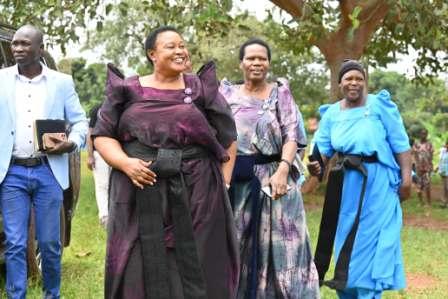
For nine straight days, the grounds of Nkondo SDA Church Zone in Buyende District echoed with something Uganda’s villages rarely get to experience uninterrupted.
Prayer.
Bible study.

Fellowship stretching from morning devotion to evening testimony, drawing hundreds of Seventh-day Adventist believers from across the district into one continuous spiritual gathering.
When the closing ceremony finally arrived, it carried a message that reached far beyond the Camp Retreat itself.
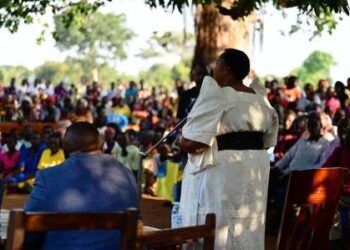
Minister for the Presidency Hon. Babirye Milly Babalanda, who doubles as Member of Parliament for Budiope West and as Director of the Busoga SDA Women’s Field, stood before the congregation with an appeal that fused scripture with statecraft.
Preach wealth creation from the same pulpit where you preach salvation, she told the assembled pastors.
Faith and hard work, she argued, must now walk hand in hand if Uganda’s households are ever going to escape poverty.
Greetings Before the Sermon
Before turning to policy, the Minister carried out a duty she takes seriously at every stop across her constituency.
She conveyed regards from President Yoweri Kaguta Museveni to the gathered believers.
She passed on greetings from the First Lady and Minister of Education and Sports, Maama Janet Kataaha Museveni.
She relayed goodwill from the Permanent Secretary of the Office of the President, Hajji Yunus Kakande, and from the entire staff of the Office of the President.
She then turned to the achievement being celebrated that day.
She applauded the SDA Church leadership of Buyende District and its believers for setting aside nine full days for prayer, Bible study and fellowship, a commitment of time and devotion she said deserved recognition.
Faith as a Development Partner, Not a Bystander
Hon. Babalanda then framed her government’s relationship with religious institutions in terms that went beyond polite courtesy.
She told the congregation that the NRM Government under President Museveni has granted Ugandans freedom of worship.
More than that, she said, government recognises religious institutions as genuine partners in national development, unity and moral transformation, not merely as spiritual spaces disconnected from the country’s economic ambitions.
It is a partnership the President himself has publicly affirmed in the past, including in remarks made specifically to the Busoga SDA community.
During the installation of a new Bishop for the Busoga SDA Field, President Museveni praised the church for strengthening Christian values and promoting community transformation, describing it as spreading “the gospel of unity and patriotism inherent in Adventist spiritual values.”
He argued then that a community that prays together can also work together to fight poverty, framing unity itself as a form of strength capable of tackling shared community challenges.
That message sits comfortably within a much larger institutional story.
The SDA Church in Uganda counted 1,739 churches and a membership of 557,598 as of June 2024, a footprint spread across eleven administrative fields covering the entire country, including the Busoga Field that hosted this week’s retreat.
By the middle of last year, that membership had grown further still.
Church records for the Uganda Union Mission show 1,879 churches and 613,622 members as of June 2025, out of a national population of just over 50 million.
Against that backdrop of institutional reach and continued growth, Hon. Babalanda’s appeal to pastors carried real weight.
A message preached from that many pulpits, across that many congregations, has the potential to travel further and faster than almost any government radio spot or district baraza.
“As the government pushes for transformation to upper middle-income status, faith must go hand in hand with work to meet the target of ending poverty and contributing to national development,” she said.
A Long List of Programmes, One Simple Instruction
Having made her theological case, the Minister turned to specifics.
She reminded the congregation that government has not simply talked about ending poverty, but has built an entire architecture of programmes meant to attack it directly.
She listed them one by one.
The Parish Development Model.
Emyooga.
The Youth Livelihood Programme.
Operation Wealth Creation.
GROW.
And others besides, each one injecting significant public money into the fight against household poverty.
But money alone, she stressed, has never been the entire solution.
“Our role is to ensure these resources are used with proper financial discipline and hard work to create wealth and jobs at the household level,” she emphasised.
It is a caution rooted in hard experience.
Uganda’s own economic researchers have long noted that a string of earlier poverty programmes, from Entandikwa through Bonna Bagagawale to Operation Wealth Creation, produced results far more modest than intended, often because funds moved faster than the discipline needed to use them well.
The PDM’s own scale, by contrast, is not in dispute.
Government has transferred Shs 4.4 trillion to all 10,589 parishes nationwide as revolving capital over the past five years, with funds expected to reach over four million beneficiaries by the close of this financial year.
For Hon. Babalanda, the pulpit’s role was to make sure that money translates into real transformation rather than becoming another cautionary statistic.
Breaking Down the Four-Acre Model, Acre by Acre
It was here that the Minister moved from broad appeal to precise instruction, walking the congregation through a model President Museveni has championed for years as the clearest pathway out of subsistence farming for households with limited land.
She broke the Four-Acre Model down plot by plot.
Acre one, she explained, should go to coffee, a long-term cash crop capable of delivering stable income year after year.
Acre two should be planted with fruits, among them oranges, mangoes and cocoa, crops that diversify income beyond a single harvest cycle.
Acre three should be reserved for food crops, including maize, beans, cassava, sweet potatoes and vegetables, securing the household’s own food supply before anything is sold.
And acre four, she said, should be set aside as pasture for zero-grazing dairy cows, turning even a small plot into a source of daily milk income.
The model she described mirrors what the President has been preaching at rallies and farm visits across the country for years.
According to the President’s own outline, the model recommends coffee on one acre, fruits such as citrus and mangoes on a second, pasture for zero-grazing dairy on a third, and food crops for family consumption on the fourth, with backyard poultry, piggery and fish farming layered on top where feasible.
President Museveni has framed the model’s underlying economics in his own words on numerous occasions.
“These are activities that have got a huge global market that we have long ago confirmed and have a good return per acre, per annum. With these, we cannot go wrong,” he has said of the combination.
He has also been candid about why the model exists in the first place, tied directly to Uganda’s land realities.
He has noted that 68 percent of Ugandan homesteads remain in subsistence farming, growing crops only for food rather than income, a situation he has bluntly called “a sentence to poverty for those families that have not woken up.”
Success stories tied to the model have circulated widely in government messaging, including one the President has cited repeatedly.
Joseph Ijara, a former taxi driver from Serere District, turned two acres into a poultry operation with 1,000 chickens, earning roughly Shs3 million monthly from eggs before growing the enterprise into one now generating more than Shs1 billion a year.
Not every farmer’s experience with the model has matched that trajectory, and critics in several regions have pointed to gaps in seed and input support as a persistent obstacle to wider adoption, a tension the Minister did not directly address at Nkondo but one that has shaped public debate about the model elsewhere in the country.
Backyard Projects Tailored to Faith
Beyond the four-acre framework, Hon. Babalanda offered the congregation something more immediately actionable, projects that could begin in a backyard the very next morning.
She urged believers to take up vegetable farming and poultry for eggs, an enterprise she specifically recommended for SDA and Muslim households given shared dietary considerations around pork.
For non-Muslim households, she recommended piggery instead, describing both enterprises as capable of generating relatively quick returns.
She framed the guidance as coming directly from President Museveni himself, in his role as the self-described champion of the wealth creation drive.
“No Sleeping”: The President’s Two-Point Instruction
Turning to the tone of the current political term, the Minister relayed what she described as a direct instruction from the President to leaders and citizens alike.
This term, she said, the President has tasked the country with exactly two things.
Fighting corruption.
And working hard, with what she summarised sharply as “No Sleeping.”
For a congregation gathered under the banner of faith, she translated that instruction into terms drawn straight from scripture.
“As Christians, our hands must work as much as our voices praise; that is how we shall defeat poverty,” she said.
It was a line that fused two ideas Adventist theology has long held close together, that faith without works carries little weight, and that diligence in daily labour is itself a form of worship.
A Personal Contribution and a Spiritual Send-Off
Before the ceremony closed, Hon. Babalanda backed her words with a tangible gesture.
She contributed Shs 1.2 million toward the ongoing construction of the church, a gift the congregation received as a further sign of her continued investment in the community she represents.
She closed her remarks not with policy, but with a spiritual charge, urging believers to remain rooted in God so that the work of their hands might be blessed in turn.
The SDA leadership responded with gratitude of its own, thanking the Minister for her continued support of the church and for what they described as her consistent solidarity with the people of Budiope West and the wider SDA fraternity across Busoga.
Faith and Wealth, Preached From the Same Pulpit
What unfolded at Nkondo over nine days, and in the closing remarks that capped them, reflected something larger than a single church retreat.
It captured a governing style that has become increasingly visible across Uganda’s political landscape, one in which economic policy is delivered not only through district offices and technical briefings, but through pulpits, camp meetings and congregational fellowship.
For a church with well over half a million members spread across more than a thousand congregations nationwide, that pulpit is no small platform.
If pastors across Buyende and beyond take up Hon. Babalanda’s charge as she framed it, the next sermon on wealth creation may arrive not from a government office, but from the very altar where believers gather each Sabbath to pray.