
















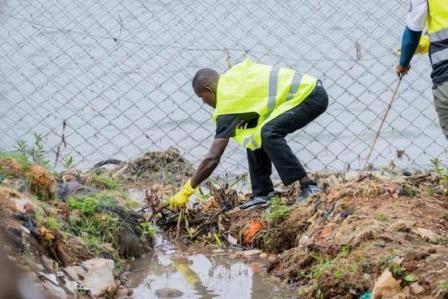
A market stall in Kulambiro became an unlikely classroom this week. Under the shade of makeshift stalls, health officials, city authorities and waste entrepreneurs gathered not to sell anything, but to demonstrate something.
They wanted Nakawa West residents to watch, up close, how a pile of ordinary household rubbish can be pulled apart into plastic, paper, metal, glass and food scraps. It was a small demonstration with a large message behind it.
Uganda has a waste problem, and that problem is quietly costing the country money, health and, in some tragic cases, lives.

A Crisis That Grew Faster Than the City Could Handle
To understand why the Ministry of Health felt compelled to stage a sorting demonstration at a neighbourhood market, it helps to look at the scale of what Uganda’s urban centres are now generating every single day.
Kampala alone produces a staggering volume of rubbish.
The city generates up to between 2,000 and 2,500 tons of waste daily, but is only able to collect and dispose of an average of 1,300 to 1,500 tons per day, meaning roughly half of everything the city produces is uncollected or improperly disposed of.
That gap between what is generated and what is collected has not closed on its own.
The collection rate for solid waste in Kampala rose from 35 percent in 2016 to 59 percent in 2023, an improvement KCCA attributes largely to partnerships with private collection companies, yet even that progress still leaves a significant share of the city’s daily waste unaccounted for.
The composition of that waste tells its own story.
Biodegradable waste accounts for 43 percent of everything generated in the city, followed closely by mixed fines waste at 42 percent, with plastics making up about six percent and animal, sanitary and paper waste splitting the remainder.
Nakawa West, where the Ministry chose to hold its demonstration, is itself a significant contributor to that daily mountain.
Ecoserve Limited, the company mandated to collect waste in the area, disclosed that the constituency alone generates about 187 tonnes of garbage every day.
The Human Cost the Numbers Don’t Always Show
The consequences of this uncollected waste are not abstract statistics.
They show up directly in Uganda’s disease burden.
Poor sanitation and hygiene account for approximately 75 percent of diseases reported in the country, with malaria, diarrhoea and typhoid ranking among the most common illnesses linked to unhygienic environments.
For the country’s youngest citizens, the toll is measured almost daily.
Ministry of Health statistics show that about 33 children die every single day from diseases associated with poor sanitation and hygiene.
That burden is precisely why Dr. Diana Atwine, Permanent Secretary in the Ministry of Health, chose to speak so directly to residents at Kulambiro.
She said Uganda still lagged behind other countries in proper waste management, a gap that has real consequences measured in illness, lost productivity and strained health budgets.
She noted that during the country’s first-ever National Cleaning Day, urban residents had generated large volumes of waste that had accumulated quietly in homes for weeks before being brought out all at once.
That surge, she explained, created serious challenges for collection and disposal systems that were never designed to absorb so much rubbish in a single moment.
Uganda’s own recent experience with the exercise validated her concern.
The country’s first statutory National Cleaning Exercise, held on Saturday, July 25, 2026, mobilised millions of Ugandans to clean their neighbourhoods, unclog drainage channels and remove illegal dumps, but the success was overshadowed by a post-exercise crisis of heaps of uncollected garbage that overwhelmed Kampala and several other urban authorities.

Sort at the Source, Dr. Atwine Urges
Faced with that reality, Dr. Atwine’s central message to residents was simple.
Waste sorting must begin at the point where waste is generated, not at some overwhelmed landfill weeks later.
She urged residents to adopt better waste-management habits at home, in markets and in workplaces alike.
Plastics, she said, should be separated from other waste entirely and sold to recyclers rather than burned or dumped in drainage channels.
Paper, glass and metal can equally be collected separately and channelled into the recycling economy rather than treated as worthless rubbish.
For biodegradable waste, Dr. Atwine had a practical suggestion for households with compounds.
She encouraged them to establish compost pits, where food waste, fruit peels and other organic material can decompose naturally rather than rotting in open heaps.
For residents living in apartments without such space, she recommended engaging waste collectors who can put sorted organic waste to alternative uses, such as animal feed.
“Don’t Burn”: A Warning Rooted in Hard Science
It was on the subject of burning plastic that Dr. Atwine’s tone grew most urgent.
She issued a strong warning against the practice, describing it as a serious risk to both human health and the environment.
“We want you to make sure that if you have plastics, let them be taken for recycling. Don’t burn,” Dr. Atwine said.
She noted that fumes from burning plastic can contribute directly to respiratory problems and broader environmental pollution.
The science backs her warning in stark terms.
Burning plastic leads to severe health risks such as heart disease, aggravates respiratory ailments such as asthma and emphysema, and causes rashes, nausea, headaches, and damage to the nervous system, kidneys or liver.
The specific chemistry of what happens when plastic burns explains why the danger is so severe.
Municipal solid waste containing about 12 percent plastic, when burnt, releases toxic gases including dioxins, furans, mercury and polychlorinated biphenyls into the atmosphere, while burning of PVC in particular liberates hazardous halogens that pollute the air.
Dioxins, the most notorious of these compounds, do not simply disappear into the sky.
Dioxins settle on crops and in waterways where they eventually enter food and, in turn, the human body, and these persistent organic pollutants are potentially lethal, capable of causing cancer and disrupting the thyroid and respiratory systems.
Communities living near open burning sites elsewhere in the world offer a preview of what sustained exposure looks like.
A study of residents living within three kilometres of a major dumpsite found 68 percent reporting respiratory problems, compared with just 22 percent of those living further away, while medical professionals in the same area reported higher incidences of lung cancer, heart disease and other chronic conditions among long-term residents.
Dr. Atwine’s own reference point was much closer to home.
She raised concerns about an increase in people suffering from lung-related problems at Mulago Hospital, attributing part of that rise to practices such as plastic burning, though she acknowledged the specific claim had not been independently substantiated.
Even without a confirmed causal link at Mulago specifically, the broader pattern connecting plastic smoke to lung disease is well established internationally.
Inhaling the particulate matter and toxic gases from burning plastic can exacerbate existing conditions like asthma and emphysema, leading to increased hospitalisations, while prolonged exposure can contribute to the development of chronic bronchitis and persistent cough even in people without pre-existing respiratory issues.
Dr. Atwine also cautioned residents against a related but distinct danger, that of mixing potentially hazardous materials such as expired medicines, old computers and other electronic waste with ordinary household rubbish, a practice that complicates safe disposal and increases the risk of toxic exposure during collection and dumping.
What This Is Costing the Government
Beyond the human toll, Uganda’s waste crisis has become a genuine drain on public resources, one that touches nearly every level of government from City Hall to the Treasury.
The financial scale of the problem in Kampala alone illustrates why.
Kampala’s 99 parishes generate 2,500 tonnes of waste daily, prompting the city’s Lord Mayor to publicly lament that the authority needs a sufficient budgetary vote for sanitation and hygiene, since existing allocations fall far short of what proper citywide collection would require.
Government has had to turn to external financing to plug some of that gap.
Following the August 2024 Kiteezi landfill disaster, which claimed at least 35 lives, Uganda secured a 600 million dollar aid package from the World Bank and the French Development Agency to improve waste management infrastructure in Kampala and address long-standing safety concerns.
The tragedy that triggered that funding remains a grim reminder of what happens when a waste system is pushed beyond its limits.
The August 2024 Kiteezi garbage slide, which displaced 142 households, has been described as a disaster waiting to happen, with the landfill having long outlived its intended purpose before multiple systemic failures caught up with it.
Efforts to shift some of the financial burden away from government have followed, with the city now asking residents themselves to shoulder part of the collection cost.
Households now pay Shs 3,000 per month for garbage collection under a new structured payment system, while businesses such as shops are charged Shs 5,000 per 50-kilogramme sack, part of a broader effort to correct what officials describe as a long-standing culture of neglect around who is responsible for managing waste.
The reasoning behind government’s push for household-level sorting is, at its core, an economic one.
Fewer tonnes reaching landfills means less pressure on overstretched trucks, fewer emergency interventions like the one at Kiteezi, and ultimately lower long-term costs for a health system already treating the diseases that dirty environments produce.
Museveni’s Push for a Culture of Cleanliness
The National Cleaning Day framework that gave rise to this week’s Kulambiro demonstration did not emerge from the Ministry of Health alone.
President Yoweri Museveni has positioned himself as the direct champion of the initiative, and his own remarks on the subject frame cleanliness as inseparable from public health and national productivity.
Speaking through a message delivered by Vice President Jessica Alupo at the programme’s national launch, the President argued that prevention, not treatment, should be Uganda’s first line of defence against disease.
The President said many diseases affecting Ugandans can be prevented through improved sanitation, proper waste management and collective community responsibility, noting that government has consistently invested in preventive healthcare through immunisation, nutrition, physical exercise and sanitation, and stressing that cleanliness remains one of the most cost-effective ways of protecting public health.
The Vice President, speaking on the President’s behalf, made the connection between hygiene and prosperity explicit.
“Once fully implemented, the National Cleaning Days will strengthen our communities, reduce preventable disease, lower catastrophic household health expenditures, enhance productivity, and contribute to improved household incomes and national development,” she said, delivering the President’s message.
“Let us therefore make cleanliness a daily habit, not an occasional activity. If each of us plays our part, Uganda will be clean, healthy, and prosperous,” she added.
Government officials have consistently tied the initiative back to a decision made at the highest level.
The National Cleaning Day initiative was approved by Cabinet, chaired by President Museveni, on 11 August 2025, with the monthly cleaning exercise scheduled to take place from 7:00 a.m. to 10:00 a.m. on the last Saturday of every month, during which Ugandans are expected to clean homes, markets, schools, health facilities and drainage channels.
City Hall’s Digital Push to Formalise the Waste Economy
Back at the Kulambiro demonstration, KCCA’s Director of Public Health, Dr. Sarah Zalwango, made the case that sorted waste is not merely an environmental obligation but a potential income stream.
She highlighted two digital platforms designed to connect ordinary residents with the people who buy sorted, recyclable material.
The Weyonje app and its companion, the Towa Uchafu na Nusu app, help residents identify waste collectors operating in their specific neighbourhoods.
Dr. Zalwango revealed that KCCA is in the final stages of mapping waste entrepreneurs across the entire city, an exercise intended to make it far easier for households to find a recycler or collector nearby.
She added that the nine private companies now licensed to collect waste in Kampala carry a specific mandate, namely to sensitise residents and actively promote sorting at the source, reducing the volume of waste that ultimately reaches the Buyala disposal site.
Ecoserve’s Hadson Alinaitwe, whose company handles collection in Nakawa West, described a concrete plan to close the gap between generation and collection in his own area.
He said Ecoserve would deploy a 20-tonne garbage truck to each parish within the constituency to improve collection capacity.
He also urged residents to embrace the polluter-pays principle promoted by the National Environment Management Authority, arguing that it would push people to take genuine responsibility for the waste their own households generate.
Turning Rubbish Into Livelihoods
For Fahad Sserumpanise of Towa Uchafu na Nusu, the sorting message carries an economic dimension that goes beyond mere disposal.
His company works directly with institutions and communities to teach waste segregation and connect residents to buyers of recyclable material.
He disclosed that the company has already mapped around 600 waste buyers across Kampala, with that mapping exercise still ongoing.
“If you have segregated materials, you have papers, boxes, sacks, metals, PET bottles, any inorganic material that is segregated can be bought by our agents,” Sserumpanise said.
He explained that many of the individuals who buy and resell this material have historically operated informally, without any structure or recognition.
His company, he said, is now working with KCCA to explore ways of formalising these businesses and drawing them fully into the mainstream waste-management sector.
According to Sserumpanise, that formalisation carries a double benefit, protecting the environment while simultaneously creating employment, particularly for women and young people who have found income in collecting and reselling what others discard.
He said the company’s network of agents has the reach to collect segregated material across the entire Greater Kampala metropolitan area, funnelling it onward to factories for processing into new products.
A Message Bigger Than One Market
What played out at Kulambiro Market this week was, in the end, a small demonstration carrying a large national argument.
Uganda’s cities are producing more waste than their systems can currently absorb.
That gap is costing government hundreds of millions of dollars in emergency infrastructure and foreign financing.
It is costing ordinary families in hospital bills for preventable respiratory and diarrhoeal illness.
And in the case of Kiteezi, it has already cost dozens of lives.
The message from the Ministry of Health, KCCA and the waste entrepreneurs gathered at the market was ultimately a unified one.
Recyclable material should not be treated as worthless rubbish bound for a smouldering heap.
It should be seen, and used, as a source of income, a protector of public health, and a small but real contribution to the cleaner, more prosperous Uganda that President Museveni’s National Cleaning Day was designed to build.