
















Background
The National Agriculture Advisory Services (NAADS) is one of the statutory semi-autonomous bodies in the Ministry of Agriculture, Animal Industry and Fisheries (MAAIF) which was established by the NAADS Act 2001 as a result of key reforms implemented by the Government of Uganda under the Poverty Eradication Action Plan (PEAP, 1997). In the Agriculture sector, the reforms were guided by the Plan for Modernisation of Agriculture (PMA). NAADS mandate, then, was to specifically facilitate efficient and effective delivery of agricultural advisory services to farmers to enhance production and productivity. The role and responsibility of NAADS has been evolving since its establishment on the basis of lessons learnt from its implementation. These include the growing need to support farmers with improved agricultural inputs (seeds, seedlings and stocking materials) to boost production and productivity, support interventions that aim at developing agribusiness enterprises, promoting value addition and market linkages for agricultural produce.

On the basis of achievements registered during the implementation of “Luwero-Rwenzori Anti-PovertyCampaign”, H.E the President in 2014 directed that the programme should be rolled out in the entirecountry to facilitate growth of wealth at household level through agriculture. The new title of the initiative became Operation Wealth Creation (OWC). NAADS is one of the key institutions playing a central role in the implementation of the programme.
Subsequently, in 2014, NAADS was restructured. Its new mandate became: “To provide support for the management of agricultural input distribution chains, promotion of strategic commodity interventions, agricultural chain development, and farmer access to agricultural financing”.
1.0 NAADS Contribution to NRM Manifesto 2016-2021
The 2016 NRM manifesto committed to support key strategic commodities to ensure greater impact on food security, household incomes and national export earnings.
Emphasis of the NAADS intervention for wealth creation has therefore focused on scaling up production, value addition and processing for selected commodity value chains including maize, beans, cassava, tea, cocoa, fruits (pineapples, mangoes, citrus & Apples), cattle diary among others. Specific focus has also been put on purchase of specialized agro machinery & equipment for production and processing along the agricultural value chains for agro industrialization.
Maize
Government of Uganda prioritized Maize due to its high potential for food security and contribution to national export earnings. Through the NAADS/Operation wealth creation programme, Government has distributed 19,562,506kgs of maize seed to both small holders and commercial farmers in 120 district local governments in the last four years.
Due to this intervention, the production of maize has increased by 33% from 2.6 million MT in 2016 to 3.6 million MT in 2019. The volume of maize exports has also increased by 6% from 263,114 MT in 2016 to 278,693 MT in 2019 while the value of exports has increased by 12% from USD 84.99 million in 2016 to USD 95.48 million in 2019.
Beans
Beans remains another important food crop, grown by households all over the country with high potential for increasing household incomes. Over the last four years, Government through NAADS has distributed 7,086,504 kgs of bean seed to smallholder farmers in all district local governments that prioritized beans in the past four years.
Cassava
NAADS/OWC programme provided support to both small holders and commercial cassava farmers in more than 60 district local governments that prioritized cassava. A total of 793,223 bags of cassava cuttings were distributed. These interventions have led to a 131% increase in cassava production from 3 million MT in FY 2015/16, to 7 million MT in FY 2018/19.
Tea
The sector targets to produce 112,000 MT of tea by 2020, with exports valued at approximately US$155 million.During the past four financial years, NAADS/OWC has distributed 410,737,788 tea seedlings in 21 tea-growing districts and there is marked increase in leaf production. These efforts have increased tea production by 19% from 67,000MT in the FY 2015/16 to 79,466 MT in FY 2018/19. In addition, the volume of exports increased by 34% from 54,898 MT worth USD 74.5 million in FY 2015/16 to 73,580 MT worth USD. 89 million. Reports indicate over production of leaf in some districts over the existing tea processing capacities, as is the case of Kyenjojo, Kabarole, Kanungu and Buhweju.
The sector interventions together with the farmers’ own initiatives has stimulated establishment of more tea factories from 27 to 33 factories including 2 new ones established in Kabale and Kisoro with the support from the Ministry. Additionally, 15 new tea factories are being established and are at different levels in several districts including; Kyenjojo (2), Buhweju (4), Kanungu (1), Bushenyi (1), Rukiga (1), Kisoro (1), Ntungamo (1), Kamwenge (1), Mbarara (1) and Luwero (1).
Fruits (Citrus, Mangoes, Pineapples, Apples)
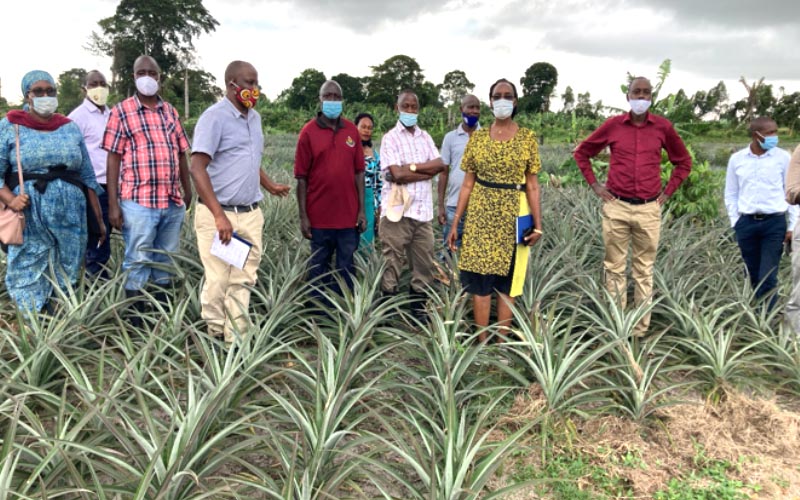
In the last four financial years, support towards production of fruits focused on provision of seedlings tolerant to pests and diseases and with desirable fresh and processing characteristics, improvement in post-harvest handling and establishment of processing facilities for citrus, mangoes, apples and pineapples in 10 district local governments.
A total of 41,426,303 citrus seedlings; 28,706,281 mango seedlings; 2,439,155 apple seedlings and 36,446,670 pineapple suckers were distributed. These interventions over the last 4 years have already resulted into a 20% increase in export volumes of fruits and vegetables from 57,358 MT in 2015 to 68,862 MT in 2019 while the export values have increased by 13% from USD 32.1 million in 2015 to USD 36.1 million in 2019.
Cocoa
The Governmentthrough NAADS has distributed a total of 21,526,743 cocoaseedlings to bothsmallholders and commercial farmers in district local governmentsthatprioritizecocoa production in the past four years. Due to this intervention, cocoa export volumes have increased by 19% from 29,761 MT in FY 2015/16 to 35,318 MT in FY 2018/19 while the value of our cocoa exports increased by 3% from USD 75 million to USD 78 million in the reporting period.
Cassava
NAADS has provided support to both small holders and commercial farmers through provision of cassava cuttings in more than 60 district local governments that prioritized cassava. A total of 752, 219 bags of cassava cuttings have been procured and distributed. In an effort to commercialize cassava production in Northern Uganda, Government through NAADS has distributed additional 110,000 Bags of cassava cuttings to farmers in farmers in Acholi sub region. The project is implemented in collaboration with Gulu Catholic Arch Diocese to address rural poverty and stimulate industrialization of this commodity in Northern Uganda.
Whereas cassava is predominantly a staple food crop, it’s becoming an important cash crop contributing to household incomes, sold in either fresh or processed forms. Increasingly, substantial quantities of cassava flour are exported to neighboring countries, to the Democratic Republic of Congo (DRC), and occasionally Kenya, Tanzania, and Rwanda.
Livestock interventions
The interventions in the area of livestock aimed at increasing production and productivity of priority livestock for improved household food, nutrition and income security; as well as export earnings in the case and some livestock and livestock products, such as milk, meat and eggs. It is worth noting that these interventions put special emphasis on special interest groups, especially youth and women and beneficiaries in urban and semi-urban areas, especially in the case of livestock materials for heifers, poultry and pigs. Key achievements include the following;
- Distributed 17,151 Dairy heifers for household income and nutrition security to Households and special interest groups (youth and women) in 115 DLGs
- Distributed 3,412 beef cattle including 2,800 beef young bulls for fattening to NEC Katonga farm for the Meat Export Support Services Project (MESSP), 612 beef bulls to serve communities in 56 DLGs for improvement of beef production.
- Distributed 34,800 Cattle Semen (doses) & 30,186 Liquid Nitrogen (Litres) in partnership with NAGRIC & DB for up grading existing breeds to 116 DLGs including KCCA.
- Distributed 13,751 pigs; for household income in 60 DLGs and special interest groups such as youth and women.
- Distributed 632,497 poultry – Birds for household income to 2,530 households in 70DLGs and special interest groups such as youth and women; and 1,768,294 Kgs of poultry Feeds (Chick & duck mash). As part of the poultry package – startup kit to each poultry beneficiary farmer for three months to support 2,530 households in 70 DLGs and special interest groups such as youth and women.
- Distributed 7,405,117 fingerlings for tilapia, catfish and mirror carp as well as 352,773 kgs of fish feed for income and nutritional security to households.
- Distributed 120 AI Kits in 116 DLGs including KCCA for breed improvement.
Solar water pumping systems
The Government through NAADS has procured and distributed 45 Solar water pumping systems for 33 selected districts of Kaberamaido, Mukono, Soroti, Masindi, Kabale, Kumi, Kiryandongo, Katakwi, Kitgum, Soroti, Amuria, Katakwi, Luwero, Wakiso, Kamwenge, Mpigi, Kiruhura, Kamuli, Bukedea, Katakwi, Buikwe, Kayunga, Mbarara, Rubirizi, Kibuku, Kiboga, Ntungamo, Hoima, Koboko, Kayunga, Yumbe, Buvuma, Mubende.
The increased access to water for agriculture production by our farmers has resulted in increased yield and production in the irrigated areas. With increased access to water, productivity under the crop, livestock and fish subsectors is projected to increase in the short and medium term across the country.
Tractors and matching implements
As part of the broader agriculture mechanisation program,Government through NAADS has distributed 320 tractors and matching implements to farmer groups in 123 DLGs to scale up farm production for commercialisation of agriculture.
Value addition & processing
- Community Grain stores
The Government through the National Agricultural Advisory services (NAADS) constructed farmer-based community grain stores across the country to support farmer access to markets through collective marketing. NAADS/OWC entered in a partnership with World Food Programme through a Memorandum of Understanding in 2016 to jointly address identified gaps in food storage capacity, post-harvest losses eradication, value addition and collective marketing systems, besides improving access to agri-inputs in selected parts of the country. The NAADS/OWC – World Food Programme partnership has seen the construction of 12 Community Grain Stores in 11 different districts of Napak, Adjumani, Kiryandongo, Masindi, Hoima, Kyenjonjo, Mubende, Kakumiro, Kiboga, Nakaseke and Kyegegwa.
- Milk coolers & matching generators:
Government through NAADS has distributed 121 sets of milk coolers and matching generators to dairy farmer organization in various districts across all the milk sheds in the country. Districts include Kiboga, Kyankwanzi, Palisa, Apac, Gulu, Bugiri, Kibuku, Kamuli, Luwero, Nakaseke, Sembabule, Lyantonde, Isingiro, Kiruhura among others.
- Milling equipment:
Government through NAADS has distributed 58 maize milling equipment f &5 rice milling equipment or farmer groups in various Districts across the country.
- Fish hatcheries:
Government through NAADS has established Two fish hatcheries i.eNalugugu Fish Hatchery, Sironko District &Anyara Fish Hatchery
- Fruit processing facilities
The interventions in the key strategic fruits have stimulated the need to establish Agro-based factories in the different production areas. Gov’t through NAADS is supporting establishment of the following fruit processing facilities, i.e.
- Yumbe Mango Processing Plant (40 MT per day)
- Kayunga Pineapple processing plant (8 to 11 MT/day)
- Nwoya Multi-Fruit Processing Plant (12MT/hour)
- Kapeeka Multi Fruit Processing Plant (3MT/hour)
- Floky wineries in Bunyangabo for grapes (2000 liters per day)
Establishment of agro industrial & business parks
The Government of Uganda through NAADS/Operation Wealth Creation are implementing the Presidential initiative on Agro-Industrialization for Local Economic Development (AGRILED). The AgriLED strategic interventions being piloted in Rwenzori sub region and some of the on-going undertakings include establishment of the Kasese&Kabarole Industrial and Business Parks respectively.
At the Kasese Industrial Park, to date the progress includes Opening of Roads, construction of water pipe network, construction of 33KV High Voltage Power Line network: while for Kabarole Industrial park, the development of the Master Plan for establishment of the Kabarole Industrial park is on-going and therefore infrastructure works will commence once the plan is in place.
Sugar cane production in Northern Uganda
Government of Uganda, through the NAADS is supporting the sugar cane production project in selected districts in Northern Uganda. The goal of the project is to empower and uplift the most vulnerable groups including women in the Sub-region who are members of the cooperative society to have a source of livelihood through sugar cane growing. Additionally, at the national strategic level the intervention is aimed at boosting sugarcane production for increased sugar production for both the domestic and export markets
This project is being supported and implemented under a Memorandum of Understanding (MOU) between NAADS, participating District Local Governments (Amuru, Lamwo, Gulu, Adjuman), Horyal Investment Holding Company and two farmer Cooperatives (Atiak Sugar out growers Cooperative Society Limited and Gem Pacilo farmers’ Cooperative Society). A total of 13,841 acres of sugarcane are being established in Attiak, Amuru district and additional 41,000 acres are being established in Lamwo district.
2.0 Current Interventions FY 2020/21
In line with the NDP III, NAADS interventions for the agriculture sector will contribute to the Agro-industrialization program to promote agro industrialization for inclusive employment, increased household incomes, food security and contribute to agricultural export earnings.
Support will focus on key strategic commodities taking into consideration the commodity value chains proposed for the NDPIII and most importantly the policy guidance of H.E the President of Uganda. The key enterprises targeted for support in line with H.E’s guidance are maize; beans, cassava; Irish-potatoes, sweet potatoes, tea, poultry, pigs,cattle dairy and fish.
Objective 1: Increase production and productivity of agro-enterprises
Intervention area: Provision of Agricultural Inputs to farmers’ i.e.
- Seed & vegetative materials for food security (Maize- 2,246 MT, Beans- 583 MT, Sorghum – 300MT, Cassava – 250,000 cuttings, Sweet potatoes vines – 25,500 bags , Irish potatoes seed -4,808 bags )
- Strategic planting materials to scale up production for processing in selected clusters (Tea – 22,158,614 million seedlings, Citrus – 1,540,560 million seedlings , Mangoes – 2,217,481 million seedlings, Pineapples – 4,190,000 suckers, Cashew nuts – 333,333 seedlings , Apples – 111,111 seedlings)
- Livestock/stocking materials (1,782 heifers, 8,186 Pigs, Poultry birds -29,950 broilers,6000 layers & 59,950 kroilers& Fish – 3,960,400 fingerlings)
- Provision of Hand hoes (3,010,000 hand hoes )to support small holder farmers
Intervention area: Setup and equip farm service centers for bulk input procurement, storage and distribution.
- Equip & Upgrade of Kapeeka Regional Farm Service Centre in Nakaseke
- Set up & establishment of Regional farm Service Centre in Kasese
Objective 2: Improve post-harvest handling, storage of agricultural products …
Intervention area: Establish post-harvest handling, storage and processing infrastructure reduce post-harvest losses & increase value of farm produce
- Establishment of One large scale Grain milling facility (1.5 MT/hr) in Kyenjojo
- Establishment of 4 Mini diary processing facilities( 5000-1000 ltrs/hr) across the 4 regions of Uganda
- Support Establishment of 4 Fruit processing facilities
- Procure & install additional equipment for Completion of Kapeeka Fruit processing facility (2 MT/hr)
- Provision of additional equipment for Completion of Kayunga Pineapple processing facility (0.6 MT/hr)
- Procure civil works and additional equipment for Completion of Yumbe Fruit processing facility (5 MT/hr)
- Procure Civil works for Establishment of Nwoyamultifruit processing facility (12 MT/hr)
- Feasibility & design studies for planned fruit processing facilities
- Carry out Engineering designs Studies & Plans for establishment of Fruit factory in Greater Masaka
- Carry out Feasibility studies for establishment of fruits industry in Rwenzori sub region
- Carry out feasibility study for a value addition chocolate manufacturing plant in Bundibugyo
Objective 3: Increase agro-processing of the selected products
Intervention area: Establishment of Agro Industrial & Business Parks to stimulate and expand agro-processing.
- Completion of physical infrastructure works for Kasese Agro Industrial & Business Park
- Establishment of Kabarole Agro Industrial & Business Park