

















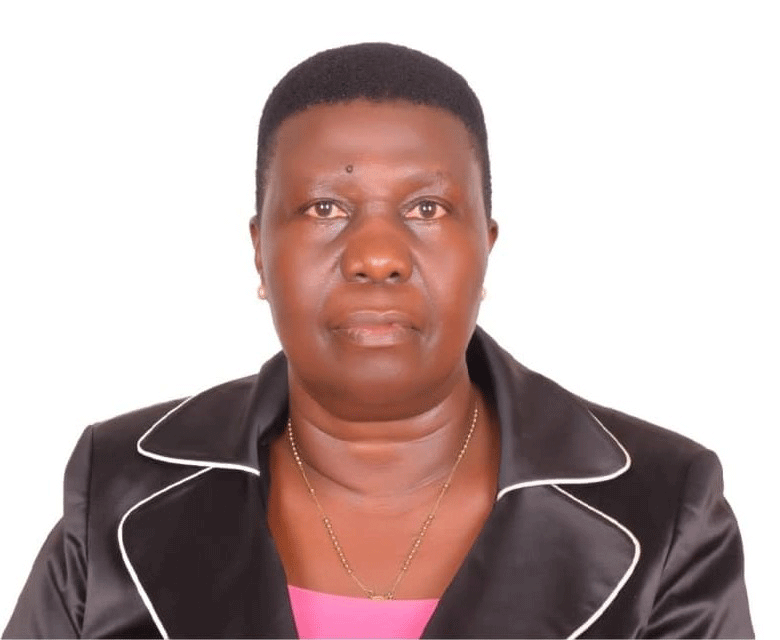
By Maj. Martha Asiimwe
As we await the swearing in of new Members of Parliament and Local Council leaders, and the appointment of a new cabinet, now is the best time to prepare the minds of all public servants to work together for common benefit and development. In particular, I have been receiving reports, and sometimes witnessed in person, as serving officials, including civil servants, sideline and maligne Resident District Commissioners (RDCs). This problem has been quite widespread and I wish that it is addressed once and for all.
Some officials in the districts have a negative attitude towards RDCs. They may have their reasons but first, it should be understood that the office of RDC is Constitutionally provided for.
For avoidance of doubt, the functions of RDC are; “to monitor the implementation of central and local government services in the district; to act as chairperson of the district security committee of the district; and to carry out such other functions as may be assigned by the President or prescribed by Parliament by law.”

Under the Constitution, RDCs and their deputies are senior civil servants directly appointed and deployed to respective districts by the president. They represent the president and Central Government respectively, and are expected to exhibit a high level of personal and official dignity, and possess firm knowledge on government policies and ongoing programs. Their day-to-day duties include monitoring and supervising services delivery. Furthermore, RDCs conduct sensitisation to the population on governmental policies and programmes. In delivering on this function, they liaise with district chairpersons, council and technocrats.
In their role, RDCs are also mandated to follow up and unearth acts of corruption, mismanagement or abuse of office, and draw the attention of relevant government agencies such as IGG’s office, police and State House Anti-Corruption Unit.
In consultation with the speaker or chairperson of a council, RDCs are required to address district and sub-county councils from time to time on any matter of national importance. Regularly, RDCs take on meditating in disputes among citizens especially the vulnerable that may not afford or know how to navigate the corridors of government. These are senior and vital roles that encompass almost every aspect of life and service in the districts. This draws attention to the seniority and authority possessed by office holders in society.
Because of the critical roles they play, RDCs are treated as enemies. They are regarded as spies and feared, resulting in witch-hunt. At times, entire district councils gang up against them. This complicates their work because they play a complementary role alongside the elected leaders. I believe that every government official, elected or appointed, should work as a team with others to achieve the objective of transforming the lives of residents.
Hostility to RDCs is most pronounced in jurisdictions where the elected leadership is dominated by the opposition because the elected leaders regard the RDCs as partisan towards NRM and President Museveni. This is not true. RDCs are senior civil servants who serve everybody, but their roles such as those related to security enforcement may get them at odds with those who wish to cause trouble in their jurisdictions.
And with corruption, it is a whole large ground for conflict to crop up. When an RDC storms a works site and finds shoddy works in progress or enters a government office and finds staff away from station, obviously the concerned officials respond with aversion and vengeance. They author dossiers intended to get the RDC fired rather than cooperating with investigators to conclude a matter or matters at hand. True, some RDCs may make mistakes but the duty of finding fault with their work is the appointing authority and supervisors. Where some have been found in error, they have been reprimanded or dismissed, like it is with all government workers found wanting or in breach of their terms of service.
My appeal is that officials work amicably with RDCs since they are not politicians and provide them with necessary support and information they need. An adversarial approach to government work is detrimental for all. If a district fails to deliver services and the elected leadership doesn’t want to be held to account, eventually they lose the power that people have entrusted them with. Civil servants, too, risk their tenures by undermining the service of those appointed by the president.
I urge RDCs to take their jobs seriously and reflect the vision of the president in their jurisdictions. They should not be the source of bad blood or engaging in corrupt acts or anything that raises queries of conflict of interest. They should be real agents of transformation since national progress culminates from the better functionality at grassroots where they are in charge.
With elections behind us, whichever side one was on, it is time to work for the good of all in order to prove our relevance and worthiness to hold the offices we hold in public trust. That is how the full confidence and cooperation of the wanainchi will be gained to participate in advancing their communities.
The author is Head of RDC Secretariat/Anti-Corruption Unit, President’s Office