














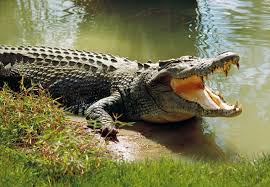
Crocodile eats fisherman alive
By The Public Lens
Residents of Walumbe landing site on the Shores of Lake Victoria in Bukatube Sub County of Mayuge District, are in shock as most of them were during today’s morning awakened by alarms and cries then treated on a rare and hideous episode of helplessly watching one of their own being torn and chewed by a crocodile piece after another.

According to the area LC. 3, Chairman, William Atube, the Victim, Kitimbo Musa 48 and resident and fisher had gone to check on his nets in a small canoe when he met the possibly hungry crocodile.
“We helplessly watched in fear and with difficulty restrained the wife and children of Kitimbo from falling into the water to try and save him as the huge crocodile tore his flesh piece by piece in the deep waters a few meters off shore before our naked eyes,” Atube tearfully narrated.
Atube estimated the huge crocodile to be measuring about thirty feet and said that in the recent few years the area has lost six people to the beast at the same spot with the most recent one last month.
He however attributed the scenario on the lack of food for crocodiles caused by the scarcity of fish in the Lake due to the employment of illegal fishing methods by the fishers rendering the Lake depleted of its fish stocks.
Atube has implored for Government intervention to treat this issue as a disaster that requires immediate action to save the lives of wanainchi in this area.
Some hunting and diet behavior of the Nile crocodile
Nile crocodiles are apex predators throughout their range. In the water, this species is an agile and rapid hunter relying on both movement and pressure sensors to catch any prey unfortunate enough to present itself inside or near the waterfront.
Out of water, however, the Nile crocodile can only rely on its limbs, as it gallops on solid ground, to chase prey. No matter where they attack prey, this and other crocodilians take practically all of their food by ambush, needing to grab their prey in a matter of seconds to succeed.
They have an ectothermic metabolism, so can survive for long periods between meals. However, for such large animals, their stomachs are relatively small, not much larger than a basketball in an average-sized adult, so as a rule, they are anything but voracious eaters.
Young crocodiles feed more actively than their elders, according to studies in Uganda and Zambia.
The Nile crocodile mostly hunts within the confines of waterways, attacking aquatic prey or terrestrial animals when they come to the water to drink or to cross.
The crocodile mainly hunts land animals by almost fully submerging its body under water.
Occasionally, a crocodile quietly surfaces so that only its eyes (to check positioning) and nostrils are visible, and swims quietly and stealthily toward its mark and the attack is sudden and unpredictable. The crocodile lunges its body out of water and grasps its prey.
On other occasions, more of its head and upper body is visible, especially when the terrestrial prey animal is on higher ground, to get a sense of the direction of the prey item at the top of an embankment or on a tree branch.
Crocodile teeth are not used for tearing up flesh, but to sink deep into it and hold on to the prey item. The immense bite force, ensures that the prey item cannot escape the grip.
Prey taken is often much smaller than the crocodile itself, and such prey can be overpowered and swallowed with ease.
When it comes to larger prey, success depends on the crocodile’s body power and weight to pull the prey item back into the water, where it is either drowned or killed by sudden thrashes of the head or by tearing it into pieces with the help of other crocodiles.
Subadult and smaller adult Nile crocodiles use their bodies and tails to herd groups of fish toward a bank, and eat them with quick sideways jerks of their heads.
Some crocodiles of the species may habitually use their tails to sweep terrestrial prey off balance, sometimes forcing the prey specimen into the water, where it can be more easily drowned.
Groups of Nile crocodiles may travel hundreds of meters from a waterway to feast on a carcass.