







By Public Lens Team
President Museveni’s brother, Gen Salim Saleh is the head of the Operation Wealth Creation.
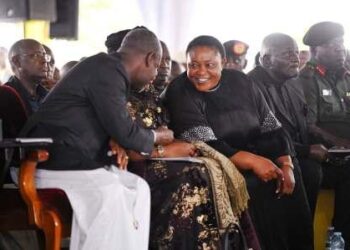
While addressing mourners at the burial of Mzee Savio Ojok Awany [father to NRM deputy secretary general Richard Todwong and Gen Charles Otema, UPDF Reserve Commander] at Tangi Village in Nwoya District recently, Gen Caleb Akandwanaho aka Salim Saleh cried out that “politics is killing” his operation wealth creation as leaders are politicizing the good-intensioned programme which is aimed at lifting 68% of the population who are in subsistence production to middle class income status. The OWC Coordinator rallied leaders to focus more on production to enhance household revenue, more jobs, value addition, more exports, and attainment of middle income status. The Public Lens reproduces the retired General’s earlier interview where he links wealth to security, and also opens up about his 40-year liberation journey. Veteran journalist Namara Rwomushana interviewed him a year ago.

I am RO16, retired Gen Caleb Akandwanaho, also known as Salim Saleh. I am the senior presidential adviser – defence. I am also the coordinator of Operation Wealth Creation.
I did not join the army; I joined the struggle at first in 1976. This year it will be 40 years in the struggle. And at that time, the one who recruited me [Yoweri Museveni] was recruiting me into the armed struggle for my own security because he had already declared war on the regime of Idi Amin and he thought that my stay in Uganda would be dangerous for me.
So he organised and I went to stay with him in Tanzania in June 1976 and he interested me in the struggle. I read some books about fighting for freedom and I was recruited. We started our training on Christmas Day of 1976 at Cabo Delgado in Mozambique. I was 16. We had language problems with the instructors. But the training was very good because I was a young but mature man. The training was very good for me because it shaped my character.
We were 28 [trainees] and were supposed to be trained for two years in leadership, section platoon and company command. The chairman at that time was building us to be leaders of our own units when we come back to the country. His plan was to train us, infiltrate us into the country and start mobilising the people against Idi Amin. However, while we were finishing our training, Idi Amin invaded Tanzania, in 1978 and Tanzania declared war on him.
After we had finished training, we were sent with the Tanzanian forces. I remained in Dar es Salaam as the Fronasa liaison officer with the Tanzanians and the other fighting forces – Kikosi Maalum and Save Uganda Movement, etc.
Kampala fell in April 1979. Then I flew in from Dar es Salaam [to] Mwanza and [then to] Kampala.
When I reached Kampala, they sent me to the west [Uganda] because that was where Fronasa was active. I joined the so–called western Axis which was being led by Fronasa. I was given a unit called the ‘Red Army’. There was no fighting going on; we found the frontline at Pakwach. So I joined the last phase of the war against fleeing Amin soldiers and went to Arua. Other units went up to the border and the war was finished.
Then a decision was taken to reorganise all the fighting forces into a professional force. Although I was a commander, I was not selected to attend the first cadet course where Gen Elly Tumwine, Gen Katumba Wamala, Gen Gerome Mugume and others went for cadet [training].
That is when qualifications in the military started emerging. They said they couldn’t take anybody who didn’t complete S4 or A-Level – I don’t remember – the same challenge I got later on when I was appointed minister.
That time there was a compromise because our chairman [Museveni], who was the minister of Defence at that time, said he had got few officers and commanders who although were not qualified could be given an alternative course in Jinja. So we were selected. From the Fronasa group, I was there with Peter Mugasha and six others I don’t remember very well.
So
we were taken to Jinja and given an alternative course which we did very well.
Upon completion, we were commissioned by president Godfrey Binaisa. I was
immediately posted to Moroto 14th Battalion. That’s where I was when the others
went to the bush.
I was not very political. In fact, I thought after overthrowing Idi Amin there
would not be another war. But then a war came out of the disputed elections in
1980.
I
had good personal relations with my soldiers. So they knew that they had to
defend me against the establishment in Kampala. I was in charge of support
weapons. These are small weapons: mortars, machine guns of the whole battalion.
I had been posted to Kidepo.
When the rest of the group went to the bush, I learnt of it on BBC. I said I
have to internalise the situation first and then see how to survive.
I
had two options because the Kenyan border was nearby. I had two options; to go
into exile and run away. But I didn’t.
They went [to the bush] in February. I stayed there from March to April. Then
there was total silence in Moroto, my battalion headquarters, until mid April
when my fellow officers who were suspected to be sympathetic to the NRA were
picked up by someone. Capt Matovu, Lt Murali, Lt Silver Turyika, Lt Muhairwe.
They were picked up on tribal basis and locked up.
When I heard of that, I started feeling uncomfortable. Still, I decided to go back to Moroto and see what was happening. When I went back to Moroto, I was immediately arrested and charged with theft and locked up in prison for, I think, three months. The people who had gone to the bush got my address. So they came and told me they had now established themselves in the bush and they would manoeuvre and get me out of prison.
In July, I got contact through the network they had created and I went to the bush. They released me. There was cooperation, I think, with the magistrate and Maj Dora Kutesa, the wife of Gen Pecos Kutesa and my cousin sister – the sister of Dampa – who organised and then Gen Katumba Wamala, who was also in the know; they organised and I came to Kampala and then to the bush.
I had already been prepared by the training I told you. We were experts. We were trained to be experts in guerrilla war. So for me joining the guerrillas was easy because I knew how to manage that situation of getting a guerrilla unit.
The battles were very many. A lot of organisation was put in place. Organising the resistance was not a one–man action. It was a popular uprising by people who thought they had been cheated politically. It was a people’s war and it has its principles, the linkage between the people and the soldiers. I had built that capacity in Mozambique and it was easy for me.
Motivating
peasants
The period between 1981 and I think the whole of 1982 was for training. When I
reached the bush, there were, I think, seven detachments, maybe of 40 people
each. Mwanga in Kyaggwe area, Abdul Nasser in Kyadondo, Mondrani in Bulemezi,
Kabalega in Bulemezi also, Nkrumah in Singo. Five units or five detachments.
And they started by training militarily and political consciousness and by the
time they finished their training, they were self–motivated.
Commanding
Kabamba attack
It is my soldiers; the soldiers you are leading are the ones who really fight
the battle. I had very good commanders and I got very good, motivated fighters.
At that time we were just freedom fighters. All the planning was done centrally
by the chairman of the High Command.
Detailed planning of any attack amounts to 60 per cent of the success. He spent quite a lot of time doing reconnaissance. So detailed reconnaissance of the targets was key so that everybody knows where he is supposed to go at what time.

Then NRA commander Pecos Kutesa.
But like all battle plans, they all just scatter when the first bullet is fired. But in Masindi 3, I was very successful [though] with a lot of difficulties at the pre–attack level. And we did very well and that one really changed the course of the war because we got a lot of weapons.
Then Kabamba 3 was really endurance because we walked [for] more 400km in, maybe, less than a month. Those two surprise attacks really created an impact on him. Later on, there were many engagements after we had expanded to I think 12 companies or more, armed. And then there was the battle for Kembogo.
After we got guns from Masindi and Kabamba, the chairman of the High Command decided that we should open the second front, the western front. So for me, with about three units, I remained in the triangle and Maj Gen Fred [Mugisha] went to open the western front.
I was very light because all the causalities, all the sick people and the political leadership – all had gone to the west. So I was light and mobile. The government decided that it must concentrate its force on me and finish me because after we opened the second front, the chairperson of the High Command went ‘outside’ to do the diplomatic work now because he was comfortable with the military situation.
When the two forces separated, UNLA decided it was time now to look for Salim Saleh’s mobile force. We went on and around but we were trying to get them properly because they constituted also what they called also the mobile brigade – also on their part. But they were three to one or four to one.
They [UNLA] didn’t know that the action to open the western front was deliberate. We kept manoeuvring with each other. But we were looking for an opportunity. And that opportunity came at a place called Kembogo in Singo. They found me with very good commanders. And when I say they were very good, they were very good. We had Nkrumah, under Kihanda – Colonel Julius Kihanda, then 1st battalion, 3rd Battalion and 5th.
And the battle for Kembogo is its own story. That is where we ended the fighting with UNLA. After that they just came back here, to Kampala and overthrew the government and then called us for peace talks.
Then the peace talks flopped in September or August, I don’t remember when. But you know the thing was that the same UNLA force had been recruited by the same person when he was minister of Defence. So we had very good officers who were in UNLA but not interested in serving a very bad situation.
So when the ceasefire broke down, I knew most of the officers who were involved in the war. So I told them those who want to join can join those who don’t want they can go back to Kampala. So we gave everybody safe passage. Those who resisted were attacked.
In Busunju there were very small attacks, the major engagement was in Mubende. And then we overrun them and I joined Fred [Mugisha]. But at that time, Gen Fred’s front and others had become very active in the west. So I found them after they had liberated Fort Portal. I dropped a lot of luggage there, a lot of ammunition. Then through Kamwenge, Rushere, I headed to Kampala. And I left them to deal with Mbarara.
The siege of Masaka, because it was heavily mined or presumed to be mined, we sieged it for 90 days and then came to Katonga Bridge where major engagements were fought.
We had a situation where you have Mbarara, the UNLA unit in Mbarara was still intact, then the unit in Masaka was also still intact. So I had to jump that one and get to Katonga Bridge so that there is no reinforcement. We were fighting in an environment that if Katonga had been broken possibly the siege of Mbarara would have been broken.
So 1st and 5th battalions were deployed and they did their work very well. And all those who came out of the barracks were found not to be enemies. Out of Masaka, we created two units: 25th Battalion and 23rd. No, 27th. We created a battalion out of the two but a very large battalion and we put it under Julius Oketta. He was a Lieutenant at that time.
In December 1985, I was asked to draw up a plan for Kampala, which I submitted on the January 17, 1986, and it took us less than a week to get into the city.
Our aim was to get into Lubiri, get to Summit View, get to Radio Uganda, get to Makindye, cut off Entebbe Road and then cut off Bombo Road. Everybody was tasked. The commander was Pecos Kutesa [for] the 1st Battalion to go to Radio Uganda, deputised by Fred Mugisha.
The 3rd Battalion was under Lumumba who was supposed to go to Lubiri, the 5th Battalion was supposed to cut off Entebbe Road, the 7th Battalion [was supposed to go to] Makindye under Maj Gen Matayo Kyaligonza, 11th Battalion under Chef Ali [was supposed to capture] Summit View and 13th Battalion under Gen Ivan Koreta [was supposed to cut off] Bombo Road. And it worked; there wasn’t much fighting really. The enemy had been beaten at Katonga Bridge.
But Summit View became very stubborn and also around Radio Uganda. And then Makindye also was very stubborn. But in the end it was concluded by 26th [January]. By 25th [January 1986] we were sure they had fled, but 26th was when we were very sure.
I went on to be the chief of combat operations from 1987 to 1988. But 1988 was when I made peace with the enemy because I believed there was no enmity between me and UNLA soldiers. We were the same fighting each other for nothing. So I made peace with the UNLA proper – those who had fled to the Sudan under Lt Col Angelo Okello.
And then, I believe, I messed myself up. The division in Gulu, under Pecos, made contact with the rebels who had attacked in August 1986 supported by the Sudan. They made contact and they called me in and they conditioned me that I have to fly to their area.
Because I believed in peace so much, I flew to their headquarters in Palabek and we agreed. But I was later charged by the [army] High Command for risking the life of a commander and the crew and assets of National Resistance Army but they put it [charge] aside when peace came. I defended myself that I was pursuing peace.
I was made army commander in June 1989 but it was not smooth. I had developed indiscipline; I was no longer a good face for the revolutionary army. So I was retired from active service to the reserve [force] November 27, 1989 – I can never forget the day. I took it in good faith. But there was also a lot of goodwill from the people who took over the command.
Then in 1990, the RDF – the Rwanda Defence Forces – went. And then in 1993, there was a forced reduction in force, 1993 [and] 1994 which was enforced. In the meantime, the remnants of UPDA had evolved into another force ‘guided by the holy spirit’, Lakwena and the father of Lakwena.
So in 1996, I remember I told you I was going back to the north to assist, not as a commander, but as an adviser to the President. But by virtue of my seniority, I assumed command of the units I found there. We did very well. ‘Mwisho One’, ‘Mwisho Two’ and ‘Mwisho Three’. And that is when we broke the back of the backers of rebellion; that is when we first entered the Sudan, where the problem was. Having done very well, they say, I was proposed to be a minister. Again, my education situation came [back to haunt me]. The Constitution had been passed that if you do not have A-Level, you can’t be a minister. So I chose not to steal papers. I went back to school, at 38, and I did my O-Level and my S5 and S6 in 2000 and I got my certificate.
Minister
of Microfinance appointment
Later on, we went again in pursuit of professionalisation of the army,
everybody at the senior most level was sent for a course at the Senior Staff
and Command College. All the leaders who had never had professional training
were nominated and sent to Senior Staff and Command College as intake number
one for the college.
That is where we developed lines of thinking. That is where I got an opportunity to consolidate all my previous views on what I wanted to do afterwards because we all realised there were young people coming up in the military and very little space for the Bush War fighters. So we chose different subjects to pursue. We were trained in as all–round, leadership is all–round and we were very aware that it has now come to light that we needed to understand the relationship between economics, governance and security.
It has now just come to light recently, in 2009 when the World Bank recognised it – that nexus. But for us we had been prepared before. So for me, I was lucky I was assigned a very good paper, to look at food security in Uganda. So I was leaving the other security – energy security, income security – for food security. And I have pursued it for the last 10 years.
When we completed the course, I was posted to the OPM [Office of the Prime Minister]. In search again of pursuing my old ideas about war–affected areas. But there was no budget for me to be active. So that is when I decided to leave even the reserve force for total retirement so that I can be able to campaign for the party [NRM], which I did very well and after the elections in 2006, I was nominated as minister of State for Microfinance where I stayed for 33 months and realised microfinance is not the silver bullet.
So I was changed again and asked to start preparing the ground for the next mission, for the next operation, which has taken a lot of time until 2013 when the President permitted us – me and active UPDF officers – to get involved in wealth creation.
Saleh links security to wealth
You
are a decorated General not commanding battles but heading “Operation Wealth
Creation” to improve agricultural production in the rural areas and end
poverty. But it is essentially an economic, not a military activity. How does
economics mix with the military?
It is a total concept; there cannot be any good economics without good
security. And you cannot have the other two without good governance. So any
military officer at my level must be able to understand that. And I have
understood very well. And I think that very soon many people will understand
that the connection between the three is unavoidable.
So
why deploy the military and not economists?
These [military] are very good cadres in terms of leadership, honesty,
understanding the farmers, understanding the peasants – almost all came from
peasant background and they are disciplined, they take orders.
Still,
what is it that they do that an economist can’t?
By the time we intervened, I think the economists or the projects they had
conceived had to be dealt with in Naads and other government agencies. So we
designed a concept that would bring order in the development process and so far
so good. We have been able to do that in the last three years.
The concept was first understanding the architecture of the development
process; who is doing what, where? In the civilian economics, it doesn’t apply.
We found everybody in their own silos, researching its own silo, input supplies
in its own silo, local government is not connected with the process, etc.
So we decided to give them a concept that could re-organise the whole
development process, especially rural development. And it has taken time. But
it is beginning to shape up now. We have done five seasons and we are going
into season six. And the results on the grain and cereals are obvious. Then on
the coffee plantlets, tea plantlets, beans…
I would suggest that you get all the details from the chairman of Naads because
he is the one who knows; they procure and for us we supervise the distribution.
Is
that the only role?
No, no, for us we refused that role. We said ‘for us we are coming to think in
totality, not only in Naads. There is NARO; there is NAGRIC, all government
agencies involved in development process must put their act together and have
one vision and one mission’.
And we were very successful. Recently, with the Office of the Prime Minister
and ministries of Local Government, Agriculture and Industry, we are trying now
very, very hard to link up with the financial sector so that the whole value
chain is completed and everybody plays his small role, which builds up to a
coherent, focused development.
From
your economic and military perspective, do you see development as the new
frontline?
Definitely, because, like the Prime Minister [Ruhakana Rugunda] said, Operation
Wealth Creation is a logical conclusion of the struggle because security is
there, peace is there, democracy is there, which some people are calling ‘ultra
democracy’. But development is not yet there the way we had planned it, where
everybody is above the poverty line. The poverty level has declined. But still,
seven million Ugandans are below the poverty line. So, really, it is a serious
challenge which everybody must participate in reducing.
And
what do you plan to do?
Nothing much. We have got our timeframe. I think at this stage we are in the
‘stabilisation phase’. Once we get into the consolidation phase and finish it,
then we exit. And by the time we exit, I hope there will a complete linkage
between all the agencies of government involved in the development process,
including the private sector.
Some
people are still talking about peace, that it is fragile peace…
I don’t know what they mean by fragile because they are putting us in fragile
states. But that is where this partnership must be enhanced. And I think it came
out clearly, you know we all normally listen to the World Bank, and I think in
2009, that is when there was a World Bank man called Robert Zoellick, president
of the bank.
When
he addressed some senior security people at the Institute of Peace in America,
he said in situations like that of fragile states, there must be a good
understanding for those three sectors I have told you: the economy, the
governance and the security.
He said it himself in 2009 at the “passing of the baton” conference. So with this
partnership that we have of the security, of the economists, of the government,
I think it is the best structure to hold the country while issues of
unemployment, low exports, low productivity are addressed by all of us – not by
one group.
If you leave it to the economists, they will stay economising, if you leave it
to the politicians they will always seek to get political capital. But if
security is involved, it keeps on reminding them that we still have steps to
take in order to guarantee the existing peace and that is what I am doing.