










For three hours on the last Saturday of every month, Uganda will fall silent.
No boda bodas will growl through Kampala’s jam.
No taxi will hoot for a passenger.
No shop shutter will roll up.
Instead, brooms, hoes, slashers, and gumboots will do the talking, as government has ordered every citizen of this country, from the smallest trading centre to the busiest city suburb, to step outside and clean.
It is not a request.
It is a directive, backed by the police, anchored in the Constitution, and driven by a grim statistic that the Prime Minister says has hidden in plain sight for years: that dirt, more than any single disease, may be quietly killing more Ugandans than almost anything else.
The Announcement That Set the Tone
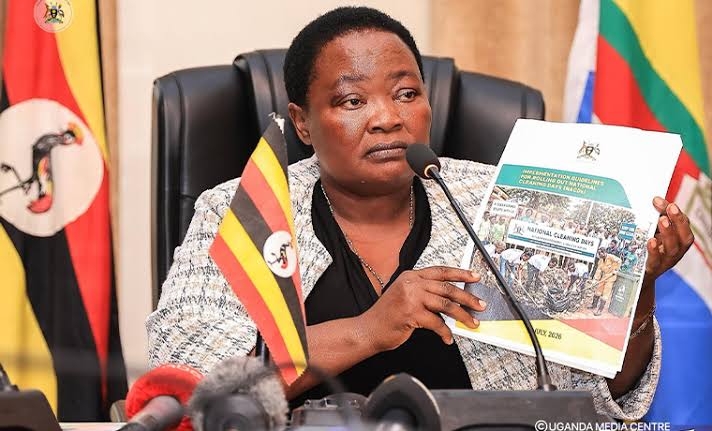
The declaration came from the Rt. Hon. Robinah Nabbanja, Prime Minister of Uganda, at a press briefing held at the Office of the Prime Minister in Kampala.
She was not alone.
Flanking her were officials from the Ministry of Health, the Ministry of Local Government, the Kampala Capital City Authority, the Uganda Police Force, and the National Environment Management Authority, a lineup that signalled this was no ordinary ministerial statement, but a whole-of-government mobilisation.
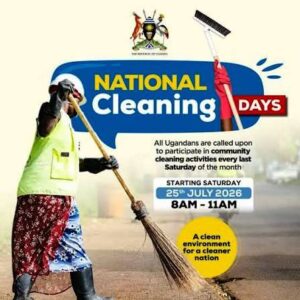
“The National Cleaning Day initiative will run from 7:00 am to 10:00 am on the last Saturday of every month,” Nabbanja announced.
“During this period, all Ugandans are expected to participate in organized cleaning activities within their communities, including roads, health facilities, drainage systems, markets, places of worship, schools, and other public places,” she said.
Government communications released in the days around the briefing have not entirely agreed on the exact clock, however.
Some official statements, including a Cabinet Circular reportedly signed by the Prime Minister, list the window as 8:00 am to 11:00 am rather than 7:00 am to 10:00 am, and residents are advised to follow the guidance issued by their local authorities closer to each cleaning day.
What is not in dispute is the date, timing, and scale.
Movement of people and vehicles will be prohibited during the exercise, except for emergency and security vehicles.
No business will be permitted to open its doors until the three hours are over.
The Number That Changed Everything: 75 Percent
Nabbanja did not arrive at this decision lightly, and she came armed with figures designed to make the directive impossible to dismiss as inconvenience for inconvenience’s sake.
According to her, 75 percent of the diseases afflicting Ugandans today are spread through poor sanitation and hygiene.
That figure is not new to public health circles in the country.
Civil society organisations and health researchers have cited a nearly identical statistic for years, with the Ministry of Health itself reportedly maintaining that more than three-quarters of the country’s disease burden is preventable, driven largely by communicable diseases such as cholera, typhoid, and diarrhoea that trace back to inadequate water, sanitation, and hygiene services.
Nabbanja painted a grim daily picture of the human cost.
She said about 33 children die every day from diseases caused by poor sanitation and hygiene, a toll drawn from Ministry of Health reporting.
She singled out Kampala as the epicentre of the crisis, noting that the city produces somewhere between 2,000 and 25,000 tonnes of solid waste daily, of which only 50 to 60 percent is ever collected and properly disposed of.
The rest, she said, chokes drainage channels, pollutes the environment, and multiplies the risk of disease outbreaks each time the rains come.
Independent research backs the broader pattern she described.
A recent baseline study covering Uganda’s Busoga region found that poor sanitation and hygiene account for nearly 75 percent of the country’s disease burden, with an estimated 23,000 deaths from diarrhoeal diseases every year, the overwhelming majority of them traced to unsafe water and inadequate facilities.
Cholera, a disease many Ugandans associate with distant history, has in fact never left.
Public health researchers note that Uganda has been endemic for cholera since 1971, with outbreaks concentrated in a relatively small number of districts along the shores of the country’s great lakes and border towns.
Nabbanja rooted the government’s mandate not just in statistics, but in law.
She invoked Article 39 of the Constitution, which guarantees every Ugandan the right to a clean and healthy environment while placing a reciprocal duty on citizens to protect it.
A Country That Has Cleaned Together Before
For many Ugandans, especially those raised in villages across Buganda and beyond, the idea of a whole community pausing its normal business to clean is not entirely foreign.
Communal work for the public good has a long, if increasingly forgotten, history in the country, once organised around local chiefs who would summon residents to clear roads, cut grass, and dig trenches together, without pay, purely as an obligation to the wider community.
That old spirit is precisely what officials now appear to be trying to revive, only this time formalised into national policy, backed by cabinet approval, and enforced by uniformed police rather than village elders.
The Cabinet’s decision, Nabbanja explained, was made during a sitting on 11th August 2025, chaired by President Yoweri Museveni himself.
Only now, roughly a year later, has that cabinet resolution been converted into an operational directive with a real date on the calendar.
Not Just Talk: Police Say They Are Ready to Enforce It
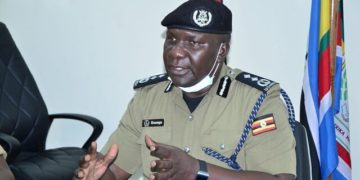
If there was any doubt about how seriously government intends to treat resistance, the Deputy Inspector General of Police, James Ochaya, erased it.
He said the police are ready to handle violators found on the roads during the mandatory hours.
He pointed to the force’s experience enforcing Covid-19 movement restrictions as proof that it has both the capacity and the institutional memory to make the new order stick.
That comparison will resonate uncomfortably with many Ugandans, given how the Covid-19 curfews and lockdown enforcement were remembered for their heavy-handedness in some quarters.
Nabbanja herself confirmed that the President has directed the Uganda Police Force and other security agencies to deploy on the roads specifically to enforce compliance.
The whole exercise, she said, will run under the theme “A Clean Uganda is Everybody’s Business.”
The Sabbath Question
Not every corner of Ugandan society received the announcement without friction, and one objection in particular forced officials to respond directly on the record.
Members of the Seventh-day Adventist Church observe their Sabbath on Saturday, the very day now set aside nationally for compulsory cleaning.
Dr. Chris Baryomunsi, the Minister of Health, took on the concern himself rather than leaving it unanswered.
“We have deliberately set these early hours of the day to enable people to carry out their other activities later,” he said.
“Secondly, we are not meant to offend any of the beliefs of Ugandans,” he added.
Then he turned to Scripture to make his case.
“But I also want to ask, do SDA members also fall sick on Saturday? Let me quote the words of Jesus in the Bible. He said you can rescue your cow or sheep immediately when it falls into a pit. So let us all participate as much as possible,” Baryomunsi said.
It was an argument built on the idea that urgent good works are permitted even on a day of rest, a principle he clearly hoped would settle the matter for worshippers uneasy about the clash of calendars.
Whether it fully will remains to be seen, particularly once the exercise becomes a monthly fixture rather than a one-off event.
The Countdown to Launch Day
The initiative’s public debut has been set for Kisenyi, a densely populated suburb of Kampala long associated with congestion, informal settlements, and exactly the kind of sanitation pressures the programme is meant to address.
According to Nabbanja, new guidelines will follow the official launch, which is expected to be presided over by the Vice President.
Government communication in the days since the initial briefing has named Vice President Jessica Alupo as the official expected to lead the inaugural clean-up in person, joining cabinet ministers, senior officials, and residents on the ground.
Local government structures across the country have been directed to take the lead in mobilising their communities and identifying the specific roads, drains, and public spaces most in need of attention.
An implementation framework reportedly places the Office of the Prime Minister in overall charge of coordination, with the Ministry of Health designated as the technical lead responsible for hygiene standards and monitoring the programme’s actual impact on disease rates over time.
For a country where a stubborn, decades-old sanitation crisis has quietly claimed thousands of lives every year, largely out of the daily headlines, the true test of the National Cleaning Day initiative will not be how many Ugandans sweep their streets on the first Saturday.
It will be whether they still do it on the twelfth.