














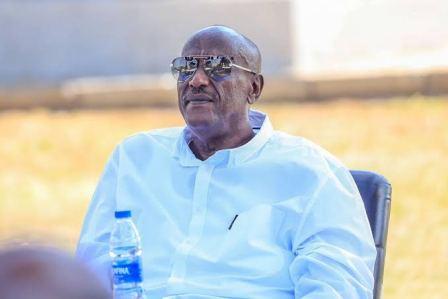
For decades, Kiroma Heritage Farm in Nakasongola District was known mainly for its cattle, its pineapples, and its role as a testing ground for one man’s ideas about wealth.
Now it has a new title on its gate.
The farm belonging to Gen. Caleb Akandwanaho, popularly known as Gen. Salim Saleh, has been converted into the General Caleb Akandwanaho School of Research, a facility meant to turn decades of hands-on experimentation into knowledge the rest of Uganda can actually use.

Saleh currently serves as Chief Coordinator of Operation Wealth Creation and Presidential Adviser on Defence and Security, roles that have kept him at the center of Uganda’s economic policy for more than a decade.
His office says the new school exists to preserve, document, and share the research and practical lessons that Saleh and his team have accumulated over the years.
A School Built on an Older Idea
The Kiroma school did not appear from nowhere.
Saleh’s spokesperson, Dismas Okoo, explained that the initiative builds directly on a School of Research concept first introduced at the National Leadership Institute in Kyankwanzi.
President Yoweri Museveni recently launched the Walter Rodney Block there during an engagement with newly elected Members of Parliament and ministers, laying what officials describe as the ideological foundation for this work.
Okoo said that while Kyankwanzi laid that foundation, the actual research and knowledge-sharing activity now happens at Kiroma Heritage Farm.
The distinction matters to him.
“This is not a policy-making institution,” Okoo said.
“Its role is to provide credible, evidence-based information that supports government planning and development,” he said.
“Researchers and practitioners can access existing findings instead of repeating work that has already been done,” he added.
That framing echoes what Museveni himself said when he laid the foundation stone for the Kyankwanzi complex, describing Saleh as a symbol of patriotism during the liberation struggle before crediting him with the transition into wealth creation and economic development that followed.
NALI Director Col. Okei Rukogota went further at that same event, describing the wider School of Research project as an arena for what he called “Musevenomics” studies, and a hub meant to preserve Uganda and Africa’s liberation history alongside its economic thinking.
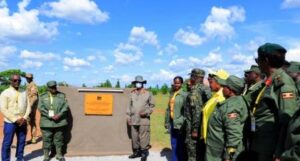
Land, Disputes, and Thirty Years of Homework
Among the new school’s priority subjects is land governance, a topic Saleh has reportedly studied since he published a paper on food security back in 1996.
According to Okoo, that research treats land as a central factor in achieving sustainable food security, agricultural transformation, industrialisation, and wealth creation, four goals that have effectively defined Saleh’s public career.
The school has since translated that research into something more immediately useful for ordinary Ugandans, an Alternative Land Dispute Resolution model built to shortcut lengthy court battles over land ownership.
Okoo revealed that more than 300 of the over 530 land disputes identified in Nakasongola District have already been resolved through this mediation approach.
That success rate, he suggested, is exactly the kind of evidence the wider country could draw on if the model were scaled beyond one district.
Beyond research and mediation, the institution is also meant to function as neutral ground for disagreement, a platform where stakeholders holding different views can exchange ideas, weigh evidence, and work toward practical solutions rather than talking past each other.
From Demonstration Plot to National Classroom
Kiroma Heritage Farm’s own story mirrors the arc of Saleh’s economic thinking.
It began as an agricultural demonstration site, and it has since grown into a multi-purpose centre supporting commercial farming, livestock production, youth mentorship, enterprise development, investment promotion, and policy discussion.
Government officials, diplomats, private sector leaders, entrepreneurs, farmers, and researchers now regularly pass through its gates looking for practical lessons in wealth creation and rural transformation.
The farm has also become something of a showcase for industrial innovation, featuring machine fabrication and value-addition technologies that support Uganda’s manufacturing agenda.
Dr. Fred Muhumuza, a lecturer at Makerere University’s College of Business and Management Sciences, welcomed the shift, saying it would help bridge the gap between academic research and practical development by giving people a place to test ideas in real-world conditions.
From the Bush War to the Boardroom: Saleh’s Longer Economic Story
To understand why officials keep pointing to Saleh as an authority on wealth creation, it helps to look back further than Kiroma.
Saleh commanded major battles during Uganda’s liberation struggle between 1979 and 1986, including at Masindi, Kabamba, Masaka, and Kampala, fighting alongside his brother, now President Museveni.
After the war, rather than remaining strictly a military figure, Saleh moved into non-combat roles, leading Uganda’s veterans and reserve force before serving as a government minister and senior presidential adviser.
It was in northern Uganda, during the region’s long recovery from conflict, that Saleh built one of his most cited legacies, pushing agro-industrial development and financial inclusion into communities that had been cut off from the country’s cash economy for years.
His often-repeated phrase from that period, that money was concentrated in Kampala while hardship remained in Gulu, became shorthand for the economic gap he set out to close.
Government’s current push for wealth creation traces its more formal roots to July 2013, when Operation Wealth Creation was launched as the successor to the National Agricultural Advisory Services, or NAADS.
Saleh himself has explained the reasoning behind that switch in blunt terms, noting that the government had spent close to one trillion shillings over ten years under NAADS without a corresponding rise in production, because the programme leaned too heavily on seminars, training, and consultancy rather than actual farm inputs.
Operation Wealth Creation, run through Uganda’s army structures, was built instead to prioritise seedlings, breeding stock, and organisational support, treating itself as what Saleh has called an aggregation centre rather than another layer of bureaucracy.
More than a decade on, President Museveni has credited OWC and Saleh directly for helping raise household incomes and moving Ugandan communities from subsistence farming into what officials call the money economy, remarks he repeated as recently as this year’s National Agricultural Show in Jinja.
OWC’s footprint today extends into industrial parks such as Kapeeka in Nakaseke District, where Saleh has continued to press officers on aligning their work with Uganda’s wider socio-economic goals, and into the government’s Parish Development Model, which Museveni has separately praised for helping move communities from poverty toward prosperity.
Saleh has not treated the programme as beyond criticism, either, having publicly called at various points for administrative reforms to fix operational gaps he identified in OWC’s own implementation, a rare instance of a programme’s own architect pushing for its improvement rather than defending it unconditionally.
That willingness to audit his own project is, in many ways, the same instinct now driving the Kiroma school, an effort to make sure lessons learned, including the hard ones, do not simply evaporate once a programme moves on to its next phase.
What Kiroma Is Meant to Prove
Taken together, the research school and the farm that hosts it are meant to answer a fairly simple question, whether decades of one man’s trial and error can be organised into something policymakers and ordinary Ugandans can actually reuse.
The land dispute numbers out of Nakasongola suggest at least one piece of that answer is yes.
Whether the wider ambitions around food security, industrialisation, and consensus-building scale the same way will likely take years to judge.
For now, the farm that once grew pineapples and reared cattle for a single family has taken on a second job, teaching the rest of the country what that family believes it has learned.