










The hill at Maya has witnessed prayer meetings before.
It has seen worshippers gather under tents, heard songs of praise rise into the night, and hosted moments of deep Christian fellowship.
But on Sunday, August 23, 2026, Maya Hill became the setting for an important new chapter in Uganda’s Christian story.

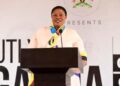
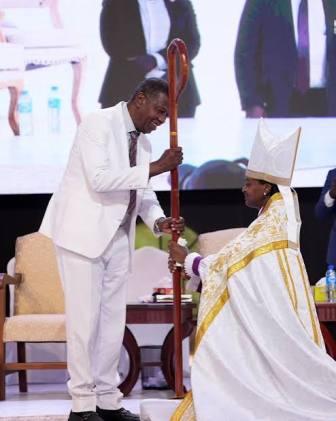
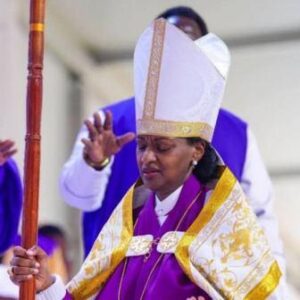
Pastor Patience Kokundeka Museveni Rwabwogo was consecrated a bishop.
The occasion was significant not because she was the first woman in Uganda’s Christian history to hold the title of bishop — she was not — but because of the scale, prominence and visibility of her consecration.
Bishop Patience became one of only a very small number of women who have ever held the office of bishop in Uganda. Given her national profile, the growth of Covenant Nations Church and the presence of prominent Ugandan and international Christian leaders, her consecration was undoubtedly a major event.
From a Small Fellowship to Covenant Nations Church
To understand why Bishop Patience’s consecration attracted such attention, it is necessary to go back about twenty years.
Covenant Nations Church traces its beginnings to a small house fellowship established after what Patience Rwabwogo describes as a divine calling.
What began modestly eventually developed into a growing ministry with several parishes and a wider reach both inside Uganda and beyond.
Its main base, the City of David in Luzira, became its first and primary parish as the ministry expanded its worship, teaching and outreach activities.
Looking back on the journey, Bishop Patience has described the growth of the church less as a personal achievement and more as evidence of God’s faithfulness.
The elders of the church similarly described her journey as one that began with a seemingly small vision but developed into a much larger ministry.
Before presenting her for consecration, the elders said they had carefully considered her character, conduct, doctrine, leadership and ministry record.
They pointed to her work with believers in different areas of life, including education, leadership, family, business, public service and national development.
A Consecration Filled With Symbolism
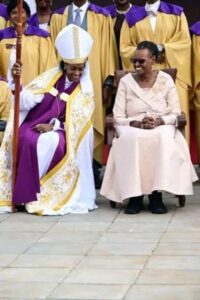
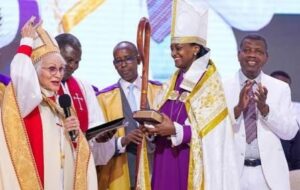
The ceremony itself carried the full weight of episcopal tradition. Bishop Patience was presented with a series of traditional symbols of episcopal office.
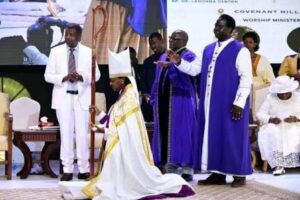
Apostle Alex Mitala presented the chemere, Bishop Simon Peter Emiau the tippet, Archbishop Moses Odongo the cross, Bishop Joshua Lwere the cope, Pastor Adeboye the ring and staff, and Bishop Dr LaDonna Osborn the mitre.
The Chief Consecrator, Bishop Dr LaDonna Osborn, presented Bishop Patience with her certificate and Bible, while Archbishop Moses Odongo and Bishop Joshua Lwere served as co-consecrators.
Bishop Osborn brought her own long connection to Christian ministry to the occasion.
She is President and CEO of Osborn Ministries International, founded by her parents, Drs. T.L. and Daisy Osborn, and also leads the International Gospel Fellowship of Churches and Ministries.
Her family’s connection to Uganda goes back decades. T.L. Osborn held a crusade in Uganda in 1957, linking the ceremony at Maya with a much older history of international Pentecostal ministry in East Africa.
Pastor Adeboye’s Role
Among the most prominent guests was Pastor Enoch Adejare Adeboye, General Overseer of the Redeemed Christian Church of God, accompanied by his wife, Pastor Mrs Folu Adeboye.
The Adeboyes have been regarded by Bishop Patience as her spiritual parents, making their presence more than ceremonial.
Pastor Adeboye participated directly in the consecration by leading the anointing with oil and prayers over the newly consecrated bishop.
His involvement gave the ceremony an additional international dimension and reflected the relationships that have shaped Bishop Patience’s Christian journey.
A Daughter, a Church Leader and a National Figure
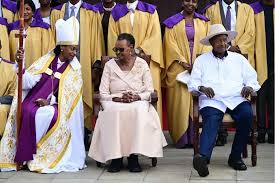
The occasion also carried a strong family dimension. Bishop Patience is the daughter of President Yoweri Kaguta Museveni and First Lady Janet Museveni.
For her father, however, the day was more than an occasion for parental pride.
President Museveni thanked God for his daughter’s elevation and described her as a capable leader who would advance the work of the Church.
He also reflected on his own long engagement with the Bible, noting that despite having studied Scripture systematically for many years, he had been impressed by his daughter’s depth of biblical knowledge.
The First Lady’s participation carried an equally personal dimension.
Having recently returned to public engagements after an undisclosed illness, Janet Museveni described 2026 as a year of deliverance and gave thanks for her recovery.
She also prayed for Bishop Patience and her husband, Odrek Rwabwogo, as they entered this new chapter of episcopal responsibility.
A Wider Question for Uganda’s Churches
Bishop Patience’s consecration also comes at an interesting moment in the history of women and church leadership in Uganda.
The Anglican Church of Uganda, the country’s largest Christian denomination, has never had a female diocesan bishop.
The issue has nevertheless been discussed publicly.
The Archbishop of the Church of Uganda, the Most Rev. Dr Stephen Kaziimba Mugalu, has previously indicated openness to the possibility, pointing to the Anglican Church in Kenya, which appointed its first female bishop.
At the same time, senior Church of Uganda leaders have clarified that although the church’s constitution and canons permit women to be consecrated bishops, there was no policy change underway and no female candidate had been nominated.
This distinction is important.
The fact that Uganda has had a woman bishop since 2014 does not mean that every major Christian denomination in the country has opened the episcopacy to women.
A Historic Moment — But Not the First
The historical record matters. The distinction of being the first woman in Uganda to hold the title of bishop belongs to Rt. Rev. Aidah Namirengo.
Namirengo, who was a schoolteacher from Bugembe in Jinja District before entering church leadership, was appointed bishop on October 10, 2014, at a House of Bishops meeting held in Garuga along Entebbe Road.
She became head of the Dorcus for Christ Diocese under the Charismatic Episcopal Church of Uganda.
That church is an independent episcopal denomination, distinct from the mainstream Church of Uganda and from Pentecostal networks such as Covenant Nations Church.
According to the available reporting, Namirengo was the first woman in Uganda to be consecrated a bishop in any Christian denomination. Her appointment came almost twelve years before Bishop Patience’s consecration.
Her story is particularly important because it shows that the history of women in Uganda’s episcopal leadership did not begin in 2026.
What makes the present occasion different is the prominence surrounding it.
Bishop Osborn’s Challenge
One of the strongest messages of the ceremony came from Bishop Dr LaDonna Osborn.
Rather than allowing the occasion to become simply a celebration of titles and ceremony, she challenged the new bishop — and the wider Church — to think about leadership in terms of national transformation.
“The Church doesn’t need leaders who preserve the institutions, but one that heals nations,” she told those gathered.
Her message placed a heavy responsibility on Bishop Patience’s shoulders.
The new office is not simply about wearing episcopal robes or carrying a bishop’s staff. It is about leadership, service, spiritual responsibility and the ability to influence lives beyond the walls of a church building.
A Milestone Worth Remembering
What happened at Maya Hill on August 23, 2026, deserves to be remembered — but it deserves to be remembered accurately.
Bishop Patience Kokundeka Museveni Rwabwogo did not become Uganda’s first woman bishop.
That distinction belongs to Bishop Aidah Namirengo, whose appointment in 2014 marked the first known occasion on which a woman in Uganda was consecrated a bishop in a Christian denomination.
Bishop Patience’s achievement is historic in its own right.
She has become one of a very small number of women to occupy episcopal office in Uganda, and her consecration was conducted on a highly visible national and international stage.
It brought together senior Christian leaders, government officials, diplomats, clergy, family members and thousands of believers.
It also placed the question of women in church leadership back into the national conversation.
For Covenant Nations Church, the ceremony represented the culmination of a twenty-year journey from a small house fellowship to a much larger ministry.
For Bishop Patience personally, it marked the beginning of a new chapter.
And for Uganda’s wider Christian community, it was a reminder that the story of women in church leadership is still being written.
The most accurate way to describe the day, therefore, is not that Uganda witnessed its first woman bishop.
It witnessed the consecration of one of Uganda’s most prominent female bishops — and an important new chapter in the country’s continuing story of women and Christian leadership.