
















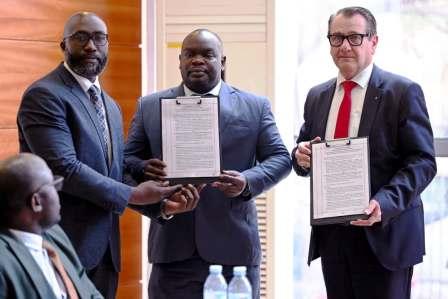
Uganda has taken an important step toward establishing the capacity to print its own currency locally following the signing of a Memorandum of Understanding between the Uganda Security Printing Company (USPC) and German-based K&B Banknote Solutions.
The agreement opens the way for feasibility studies, technical assessments and commercial negotiations that could eventually lead to Uganda’s first sovereign currency-printing facility.
The proposed facility is expected not only to meet Uganda’s currency requirements but also to explore opportunities to serve other countries in the region.

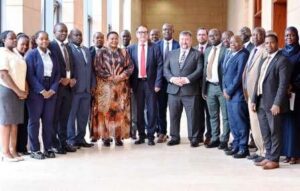
The signing ceremony was presided over by Minister for the Presidency and Budiope West MP, Hon. Milly Babalanda, at the Office of the President.
Officials from the Office of the President, USPC, the Uganda Printing and Publishing Corporation and K&B Banknote Solutions attended the ceremony.
For Uganda, the significance of the initiative extends beyond printing banknotes.
It represents an attempt to develop domestic expertise in one of the most sophisticated areas of security printing while reducing dependence on foreign facilities for the physical production of an important instrument of the State.
“We Are Building a National Capability”
Minister Babalanda said the project reflects President Yoweri Kaguta Museveni’s broader vision of national sovereignty, value addition and skills development.
“I warmly welcome our partners from K&B Banknote Solutions to Uganda,” she said.
“We are pleased to start on our journey on the collaboration for the establishment of a currency printing facility in Uganda.”
She said the MoU provides a framework for technical, security, feasibility and commercial work required before the facility can be established.
“As we begin on this journey, the question before us is simple: Can Uganda establish and operate a modern currency facility that can meet the national and regional currency demands?” she asked.
“If the answer is yes, then what does it require us to do and how long does it take to have the facility up and running?”
The Minister stressed that Uganda should not simply acquire machinery and leave the operation dependent on foreign specialists.
“This is why I want to emphasise that we are not simply installing machines,” she said.
“We are building a national capability.”
She therefore demanded meaningful technology and skills transfer.
“Our Ugandan engineers and technicians must be involved from the beginning,” she directed.
“They should work alongside specialists during the planning, installation, testing and commissioning, and gain the practical skills needed to operate and maintain the facility.”
Babalanda said she was encouraged by information that K&B operates an academy for technical training.
“I therefore look forward to seeing that moment when Ugandans will be tapping into this opportunity,” she added.
Currency Printing and Uganda’s Economic Transformation
The proposed facility comes against the background of Uganda’s long economic journey since the severe economic crisis of the 1970s and 1980s.
When President Museveni’s government came to power in 1986, Uganda was emerging from years of political instability, economic disruption and declining productive capacity.
Inflation was extraordinarily high and the Uganda shilling had suffered a dramatic loss of value.
World Bank historical assessments record that Uganda experienced average annual inflation of roughly 191 percent between 1986 and 1989.
The country subsequently embarked on major economic reforms aimed at restoring fiscal and monetary discipline, liberalising markets, reforming state enterprises and rebuilding investor confidence.
Inflation eventually fell dramatically.
World Bank analysis indicates that average inflation declined from about 190 percent during the early reform period to approximately 8 percent during 1992–1998.
Uganda’s economic transformation therefore involved much more than currency management.
It required rebuilding production, strengthening institutions, liberalising markets and creating a monetary environment in which businesses and households could plan with greater certainty.
Museveni and the Stabilisation of the Shilling
President Museveni’s contribution to Uganda’s economic transformation is best understood through the broader stabilisation policies pursued by successive governments under his leadership.
It would, however, be inaccurate to suggest that the President personally determines the value of the Uganda shilling.
The Bank of Uganda has the statutory responsibility for monetary policy and currency issuance.
The central bank’s mandate includes maintaining price stability and a sound financial system.
The government nevertheless plays an important role through fiscal policy, economic reforms, industrialisation policies and the broader economic environment in which monetary policy operates.
Under the Museveni government, Uganda moved toward a market-based exchange-rate system, liberalised foreign-exchange markets and pursued policies aimed at controlling inflation and restoring economic confidence.
The result has been a substantial improvement compared with the extreme monetary instability of the 1980s.
The Uganda shilling still depreciates from time to time because of international interest rates, import demand, commodity prices, capital flows and other economic pressures.
But the currency now operates within a substantially more stable monetary and financial framework than it did during the country’s earlier economic crisis.
This distinction is important.
A sovereign currency-printing plant will give Uganda greater control over the physical production of its banknotes.
It will not, by itself, determine the value of those banknotes.
The purchasing power of the shilling will continue to depend primarily on inflation, productivity, economic growth, monetary policy, fiscal discipline, foreign-exchange conditions and confidence in the economy.
From Extreme Inflation to Greater Stability
The progress made in controlling inflation provides important context for the new project.
During the late 1980s, Uganda experienced periods of extraordinarily rapid price increases.
Today, inflation is generally far lower and more predictable.
Recent Bank of Uganda data have shown inflation at levels of only a few percentage points, a dramatic contrast with the triple-digit inflation experienced during the country’s earlier economic crisis.
This improvement matters directly to ordinary Ugandans.
When inflation is high, the purchasing power of salaries, savings and other income declines rapidly.
When inflation is low and relatively stable, households and businesses have greater ability to plan their spending and investment.
The stability of the shilling therefore depends less on where banknotes are printed than on the strength and discipline of the economic system supporting them.
Part of Uganda’s Industrialisation Strategy
Babalanda linked the proposed facility to the NRM Manifesto 2026–2031, the Fourth National Development Plan and Uganda Vision 2040.
She described security printing as a high-technology, skills-intensive manufacturing activity.
“For this reason, I consider this project an important part of Uganda’s wider industrialisation and technological development agenda,” she said.
The initiative could create opportunities for engineers, technicians, security specialists and other skilled workers.
If properly implemented, it could also help Uganda develop expertise that can be applied to other areas of advanced security printing.
The proposed regional dimension could eventually allow Uganda to provide currency-printing services to neighbouring countries.
That would potentially turn the facility into not merely a national security installation but also an export-oriented industrial enterprise.
Accountability and Speed
The Minister warned officials against allowing the project to become another delayed government initiative.
“I expect my office and USPC to establish a multi-sectoral technical committee that brings together key stakeholders, including the Bank of Uganda, the Ministry of Finance, Planning and Economic Development, the Attorney General’s Chambers, and the relevant security agencies,” she said.
She also demanded regular monitoring against agreed milestones.
“We must also establish a formal monitoring arrangement to ensure that progress is regularly measured against the agreed roadmap milestones.”
She warned that President Museveni was increasingly frustrated by government projects that fail to start or take too long to complete.
“Please, note that of late H.E the President is tired of hearing projects that have failed to take off and those that have delayed to be completed,” she said.
Babalanda also gave a strong personal commitment to the project’s implementation.
“For this matter, as your political supervisor, I want to assure you that I will not tolerate any actions that are likely to drag the implementation of this project,” she warned.
She added that her office would remain available to help resolve obstacles.
“I will take it upon myself to mobilise my senior colleagues and any other relevant stakeholders to ensure that this project becomes a success, before I leave this office.”
Security and Integrity
Because currency production involves one of the country’s most sensitive national functions, Babalanda emphasised procurement, accountability and security.
“This is a strategic national facility that will be involved in currency manufacture,” she said.
“Therefore, procurement must be clean, timelines must be realistic and respected, and accountability must be maintained throughout the project cycle.”
“There must be no room for unnecessary delays or actions that undermine the national interest.”
She also urged K&B to protect its international reputation through the Ugandan partnership.
“From my personal experience, I have seen investors who have disguised themselves to be genuine but they end up duping the country,” she said.
“However, for your case, I have a strong belief that you are not under that category.”
She encouraged the company to work closely with Ugandan officials and share its technical expertise.
“Please work with the team to uphold your international reputation,” she told the German delegation.
The Road Ahead
The signing of the MoU does not mean that Uganda’s currency-printing plant is already operational.
The next stages will involve feasibility studies, technical planning, security assessments, financing arrangements and commercial negotiations.
The project will also require close coordination with the Bank of Uganda because the central bank remains responsible for issuing the country’s currency and conducting monetary policy.
For USPC, the immediate challenge is to develop a credible roadmap that translates the agreement into an implementable project.
For K&B, the test will be whether the partnership delivers genuine technology and skills transfer rather than simply supplying equipment.
For government, the test will be whether the facility can be completed within realistic timelines and deliver measurable economic and strategic benefits.
Babalanda said she wanted to see a detailed implementation roadmap.
“The moment I receive it, I will secure an appointment with H.E the President so that we can appraise him about the status of this project,” she said.
A New Chapter in Uganda’s Economic Sovereignty
Uganda’s journey from the extreme inflation and economic disruption of the 1980s to today’s relatively stable monetary environment provides important context for the proposed currency-printing facility.
The country’s experience demonstrates that a strong currency is ultimately built on economic and monetary discipline rather than simply on the ability to manufacture banknotes.
The proposed plant could nevertheless provide Uganda with an important additional layer of economic sovereignty.
If successfully implemented, it could give the country domestic capacity to produce secure banknotes, develop specialised technical skills, create high-value employment and potentially serve the wider East African market.
Its greatest value may therefore lie not in the machines themselves but in the knowledge and capabilities that Ugandans acquire through operating them.
As Babalanda put it, “we are not simply installing machines.”
“We are building a national capability.”