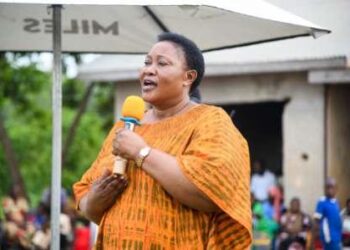
















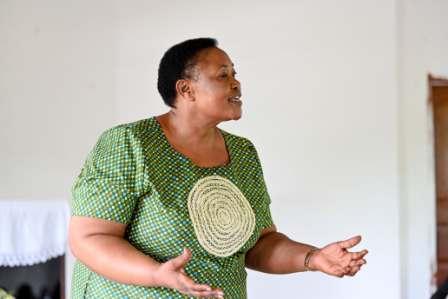
On Saturday, worshippers at Buwagi Seventh-day Adventist (SDA) Church in Jinja Northern Division, Jinja City, heard a sermon that went well beyond prayer.
The Minister for the Presidency, Hon. Babirye Milly Babalanda, had come to preach about giving.
She also had a practical message about how families can turn their blessings into lasting prosperity.

Hon. Babalanda also serves as Director for the SDA Busoga Women Field.
She told believers to combine faith with hard work, financial discipline and productive agriculture.
Her theme was faithful giving, supporting the work of God and using resources responsibly.
Greetings From the Top
Before her main message, the Minister brought greetings from the country’s leadership.
She conveyed warm regards from H.E. the President of the Republic of Uganda, Gen. (Rtd.) Yoweri Kaguta Museveni.
She also passed on greetings from the First Lady and Minister of Education and Sports, Maama Janet Kataaha Museveni.
The Permanent Secretary in the Office of the President, Hajji Yunus Kakande, sent his greetings too.
So did the entire staff of the Office of the President.
Giving With a Willing Heart
The Minister encouraged the congregation to support the development of the Church through voluntary contributions.
She said the value of a gift lies not only in the amount.
It also lies in the willingness, gratitude and commitment with which it is given.
According to the Minister, every contribution, regardless of size, advances God’s work.
She said each gift also strengthens the Church’s service to the community.
She reiterated that God blesses the work of human hands.
She added that He calls on His people to give faithfully.
She also said they must use their resources responsibly for the benefit of their families and society.
Prayer Needs Partners: Work, Discipline and Wise Decisions
The Minister was clear that prayer alone is not enough.
She observed that prayer remains essential to Christian life.
She said it must be accompanied by productive work, responsible decision-making and effective use of available resources.
In her view, households can improve their economic circumstances through a few habits.
The first is a culture of saving.
The second is reinvesting earnings.
The third is establishing productive enterprises.
The fourth is avoiding unnecessary expenditure.
She urged families to work together towards shared economic goals.
She noted that overcoming poverty requires a positive mindset.
It also requires commitment to productive activities.
It requires determination to create sustainable opportunities for present and future generations.
Government Programmes Are Seed, Not Supper
Hon. Babalanda urged believers to embrace Government wealth-creation initiatives with discipline and accountability.
She asked them to keep a clear focus on improving household incomes.
She emphasised that such programmes deliver meaningful results when beneficiaries establish viable enterprises.
She warned against treating support as short-term consumption.
Her message was that money received should be invested, not just spent.
This reflects the thinking behind the Parish Development Model (PDM).
President Museveni has highlighted the synergy between the four-acre approach and the PDM, which helps households move from subsistence to commercial agriculture.
Guarding the Family Land
The Minister also raised a concern that touches almost every rural family.
She cautioned against excessive land fragmentation.
She warned that it reduces the land available for productive agriculture.
She said it also undermines the economic potential of families.
She encouraged households to manage family land responsibly.
She asked them to preserve it for future generations.
She also urged them to treat it as a valuable economic asset.
The Four-Acre Model: A Farm Plan for Every Household
Where land size and local conditions permit, Hon. Babalanda encouraged adoption of the Four-Acre Model.
She presented it as a practical route to food security and wealth creation.
Under her outline, the first acre goes to coffee or cocoa.
These are long-term cash crops that provide sustainable income.
The second acre goes to fruit farming, including oranges and mangoes.
This diversifies household earnings.
The third acre goes to food crops such as maize, beans, cassava, sweet potatoes and vegetables.
These feed the household and leave a surplus for sale.
The fourth acre goes to pasture.
It supports zero-grazing, dairy farming and other livestock enterprises.
She explained that the model diversifies production.
She said it also reduces dependence on a single income source and strengthens resilience.
She stressed that activities should still be adapted to land size, local conditions and market demand.
She called for improved practices, proper planning, market identification and value addition.
Her aim is to move households beyond subsistence to sustainable commercial farming.
Not a New Idea, but a Growing Campaign
The model has a long history in Uganda’s policy debate.
President Museveni has said the Four-Acre Model is not new and that he first introduced it in the 1996 NRM Manifesto.
The campaign has since been rolled out region by region, with the second phase launched in Bunyoro after a first phase in November 2024.
Government has also signalled deeper support for the model in Busoga’s neighbourhood.
The President announced plans to turn his demonstration farms into centres of excellence for the 4-acre model.
He promised that farmers wanting coffee, pigs, chicken or fish fingerlings would receive them directly.
What the Numbers Say
Advocates point to farmers who have made the model pay.
In Mpigi District, model farmer Hajji Muhammad Yusuf Zziwa reportedly earns a gross annual income of UGX 294 million from his four-acre farm.
Even so, he is still working to make his fruit enterprise profitable, because production costs there currently exceed earnings.
The Minister’s call for market identification and planning speaks directly to such lessons.
Not every household finds the path easy.
A Daily Monitor report found that most agricultural households in western Uganda still focus on growing food for home consumption rather than adopting the model.
Some residents in Ntoroko argued that the initiative is well-intentioned but demands investment.
The same report noted that 54 percent of Ugandan households are food secure, while 46 percent are moderately or severely food insecure.
That gap between ambition and capacity explains the Minister’s stress on discipline, planning and viable enterprises.
Women at the Heart of Wealth Creation
The Minister reserved special encouragement for women.
She urged them to believe in their abilities, work hard and take an active part in economic activities.
She observed that when women are involved in wealth creation, families are better placed to improve living standards.
She said they are also better placed to educate their children and secure a stable future.
She called on families and communities to support women’s economic participation.
She asked them to recognise women’s contribution to household and national development.
The message carried extra weight coming from her, given her leadership of the SDA Busoga Women Field.
Praise for Buwagi, and a Gift to Match
Hon. Babalanda commended the leadership and congregation of Buwagi SDA Church.
She praised their commitment to worship, fellowship and community service.
She encouraged them to maintain unity.
She also asked them to keep contributing to the spiritual and socio-economic well-being of the community.
She concluded by urging Ugandans to remain steadfast in faith, generous in giving and diligent in work.
She asked them to embrace productive agriculture and wealth-creation initiatives.
Then she followed her words with action.
As part of her contribution to the continued development of the Church, she donated Shs 4 million towards its development initiatives.