












Government has released Shs 21.82 trillion for the second quarter of the 2026/27 financial year.
The money arrives at a tense moment for the economy. The shilling is weakening, fuel is getting dearer and the trade deficit is widening.
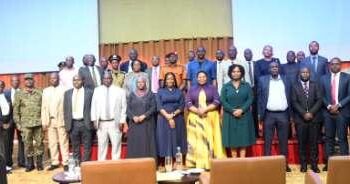
Patrick Ocailap, the Deputy Secretary to the Treasury, announced the releases on Thursday.

He spoke on behalf of the Permanent Secretary at the Ministry of Finance, Planning and Economic Development. He said the funds had been carefully programmed.
The aim, he explained, is to protect essential public services and priority investments despite growing economic pressure.
The releases represent about 26 percent of the approved annual budget for 2026/27.
Where the Money Goes First
Nearly half of the quarter’s money will go to servicing debt.
Shs 10.75 trillion is set aside for debt and treasury operations.
Another Shs 2.42 trillion will pay salaries and wages.
Pension and gratuity payments take Shs 376.6 billion.
A further Shs 130 billion is meant to clear verified arrears on salaries, pensions, gratuities and utilities.
For public servants and retirees waiting on overdue payments, that last line item matters most.
The Shilling’s Difficult Season
The shilling has lost six percent against the US dollar since the start of August.
It recently slipped past Shs 4,000 to the dollar, its weakest nominal level on record.
Ocailap put the problem plainly.
“The immediate challenge is that demand for foreign exchange has increased more rapidly than the supply available in the market,” Ocailap said.
The energy, manufacturing and telecommunications sectors have all needed more dollars.
Higher international oil prices have made it worse.
Tensions in the Middle East have pushed up petroleum prices, raising transport and energy costs for businesses and households.
Annual headline inflation climbed from four percent in July to 4.6 percent in September 2026.
That remains below the government’s medium-term target of five percent.
The Central Bank Steps In
The Bank of Uganda has responded firmly.
The central bank raised its benchmark rate by 225 basis points, from 9.75 percent to 12 percent, at an emergency Monetary Policy Committee meeting on October 14, 2026.
It was the largest monthly policy-rate adjustment since October 2011 and left the rate at its highest since December 2016.
The move also broke a long pause, since the rate had stood at 9.75 percent since October 2024.
The Cash Reserve Requirement had already been raised from 11 percent to 13.5 percent in September to tighten liquidity in the banking system.
Ocailap said the new expenditure releases had been aligned with these monetary measures.
The goal is to keep the macroeconomy stable.
The central bank has also been candid about the risks ahead.
It warned that a persistent fuel shock, a weaker shilling and El Niño weather effects could entrench inflation if policy did not act now.
It now expects headline inflation to average between 7.0 and 7.5 percent over the next 12 months, against 4.6 percent in September.
On the day of the hike, the central bank’s indicative mid rate moved from about Shs 4,130 per dollar at the opening to about Shs 3,951 at the close.
A single session does not settle the currency’s direction.
A Resilient Economy, Says Treasury
The Finance Ministry insists the economy has the strength to cope.
Real GDP grew by 6.4 percent in 2025/26, up from 6.3 percent the year before.
Nominal GDP rose from Shs 227.87 trillion to Shs 250.45 trillion.
Government projects growth of 7.6 percent this financial year and 9.1 percent in 2027/28.
It expects commercial oil production, infrastructure, industrial development and higher exports to drive that growth.
The central bank is more cautious.
Its October forecast round projects growth of 6.0 to 6.5 percent for 2026/27, revised down from 7.0 to 7.5 percent.
The gap between the two outlooks shows how uncertain the road ahead is.
The Widening Trade Gap
The trade deficit is the biggest threat to that outlook.
Uganda earned $2.89 billion from merchandise exports in July and August 2026.
That was 23.9 percent more than a year earlier.
Imports grew much faster, rising 44.8 percent to $3.94 billion.
The merchandise trade deficit widened to $1.04 billion, from $383.07 million in the same months of 2025.
Gold made up 56.5 percent of total exports in 2025/26.
Coffee followed at 13.9 percent.
Heavy dependence on a few commodities leaves the country exposed.
Government says it will respond with value addition, wider export markets, stronger commercial diplomacy and investment in productive sectors.
Buffers Still in Place
Uganda is not without protection.
Foreign exchange reserves stood at $6.7 billion as of October 6, 2026.
That equals 3.74 months of import cover, excluding oil project-related imports.
Remittances from Ugandans abroad rose 31.6 percent to $2.9 billion in the year to June 2026.
The previous year’s figure was $2.2 billion.
The reserves have also been a point of debate.
Reports say the central bank proposed using part of the reserves to ease dollar shortages, but President Museveni opposed the idea over concerns about its impact on importers.
Roads, Hospitals and Classrooms
Beyond debt and statutory obligations, the releases back the ATMS framework.
ATMS stands for Agro-industrialisation, Tourism, Mineral-based development, and Science, Technology and Innovation.
It supports the Tenfold Growth Strategy.
Transport
The Ministry of Works and Transport gets Shs 1.48 trillion.
The money covers ongoing road projects, maintenance, Uganda Airlines, Uganda Railways and the Standard Gauge Railway.
Health
The Ministry of Health will receive Shs 416.5 billion.
It will fund operations, vaccine procurement through GAVI, and ambulances for constituencies still without one.
National Medical Stores gets Shs 284.7 billion for essential drugs and medicines.
The Uganda Cancer Institute and Uganda Heart Institute share Shs 165.5 billion.
Part of that will help build a nuclear medicine and PET centre.
Education and Sports
The Ministry of Education and Sports is allocated Shs 154.6 billion.
Public universities receive Shs 209.1 billion.
The National Council of Sports gets Shs 260.5 billion.
That money will speed up preparations for the 2027 Africa Cup of Nations, which Uganda will co-host with Kenya and Tanzania.
Growth Sectors
Agro-industrial research and innovation will receive Shs 224.5 billion.
Tourism development, including the Explore Uganda campaign, gets Shs 48.2 billion.
The Uganda National Oil Company and the Petroleum Authority of Uganda share Shs 46.7 billion to prepare for first oil.
Science, technology and innovation, including internet connectivity and digitisation, will receive Shs 372.9 billion.
Local Government and the Capital
Local governments are allocated Shs 457.4 billion.
Of this, Shs 164.6 billion is for conditional and unconditional grants.
Shs 292.8 billion is for capital development.
The Kampala Capital City Authority receives Shs 223.8 billion for service delivery and urban projects, including roads and drainage.
The Ministry of Kampala Capital City and Metropolitan Affairs gets Shs 67.9 billion for the Greater Kampala Metropolitan Area Urban Development Project.
A Tighter Grip on Spending
The Finance Ministry has warned government institutions against commitments beyond approved budgets and available financing.
Accounting officers will be held responsible for enforcing the Budget Discipline and Accountability Charter.
The charter bars unfunded commitments, unnecessary supplementary budgets, new arrears, unready projects, and recruitment without approved wage provisions.
Government is also centralising counterpart funding for externally financed projects.
The aim is to protect priority investments and improve implementation.
Other reforms are planned.
They include a contributory public service pension fund, faster electronic government procurement, stronger anti-corruption measures and better oversight of state-owned enterprises.
Government has also stopped funding celebrations on public holidays.
Religious holidays are exempt, in line with presidential guidance.
The ministry says these steps will contain non-essential spending while protecting priority programmes, jobs, exports and household incomes.
The Test Ahead
Ocailap closed with a call for results.
He urged accounting officers to make sure the released funds produce measurable outcomes.
“Every shilling mobilised and released must translate into timely implementation, improved services, and measurable results, while maintaining fiscal discipline,” he said.
For ordinary Ugandans, those words will be judged in clinics, on roads and in pay packets.