






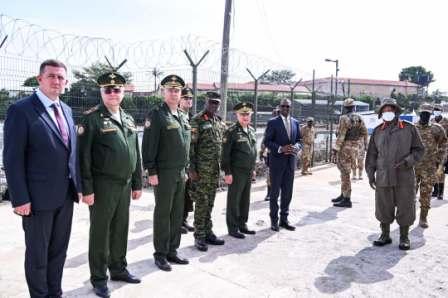
Over two days, President Yoweri Kaguta Museveni travelled across the country to open the latest products of Uganda’s defence cooperation with Russia.
The programme ran on October 21 and 22, 2026.
It was held with a Russian delegation led by Lt. Gen. Aleksandr Kshimovskii.

The activities covered military training, marine security, modern warfare technology and equipment maintenance.
The facilities are meant to strengthen the operational capabilities of the Uganda People’s Defence Forces (UPDF).
President Museveni, who is also the Commander-in-Chief of the UPDF, began at the Mechanised Warfare College in Kalama, Mubende District.
He then went to the 15 Marine Brigade Pier in Entebbe on the first day.
On Thursday, October 22, he visited the 154 Marine Battalion School at Kalangalo.
He ended the tour at Magamaga Cantonment, where he commissioned a mechanised major repair facility valued at $53 million.
Training Soldiers Before They Touch the Machine
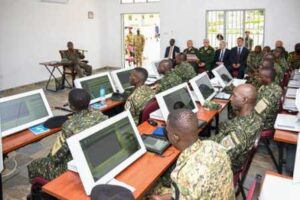
At Kalama, the President launched a digital multimedia training classroom.
It is designed to prepare military crews to operate the BRDM-2MS armoured reconnaissance vehicle.
The classroom lets personnel learn the vehicle’s capabilities before they move to practical training.
The BRDM-2 is an amphibious armoured scout car designed and developed in the Soviet Union.
The “MS” version is a modernised variant, and reports on its Russian upgrade describe added armour, a thermal-imaging camera and a laser rangefinder.
The base BRDM family has been exported extensively and is in use in at least 45 countries.
Securing the Water: Entebbe’s Marine Upgrade
In Entebbe, the President commissioned marine operational assets and supporting infrastructure.
They include surveillance radar and eight boats.
They also include a floating dock and protective barriers.
The list continues with marine workshops, firefighting equipment and specialised vehicles.
A field ambulance and training facilities complete the package.
The President said the installations are meant to improve the armed forces’ ability to detect threats, protect personnel, maintain equipment and operate in different environments.
He stressed that buying equipment is not enough.
“We should not only get the good equipment but also learn from them,” he said during the commissioning of the marine facilities in Entebbe.
Technology as the Next Battlefield
At the 154 Marine Battalion School in Kalangalo, the President turned to the future of warfare.
He urged the military to embrace artificial intelligence (AI), automation and advances in science and technology.
His aim is to improve the military’s ability to respond to emerging security threats.
“Advance on the issue of technology, embrace new technology, more automation, more AI, more range because we need to upgrade it overall,” he said.
He emphasised that modernising the armed forces requires continuous investment in technology.
He added that it also requires the development of technical skills and operational capacity.
Magamaga: A $53 Million Workshop for the Army’s Machines
The final stop was Magamaga Cantonment.
There the President commissioned the mechanised major repair facility.
According to the release, it was donated by the Russian government under the bilateral defence cooperation framework between Uganda and Russia.
The facility is expected to strengthen the UPDF’s capacity to maintain and repair military vehicles and other equipment.
It should also reduce the challenges of servicing complex military machinery.
President Museveni thanked Russian President Vladimir Putin and the Russian delegation.
“First of all, I really want to thank His Excellency President Putin and the Russian delegation for this gift of $53 million worth of equipment,” he said.
He noted that Russian assistance went beyond Magamaga.
It also covers the military training infrastructure at Kalama, the marine security facilities in Entebbe and the capabilities at Kalangalo.
“What If We Made Them Here?”
The President also looked past maintenance to manufacturing.
At Magamaga, he called for local production in partnership with Russian technical experts.
He said such cooperation could help Uganda build domestic manufacturing capacity.
“But these materials, I think, were made in Russia. What if we made them here with the Russians?” he asked.
The question echoes earlier promises.
At the 2023 Russia-Africa Summit, Uganda’s pledge to become a regional hub for maintaining previously delivered military equipment and producing modern small arms was part of its defence goals.
In June 2025, after a Uganda–Russia Intergovernmental Commission meeting on military-technical cooperation, the Russian delegation leader said Russia was willing to support Uganda’s defence industry through technology transfer and training of personnel.
Voices From Kampala and Moscow
The Minister of Defence and Veteran Affairs, Hon. Kiryowa Kiwanuka, thanked the President for strengthening relations with Russia.
He also commended the Russian technical experts for helping to develop and equip the installations.
He credited the President’s engagement with the Russian leadership for sustaining diplomatic ties and opening new opportunities.
“Your continued engagement with the Russian leadership has sustained the cordial diplomatic relations between our two countries and opened avenues for mutually beneficial cooperation, particularly in defence and military technical assistance. We thank you most sincerely,” Hon. Kiwanuka said.
The Ministry and UPDF leadership pledged to use and maintain the facilities properly.
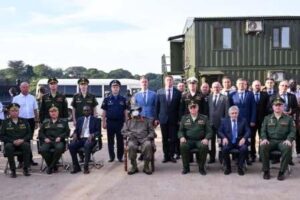
For Russia, Lt. Gen. Kshimovskii reaffirmed his country’s commitment to continued military-technical cooperation.
“We shall continue to develop mutual cooperation between Uganda and Russia. Russia is ready to supply the necessary equipment,” he said.
How the Partnership Got Here
The two-day programme is the latest chapter in a long relationship.
In December 2012, President Museveni visited Moscow and a government-to-government agreement on military-technical cooperation was signed.
Uganda has since bought Russian military equipment, including jets, helicopters, artillery and reconnaissance equipment.
In October 2025, President Museveni received a first batch of Russian military and engineering equipment worth $53 million at Magamaga.
The Russian ambassador explained that the project had two phases: delivery of equipment, then construction of a maintenance and repair facility at Magamaga, a patrol boat storage site and a floating pier in Entebbe, due for completion by September 2026.
The facilities commissioned this week appear to be that second phase arriving.
At that 2025 ceremony, the President described the relationship as ideological and strategic, not only about defence.
The ambassador also said Uganda’s recognition as a BRICS partner state would further enhance trade, investment and industrial cooperation.
The Wider Debate
Supporters see the partnership as practical and independent-minded.
Uganda has pursued a non-aligned line on the war in Ukraine, and has consistently abstained in UN General Assembly votes on it.
Critics have raised questions about the way Uganda’s Russian arms deals have been made and what they mean for its Western relationships.
In 2011, a reported purchase of six Sukhoi fighter jets caused an uproar because the President went over lawmakers’ heads and used Bank of Uganda funds.
The latest facilities are described as donations, which raises a separate question: how will their upkeep, spare parts and training be paid for?
The release gives no answer, and the answer will shape how much the new capacity is worth.
What Comes Next
The programme drew UPDF brigade commanders, junior officers, representatives of sister security agencies and local leaders.
Their presence suggests the facilities are meant to serve the whole defence community.
The President’s own test is clear: Uganda should operate, maintain and eventually build what it receives.
Whether the partnership reaches that point will depend on training, local production plans and the long-term upkeep of the new facilities.